

Location
Upstate New York
Structure Type
Four concrete approach and departure slabs (about 18 inches thick) at an active, county-operated landfill weigh station
Core Challenge
Settlement had dropped the weigh-station slabs enough to create unsafe transitions, over weak soils about four feet down, and the station had to keep weighing loaded trucks throughout the repair
Verification
Dynamic Cone Penetrometer (DCP) testing through each slab to locate the weak soils and set depths, continuous slab-movement monitoring during lifting, and a preload check under a loaded semi-truck before closeout
URETEK Scope
URETEK Deep Injection (UDI): 5/8-inch sacrificial steel tubes driven to about four feet, staged injection of structural polymer to stabilize the subsoils and lift the slabs, adjusted slab by slab
Result
Weak subsoils stabilized under all four slabs and the entrance slabs raised about 1.6 and 2.5 inches with joints returned to level; exit slabs stabilized and lifted within safe limits, in two days without closing the station
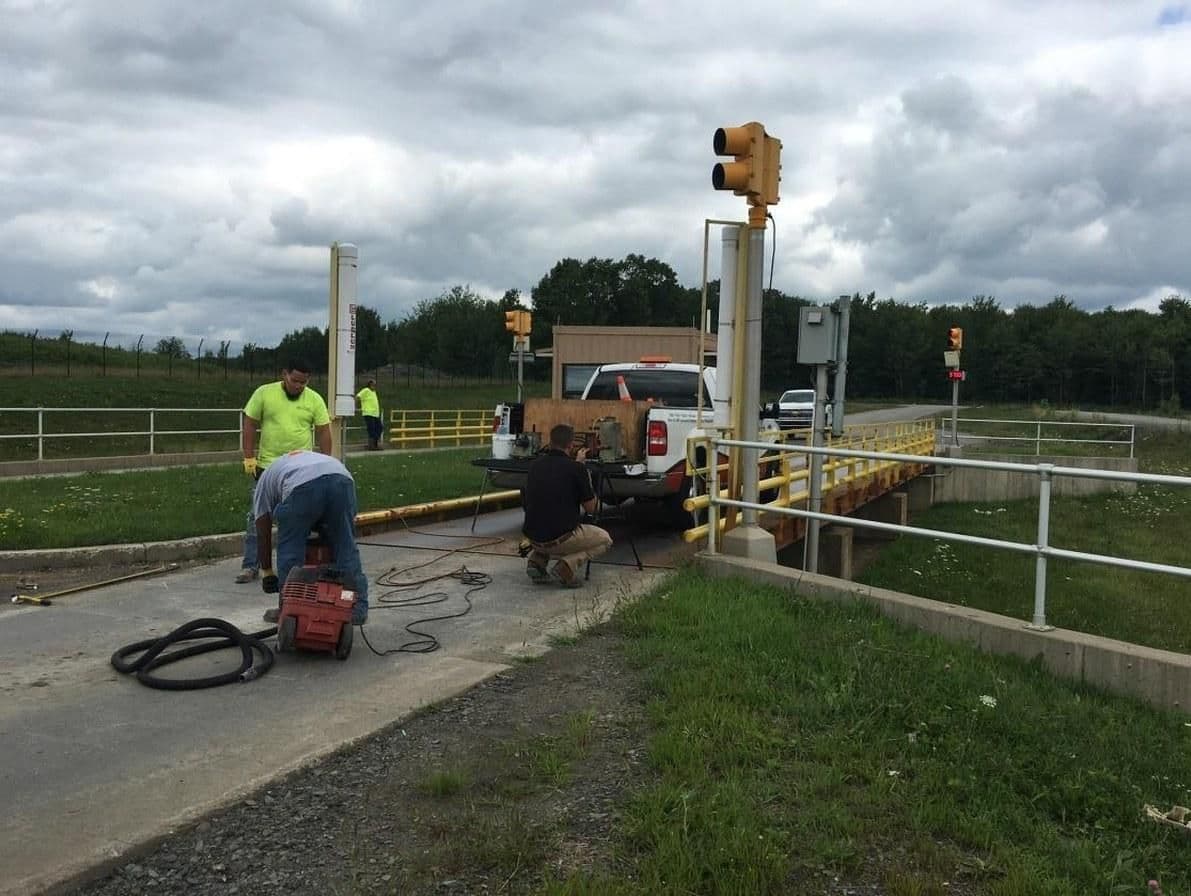
An operating landfill weigh station in New York: URETEK stabilized the weak subsoils and lifted the settled approach and departure slabs while the station kept weighing trucks
At an active, county-operated landfill in New York, the concrete slabs serving the entrance and exit lanes of the weigh station had settled. Four slabs were affected, the entrance approach and departure and the exit approach and departure, and the differential movement had created uneven, unsafe transitions for the loaded trucks crossing the scale every day.
The cause was below the concrete, and it was unknown. The roughly 18-inch-thick slabs were dropping because the soils supporting them had weakened, but no one had characterized those soils. Simply pumping material into the voids directly under the slabs might raise them briefly without addressing what was actually causing the settlement.
The repair also had to happen around a working facility. The weigh station had to keep weighing loaded trucks, so the work was staged lane by lane, and each slab had to carry heavy vehicle traffic again as soon as its area was treated.
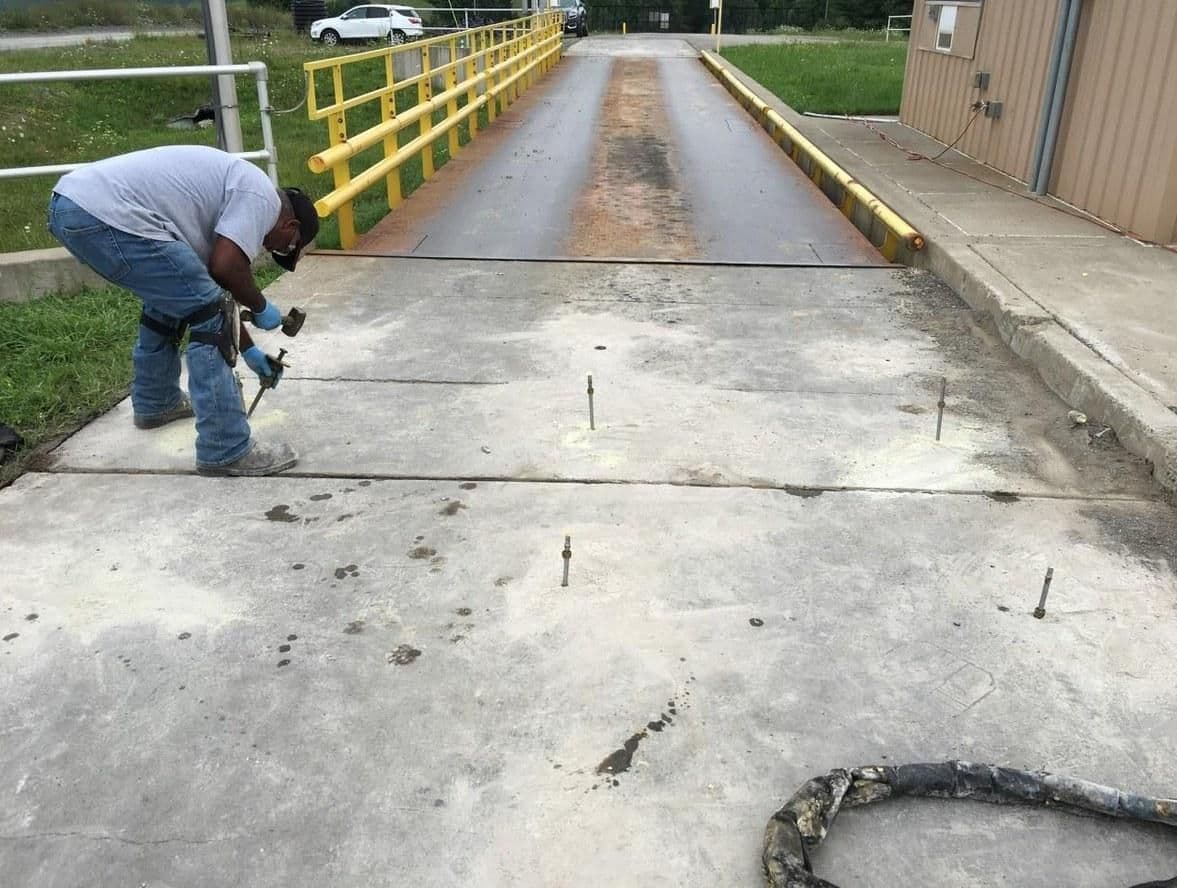
Structural polymer injected through 5/8-inch sacrificial steel tubes: staged injection stabilized the weak soil at depth, then raised the slabs under continuous movement monitoring
Tearing out and repouring four 18-inch slabs would have shut the weigh station down. Demolition, forming, pouring, and curing take a lane out of service for days or weeks, and on a facility that has to weigh every load, that downtime is the whole problem. Replacement also does nothing about the weak soils below, so new slabs could settle the same way.
Conventional slab-jacking that only fills the voids directly beneath the concrete has the opposite gap: it can raise a slab, but it does not strengthen the weak soil a few feet down that let the slab settle in the first place. Without treating that layer, the fix is temporary.
What the site needed was a method that could first find and stabilize the weak soils at depth and then lift the slabs, all through small holes, with the station staying open. That is what URETEK Deep Injection delivers.
Because the subsurface was unknown, the work started with measurement. Crews drilled through the roughly 18-inch slabs and ran Dynamic Cone Penetrometer (DCP) testing beneath each of the four slabs. The tests found weak soil under every one, at a depth of about four feet, and the profiles were not identical from slab to slab, so the treatment was tuned to each location rather than applied uniformly.
Crews drilled 5/8-inch access holes and drove 5/8-inch sacrificial steel injection tubes to about four feet, the depth the DCP testing identified. A two-component, high-density expanding structural polymer was then injected in stages. At the deeper points, the expanding polymer compacted and densified the weak soil surrounding the tubes; injections nearer the surface then filled voids beneath the slabs and applied controlled upward pressure to raise the concrete. Slab movement was watched throughout, so material delivery could be stopped or redirected as each slab responded.
The slabs did not all behave the same way. The two entrance slabs responded immediately and came back to level. On the exit side, the slabs were interlocked in a way the drawings did not show, and excess concrete at a curb and an adjacent retaining wall restricted how far the exit departure slab could move. Rather than force them and risk cracking the concrete, the crew lifted the exit slabs only as far as the existing construction would safely allow.
Verification happened under real traffic. Several locations treated on the first day needed more injection on the second: when a loaded semi-truck crossed the entrance slabs and showed slight deflection, crews returned for targeted spot injection. The slabs were then preloaded and re-checked under heavy vehicle traffic before the injection ports were sealed and the site was closed out. The project’s closing engineering memo concluded that the treated subsoils were stable and that the slabs had been lifted as far as possible without damaging the existing concrete.
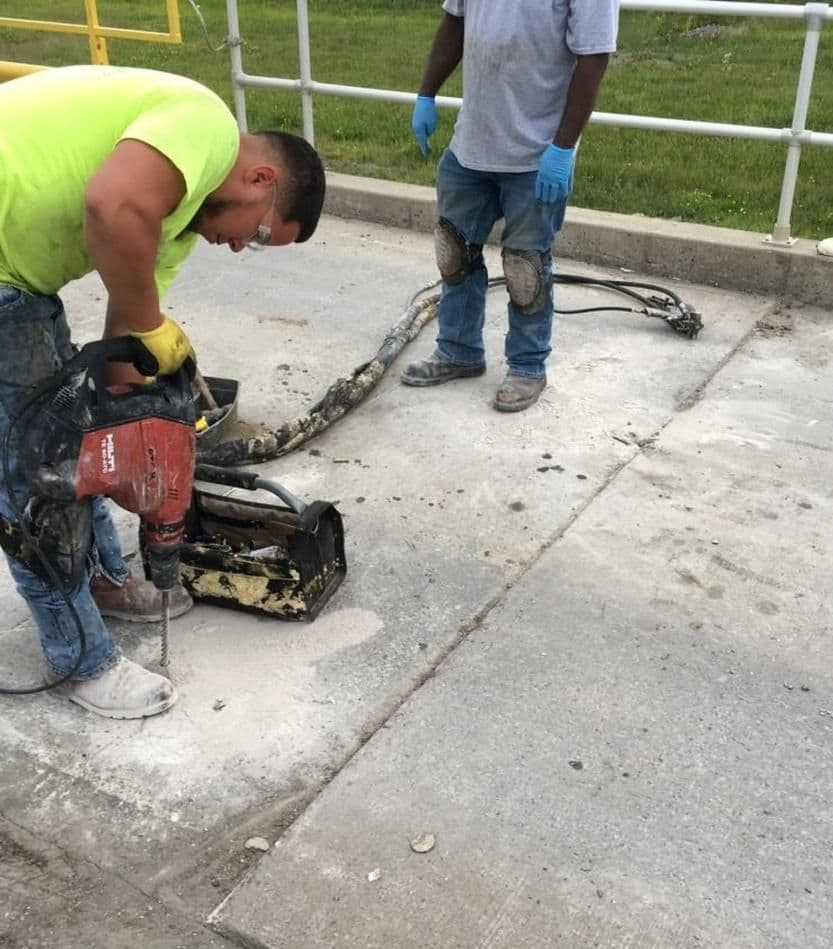
Drilling through the roughly 18-inch-thick slab to place an injection tube: access holes were drilled and tubes driven to the depth the DCP testing identified, about four feet
The figures behind this repair came from the DCP logs, the daily field reports, and the elevation checks: the record of what was tested, injected, and lifted.
The slabs were about 18 inches of concrete, and DCP testing found weak soil roughly four feet down beneath all four. Crews placed 5/8-inch sacrificial steel tubes at that depth and injected a two- component expanding structural polymer, 3,369 pounds in total across the four slabs over two working days.
The lift was measured slab by slab: the entrance approach slab came up about 1.6 inches and the entrance departure slab about 2.5 inches, with the entrance joints returned to level. On the exit side, where interlocked concrete and an adjacent retaining wall limited safe movement, the exit approach slab was raised about 3/8 inch and the exit departure slab about 1/2 inch.
Control mattered as much as quantity. Slab movement was monitored continuously during injection, first-day areas that deflected under a loaded truck were re-injected the next day, and the slabs were preloaded and re-checked under heavy vehicles before closeout, so the result was confirmed under the loads the slabs actually carry.
The program stabilized the failing support and restored the slabs safely, without taking the weigh station out of service.

Weak subsoils stabilized under all four slabs. DCP testing found weak soil about four feet down beneath every slab, and staged deep injection of 3,369 pounds of structural polymer densified those soils, addressing the cause of the settlement rather than only its symptom.
Entrance slabs returned to level. The entrance approach and departure slabs were raised about 1.6 and 2.5 inches, bringing the entrance joints back to level and restoring a safe transition for loaded trucks.
Exit slabs stabilized and lifted within safe limits. Where interlocked concrete and an adjacent retaining wall restricted movement, the exit slabs were lifted about 3/8 and 1/2 inch, as far as the existing construction allowed without risking damage to the concrete.
Verified under real vehicle loads. Areas that deflected when a loaded semi crossed were re- injected, and the slabs were preloaded and re-checked under heavy traffic before the ports were sealed, so the repair was confirmed in service, not just at rest.
No interruption to operations. Because the work went through small drilled holes and was staged lane by lane, the weigh station kept weighing loaded trucks throughout the two-day repair.
Backed by URETEK’s two-year warranty against settlement. URETEK stands behind the completed work with its two-year warranty against settlement.
Test before you lift. The soils were unknown, so the work began with DCP testing through each slab. It found a weak layer about four feet down, and different profiles under different slabs, which is what let the crew treat the cause and tune the work location by location.
Stabilize the soil, not just the voids. Filling the voids under a slab can raise it, but only stabilizing the weak soil at depth addresses why it settled. Staged injection did both: densify the deep soil first, then lift.
Let field conditions govern the lift. When the exit slabs turned out to be interlocked and restrained by adjacent concrete, the crew lifted them only as far as was safe rather than forcing them. Knowing when to stop protected the existing structure.
Verify under the real load. Checking the slabs under a loaded truck, re-injecting where they deflected, and preloading before closeout confirmed the repair against the traffic it has to carry, not just its appearance at rest.
If settlement is opening unsafe transitions in slabs or pavement you cannot afford to close, especially where the weakness is in the soil below, URETEK can help. We test the subsurface, stabilize the weak soils, and lift the concrete back toward grade through small holes, with the facility in service. We will investigate your subgrade with in-situ testing, design a staged injection program, and verify the lift under real loads, so your team gets a stabilized, safer surface without demolition and with minimal downtime.

 800-240-7868


