

Location
Northern Kentucky
Structure Type
Legacy expansion joints (a PVC waterstop behind a compressible filler) in an operational roadway tunnel beneath an active airfield
Core Challenge
Persistent water ingress through aging overhead expansion joints, causing chronic leakage and staining, on a long, discontinuous joint with active seepage in a tunnel that had to stay in service
Verification
Acceptance by direct observation: a continuous seal with no visible seepage under the conditions observed, backed by bench gel-time checks, batch tracking, tube and packer checks, temperature control, and live seepage monitoring
URETEK Scope
A specialty grouting pilot: containment plus staged, low-pressure injection of a low-viscosity acrylate gel through tubing along about 60 linear feet of overhead expansion joint, finished with an elastomeric sealant
Result
The 60-foot pilot segment held a continuous gel seal with no visible seepage at acceptance, with staged sequencing limiting migration into adjacent joints, all while the tunnel stayed operational, establishing the method for a broader program
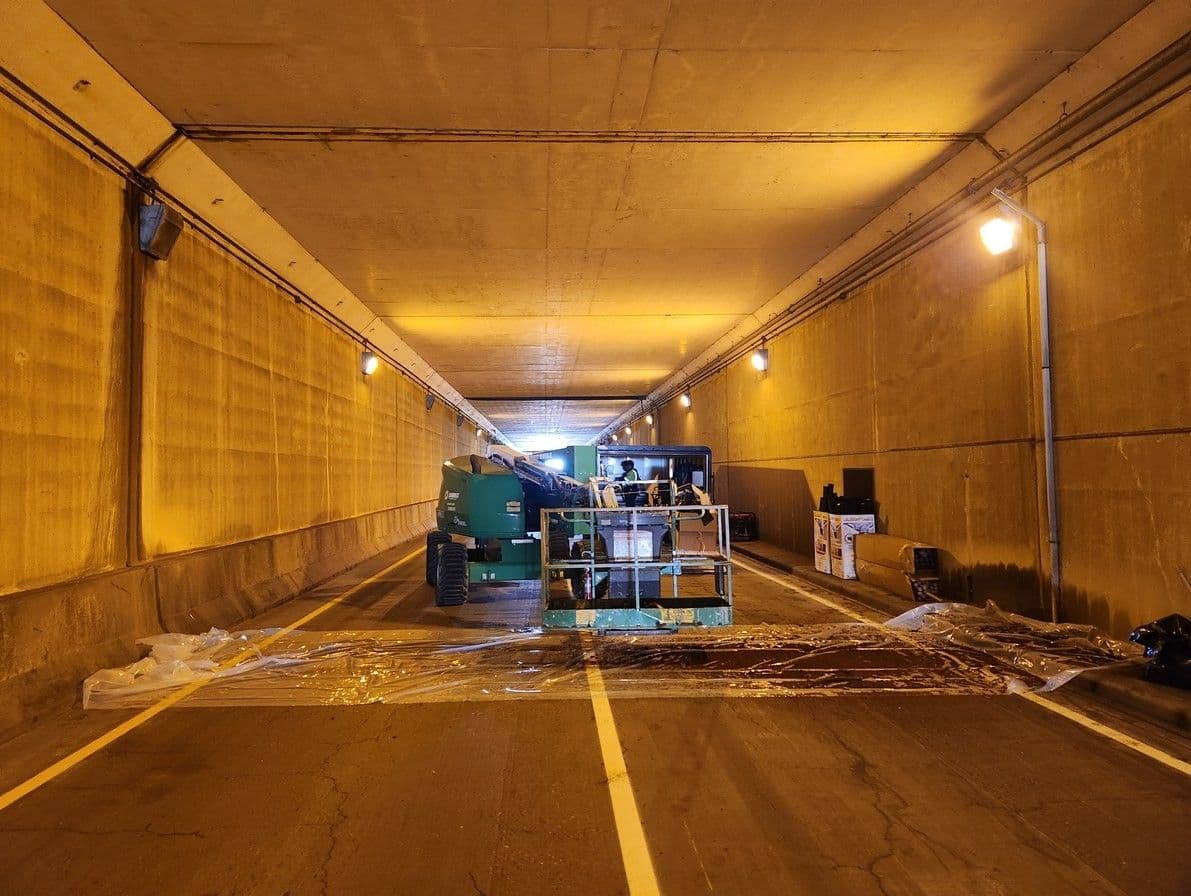
Working an operational tunnel beneath an active airfield: URETEK's specialty grouting crew sealed leaking overhead expansion joints from a lift within tightly coordinated access windows, without closing the tunnel
An operational roadway tunnel beneath an active airfield was leaking through its legacy expansion joints. The original assemblies, a PVC waterstop behind an aged, cork-like compressible filler, had stopped holding water, and the result was persistent ingress overhead: chronic leakage, staining, and a recurring maintenance burden the facility could not keep chasing.
The joint itself made the repair hard. It ran the length of the tunnel across the ceiling and down the vertical transitions, long, discontinuous, and of uncertain internal continuity, with water actively seeping as crews worked. A prior hydrophobic polyurethane injection at a different joint had been attempted by others; part of it was removed for inspection during this project, and it showed how easily a repair can leave bridged or partial pathways behind the joint.
And the tunnel could not close. Work had to happen overhead, in tight, closely coordinated access windows, around continuing operations. Whatever went into the joint had to tolerate the joint's minor cycling, stay put at corners and sidewalls rather than migrating into adjacent sections, and seal a wet interface the first time.
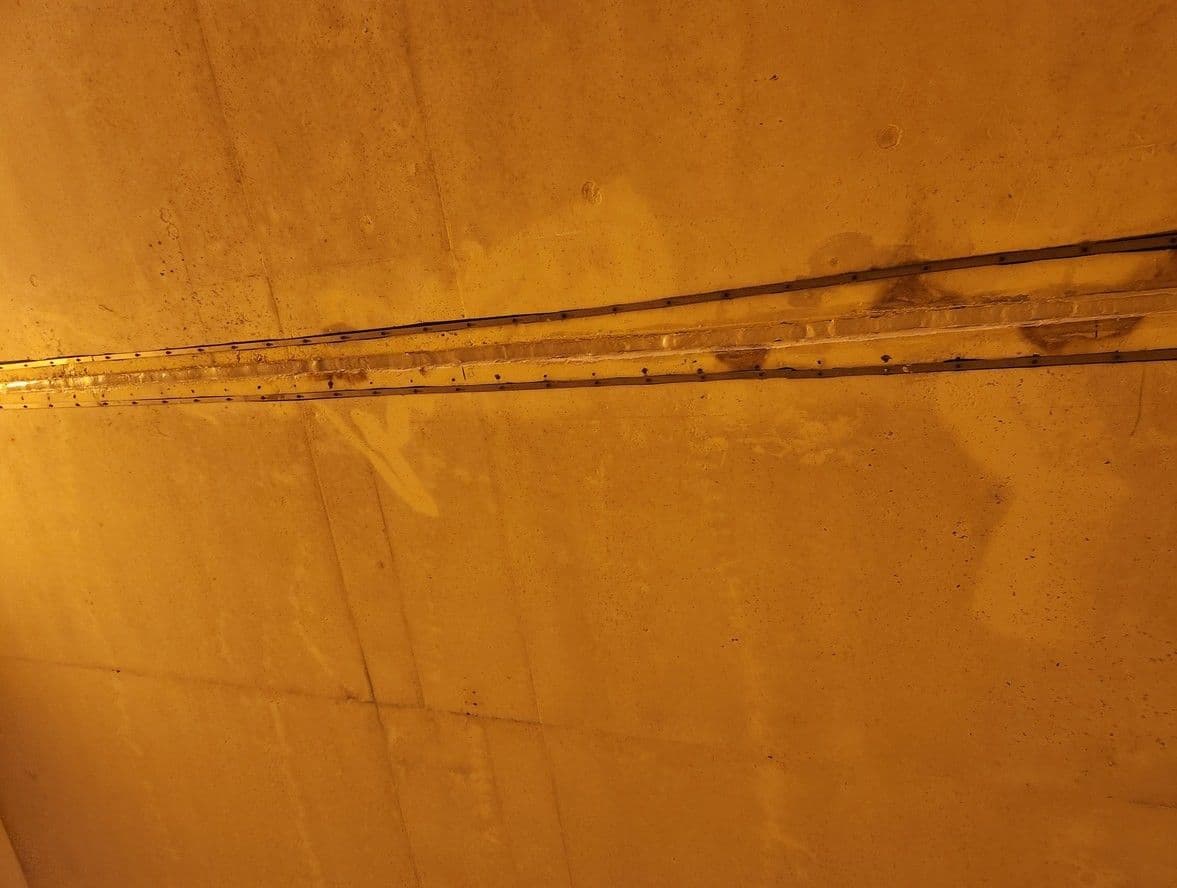
A legacy expansion joint running the length of the tunnel ceiling: long, discontinuous, and actively seeping, the condition the acrylate gel injection was designed to seal
The obvious fixes did not match the conditions. A surface-applied membrane or caulk depends on adhesion to the substrate, and on a wet, overhead concrete face that adhesion is exactly what fails first, so a surface-only patch was a poor bet for a pilot meant to prove out a durable seal.
Hydrophobic polyurethane crack foams, the reference approach and what had been tried before here, are well suited to discrete cracks and rely on tight confinement to work. They are comparatively viscous (on the order of a few hundred centipoise) and are not intended to travel a long, discontinuous joint interface. On this geometry, that is how a repair ends up bridged in places and open in others.
What the joint needed was a material thin enough to wet the whole tight interface, adjustable enough to be tuned to the water and temperature on the day, and flexible enough to move with the joint afterward. A low-viscosity acrylate gel delivers exactly that, which is why URETEK's specialty grouting team selected it for the pilot.
URETEK ran the work as a controlled pilot on roughly 60 linear feet of overhead expansion joint. The principle was simple: confine the joint, then inject a low-viscosity acrylate gel through tubing set along it so the material wets the full interface and cures into a flexible, water-compatible seal, rather than a rigid plug that a moving joint would crack.
Crews began by removing the deteriorated joint material and cleaning the substrate. They then built containment: backer rod and foam set into the joint, with a thin flexible sealant run along the sidewalls and corners to keep the gel from escaping at verticals and terminations. Injection tubing was installed along the joint to create controlled, intersecting flow paths, so the gel could be delivered continuously rather than at isolated points.
The acrylate gel was injected in staged, low-pressure passes, with its gel time tuned in the field to the temperature and the water it met, advancing stage by stage to fully wet the joint interface while crews watched the live seepage and the material travel. Where specified, an elastomeric polyurethane sealant finished the exposed joint, and rigid containment was added at the tunnel center wall where it was needed to hold continuity.
Because a joint seal cannot be seen once it is placed, the work was documented as it went. Crews ran bench gel-time checks on the material, tracked each batch, inspected the tubes and packers, controlled temperature, and observed live seepage throughout, so the acceptance judgment rested on a record, not a single look. Acceptance was direct: a continuous seal along the treated segment with no visible seepage under the conditions observed.
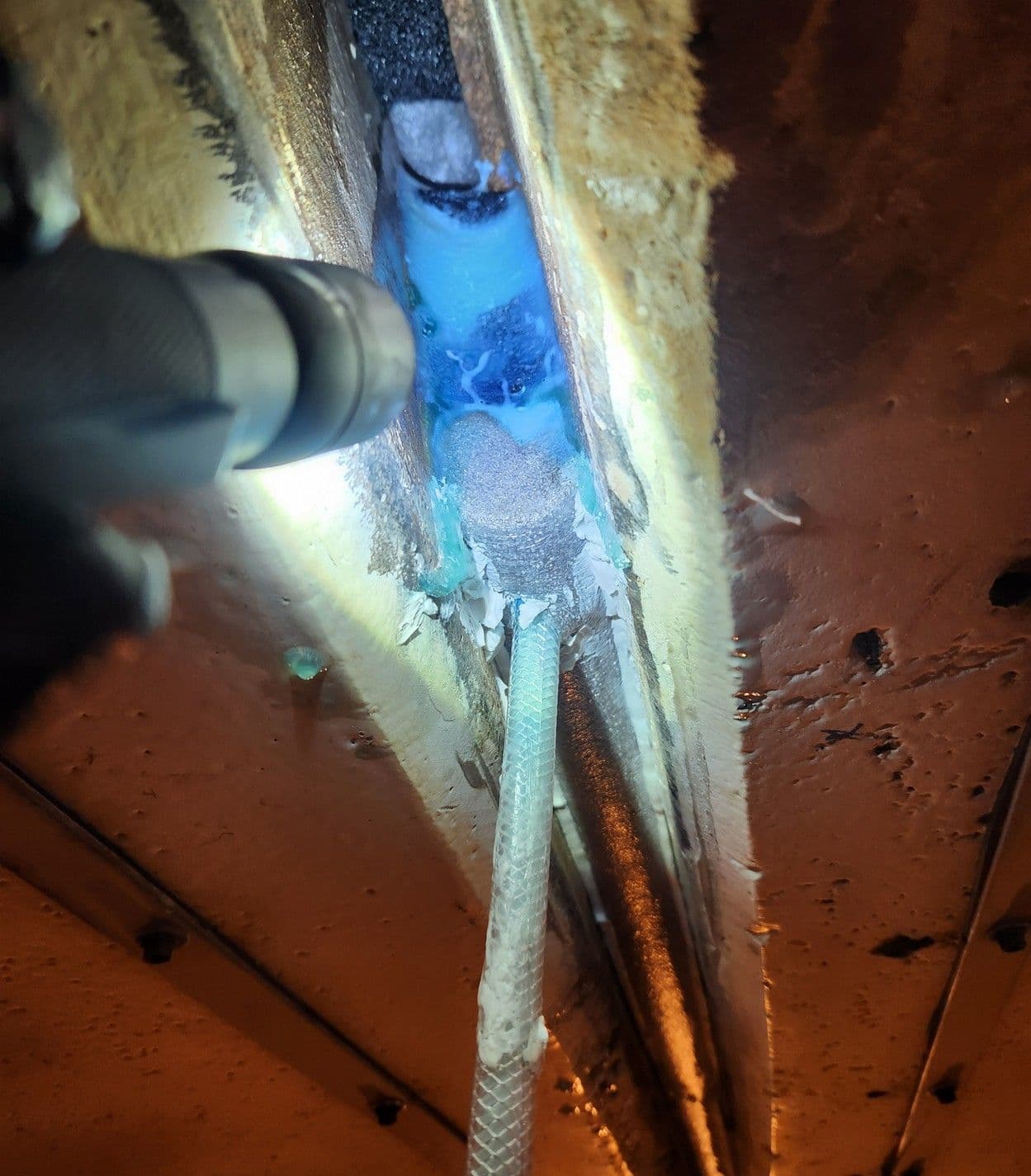
Injecting the low-viscosity acrylate gel through tubing set into the contained overhead joint: staged, low- pressure passes wet the full interface and cured into a flexible seal
This was a pilot, and its figures describe scope and control rather than a lifted elevation or a load. They set the baseline for judging the method before it is expanded.
The pilot treated about 60 linear feet of overhead expansion joint, part of a tunnel whose expansion joints run roughly 96 feet each and whose construction joints run about 72 feet, with the wall and ceiling joints not aligned. The material was a low- viscosity acrylate gel chosen for its ability to wet a tight interface, with a field- adjustable gel time and high flexibility (elongation on the order of 300 percent) to accommodate joint movement.
Control, not volume, defined the work. The gel went in through injection tubing in staged, low-pressure passes; containment at sidewalls, corners, and the center wall kept it in the joint; and gel time was tuned batch by batch to the temperature and inflow. Compared with the more viscous polyurethane foams typically used for discrete cracks, the ultra-low-viscosity gel suited the long, continuous interface this joint presented.
At acceptance, the treated 60-foot segment showed a continuous seal with no visible seepage under the conditions observed, and the staged sequencing had limited diversion of material into adjacent joint sections. The tunnel stayed in service throughout.
The pilot did what a pilot is for: it sealed the target segment, under real conditions, and proved out a method the facility can now expand.

Continuous seal, no visible seepage. Across the roughly 60-foot pilot segment, the acrylate gel established a continuous seal with no visible seepage under the acceptance conditions observed.
The seal moves with the joint. A flexible, water-compatible gel (with elongation on the order of 300 percent) was chosen over a rigid plug so the seal can accommodate the joint’s minor cycling rather than crack under it.
Migration kept under control. Containment at sidewalls, corners, and the center wall, plus staged low-pressure injection, held the gel in the target joint and limited diversion into adjacent sections.
Done without closing the tunnel. All work was performed overhead within tightly coordinated access windows while the tunnel stayed operational, with housekeeping that returned the space between shifts.
A documented, repeatable method. Bench gel-time checks, batch tracking, tube and packer inspections, and live seepage observation produced a quality- control record and a sequencing framework the facility can carry into a broader program.
Match the material to the interface, not just the leak. A long, discontinuous, overhead joint needs a material thin enough to wet the whole interface and flexible enough to move with it. An ultra-low-viscosity acrylate gel fits that where a viscous foam or a surface caulk does not.
Contain before you inject. On corners, sidewalls, and a center wall, the difference between a continuous seal and wasted material is confinement. Backer rod, flexible fillets, and rigid containment where needed keep the gel in the joint.
Tune in the field, and watch the water. Adjustable gel time let the crew respond to the temperature and the active seepage on the day, and staging with live observation kept the material traveling where it should.
Inspect the old repair before you trust the new one. Removing part of a prior polyurethane attempt for inspection revealed bridged and partial pathways behind the joint, and that informed how this seal was placed.
If water is coming through expansion or construction joints in a tunnel, structure, or below-grade wall you need to keep operating, URETEK's specialty grouting team can help. We contain the joint and inject a flexible, low-viscosity gel that seals the interface and moves with the joint, working overhead and around live operations. We will assess the joint and its conditions, run a controlled pilot with documented acceptance, and give you a sequenced, quality-controlled method you can expand across the rest of the structure.

 800-240-7868


