

Location
Denver metro area, Colorado
Structure Type
Two independent reinforced concrete equipment pads carrying ice thermal storage units at a middle school, founded on weak expansive soils
Core Challenge
Both pads settled, pulling the units out of level and obstructing their connection lines. The units carry a warning that an unlevel installation is likely to cause damage and malfunction, so both were taken out of service ahead of the school year.
Verification
Elevation profiles taken across both pads to set the injection pattern, with the equipment's 0.75-inch level tolerance as the acceptance criterion for the realignment.
URETEK Scope
URETEK Deep Injection (UDI) of structural polymer at a 3-foot depth beneath both pads, placed on angled injections from the pad perimeter, weakest soil zones treated first and staged injections used to bring the pads back into tolerance.
Result
Both pads brought within the 0.75-inch tolerance and both units returned to service the same day, with the equipment left in place and no excavation of the pads.
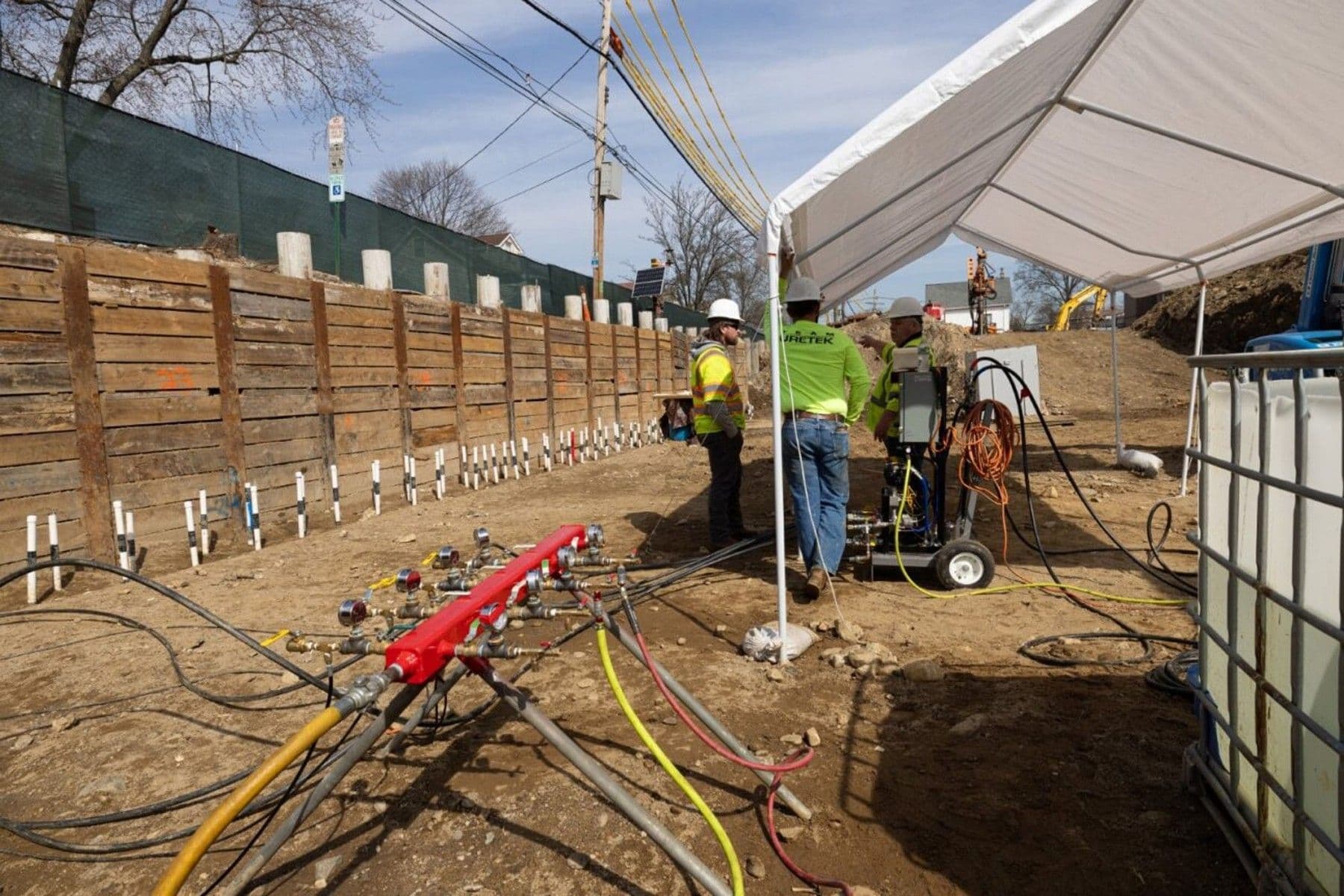
Injection ports laid out and manifolded to the pump. Pattern, depth, and sequence get designed before any polymer goes into the ground.
A middle school in the Denver metro area carried its cooling load on two ice thermal storage units. Each one sat on its own flat, independent, reinforced concrete pad. The units carry a warning that if the unit is unlevel, substantial damage and malfunction are likely, which puts the pad under the equipment on the same spec sheet as the machine it holds up.
Both pads settled. The movement dropped the units out of level and closed on their connection lines, obstructing them, and the district took both units out of service for repairs. The units had to be running at capacity again before the school year started.
The soil is the part of this record worth reading carefully. The original project account identifies weak, expansive soils under both pads and attributes the settlement to inadequate support under the equipment loads. No geotechnical report, soil test data, or moisture history came with that account, so the mechanism is the project team's finding. Expansive soils along the Front Range change volume as moisture changes, and that regional behavior does not by itself diagnose a particular site.
The connection lines at a settled pad. Slab movement shows up first at the pipe connections, and that is what put both units out of service.
The conventional fix for a settled equipment pad is to get the equipment off it. Disconnect the lines, rig and lift each unit clear, demolish the pad, rebuild it on improved support, wait for concrete to cure, set the unit back, reconnect, and recommission.
Every one of those steps costs schedule, and the site did not have room to run them in parallel. The units sit tight against the building in a service corridor a few feet wide, where rigging access and spoil handling compete for the same ground. The school weighed the time and cost of relocating each unit and decided against it, according to the project account.
What the school needed was the support under the pads corrected while the equipment stayed bolted where it was, finished inside the window before students came back.
URETEK was brought in for an on-site repair using URETEK Deep Injection (UDI). Structural polymer goes into the weak soil zones beneath the pads, where it fills voids, compacts and confines the surrounding soil, and forms stabilized support zones under the equipment loads. The same injection, staged and controlled, is what brings a settled pad back up.
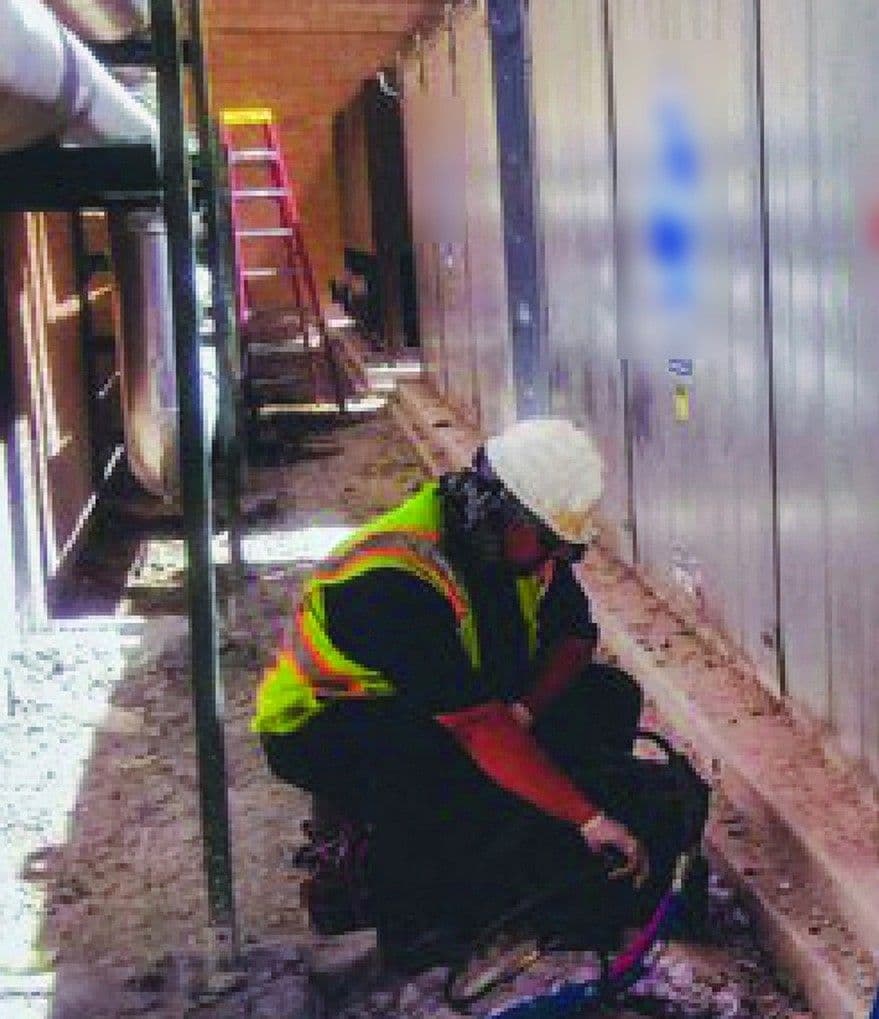
Injecting from the edge of an equipment pad. Access here is a service corridor a few feet wide, so material gets placed from the perimeter and angled in beneath the slab.
Crews took elevation profiles across both pads before any drilling. The profile shows where each pad has dropped and by how much, and that map is what determines where the injections go. Reading a settled pad by eye puts material where it is easy to reach, which is rarely where the support is missing.
Injection went in at a 3-foot depth, with angled injections used to extend coverage laterally beneath the pads. That angle matters on equipment that covers most of its own pad. There is very little exposed slab to work through, so most of the treated zone has to be reached from the perimeter.
The weakest soil zones were stabilized first. Only then did crews use additional staged injections to realign the pads. That order matters, because lifting a pad before the soil beneath it is confined pushes the slab up on material that will keep compressing under load.
Acceptance came off the equipment's own requirement: a 0.75-inch level tolerance for the units to function properly. The project account reports both pads realigned within it. The account does not state the measurement span or the datum used, and no post-treatment load testing or long-term elevation monitoring is in the record.
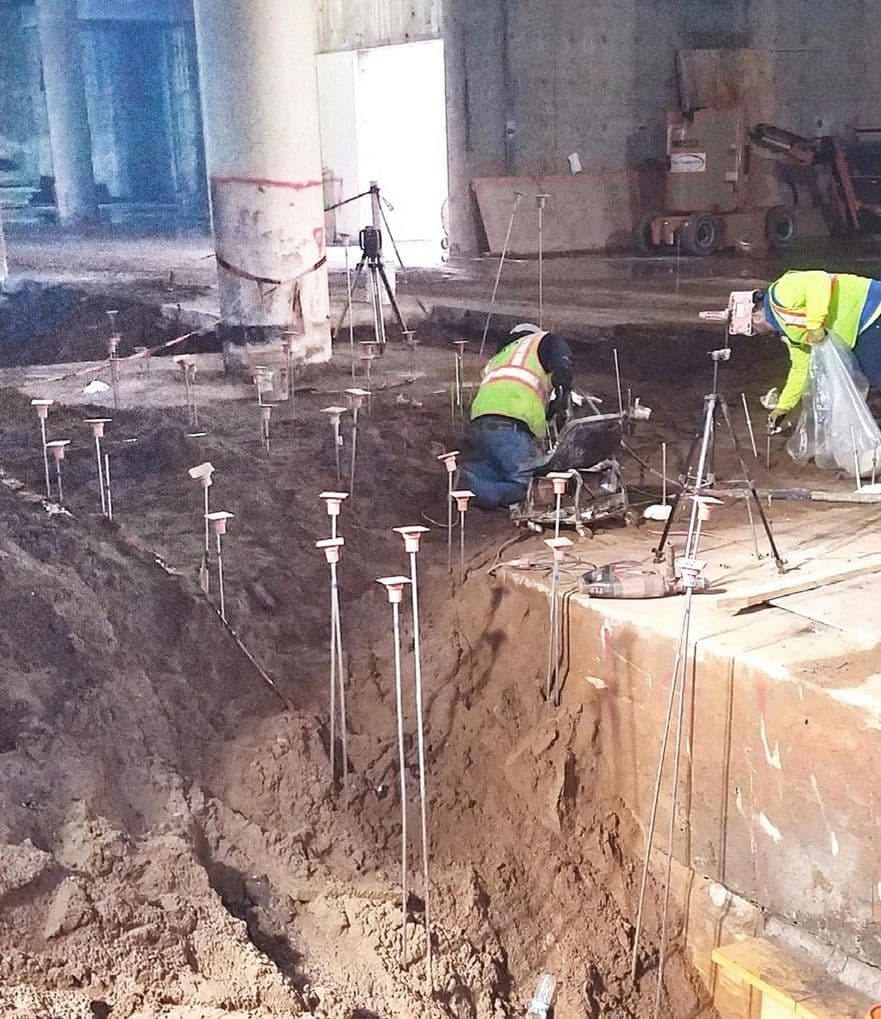
Injection ports and monitoring instruments set out together. Elevation gets watched while the polymer goes in, which is what holds a realignment inside a tolerance measured in fractions of an inch.
This is a production record, and it is worth saying so plainly. There is no pre and post plate load data here, no DCP series, and no long-term settlement monitoring. What the record does document is the geometry of the repair, the acceptance criterion, and the schedule.
On geometry: two independent reinforced concrete pads, injection placed at a 3-foot depth, and angled injections used to widen coverage beneath each pad from limited perimeter access.
On acceptance: 0.75 inch, the units' own level tolerance. The project account reports both pads realigned within it and both units returned to service, which is the operational test the owner cared about.
On schedule: one day from start to finish, with both units back in service immediately afterward. The equipment never came off its pads.
URETEK stabilized the soil beneath both equipment pads and brought both pads back inside the units' 0.75-inch level tolerance in a single day, with the equipment left in place.
 Both pads realigned within tolerance. Staged injections brought each pad back inside the 0.75-inch level tolerance the units require to run properly, which was the acceptance criterion the owner was buying.Both units back in service the same day. The repair was completed in one day and both units were returned to service immediately afterward, ahead of the school-year deadline the district was working to.The equipment stayed where it was. No disconnection, rigging, or relocation of the units, and no demolition or replacement of the concrete pads.Support treated at a 3-foot depth. Structural polymer was placed into the weak soil zones beneath the pads to fill voids, compact and confine the surrounding soil, and form stabilized support zones under the equipment loads.Full pad footprint reached from a few feet of access. Small-diameter injection ports and angled placement let crews treat beneath each pad from the narrow service corridor around the equipment.Backed by URETEK's warranty. Public projects carry a two-year warranty against settlement. Private projects carry a one-year performance warranty plus a 10-year material warranty. Project terms govern.
Let the equipment set the acceptance criterion. Machinery that carries a level tolerance has already written the spec for the repair. Design the injection to hit that number and there is nothing left to argue about whether a pad is level enough.
Profile the pad before you pick injection points. An elevation profile tells you where the support is missing. Without one, the pattern follows whatever is easy to drill, and staged lifting has nothing to work against.
Stabilize the weak zones first, lift second. Confining the soil before applying lift pressure is what keeps the correction from settling back out. A pad lifted on uncompacted material is borrowing against the same failure.
Expansive soil stays moisture-sensitive after treatment. Injection fills voids and forms stabilized support zones under the pad. The surrounding clay still swells and shrinks with moisture the way it always did, so grading, drainage, and any leaking line near the pad are all still worth attention.
If a chiller, tank, transformer, or process skid has gone out of level on a settled pad, URETEK can treat the soil beneath it and bring the pad back to tolerance with the equipment in place. The units stay bolted down, the pad stays where it is, and there is little or no excavation where conditions permit. We will profile the pad, design the injection pattern and depth for your soil conditions, work the realignment to your equipment's own level tolerance, and hand the unit back the same day where the scope allows.

 800-240-7868


