

Location
Northeast Florida
Structure Type
Two buried storm culverts beneath a multilane municipal parkway: a 60-inch pipe at the first location and a 48-inch pipe with a manhole connection at the second.
Core Challenge
Leaking pipe joints let fines wash into the culverts, leaving voids and loosened sandy soil under the asphalt. The pavement subsided, and the city covered both areas with steel plates. Patching the joints from inside stopped the leaks but left the voids.
Verification
Work plan: pavement profiled before and after treatment, and each injection stopped at 1 mm of movement at the pavement surface. The plan also called for DCP testing before injection; those results are not in the project file.
URETEK Scope
URETEK Deep Injection (UDI) on 4-foot centers in a wedge pattern extending past the visible settlement, with rows beside each pipe at 4, 8 and 12 feet and a row over the pipe at 4 feet. Three rows at the first location, five at the second.
Result
Both locations stabilized in 3 days against a 5-day schedule and within the project budget, with at least one lane open throughout. The prime contractor milled and overlaid the pavement afterward.
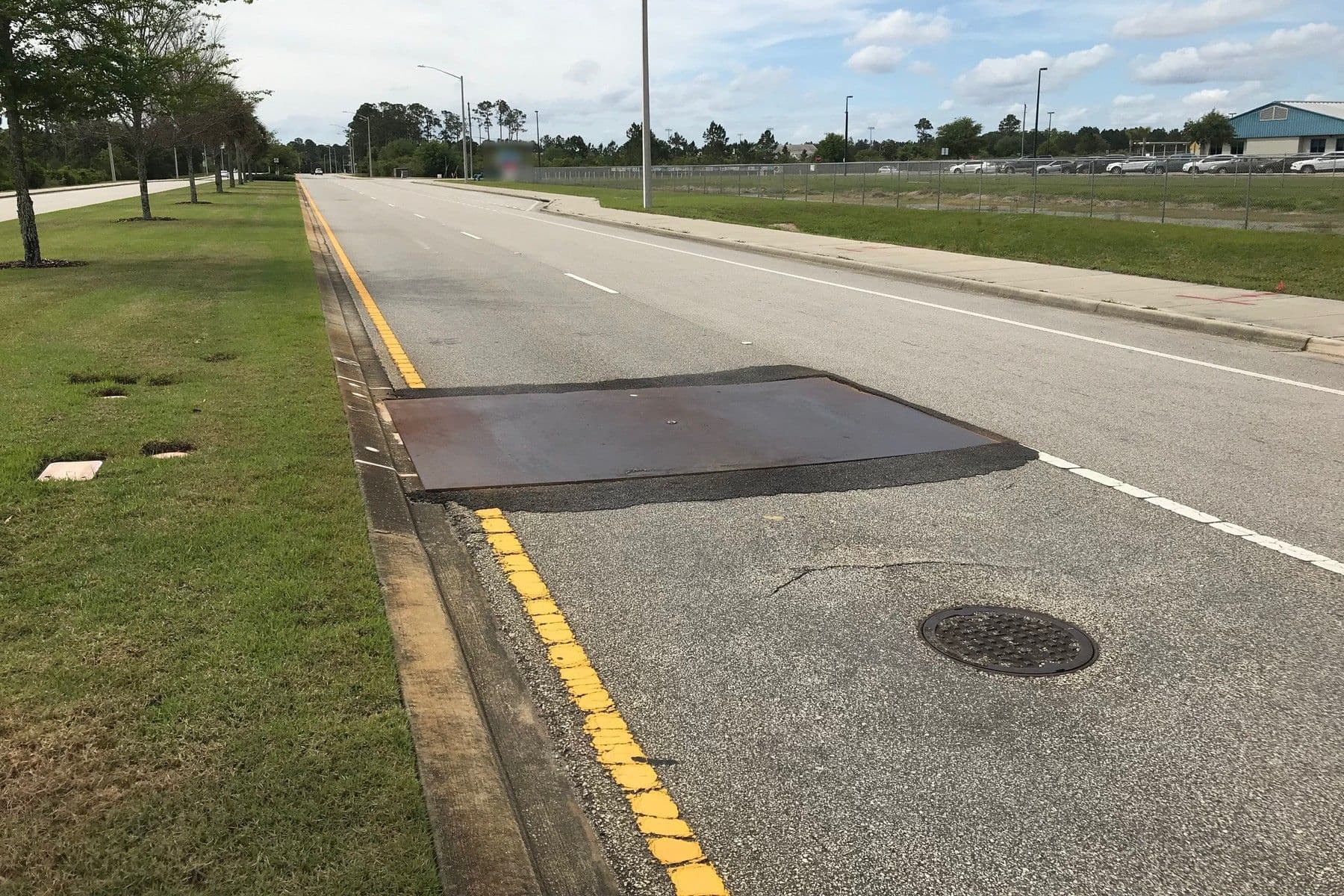
A steel plate over settled asphalt on the parkway. The city put plates down to keep traffic moving until the ground underneath could be fixed.
Two buried storm culverts run beneath a multilane parkway in a Northeast Florida city: a 60-inch pipe at one location and a 48-inch pipe at another. Both began leaking at multiple joints.
Every leaking joint was also a path for soil. Fines migrated through the joints into the pipes, which left voids outside the culverts and loosened the sandy soil around them. The asphalt above started to subside.
With the extent of the weakened ground unknown, the city covered both areas with steel trench plates and issued an emergency repair contract to its on-call contractor. URETEK came in as the subcontractor for the ground repair.
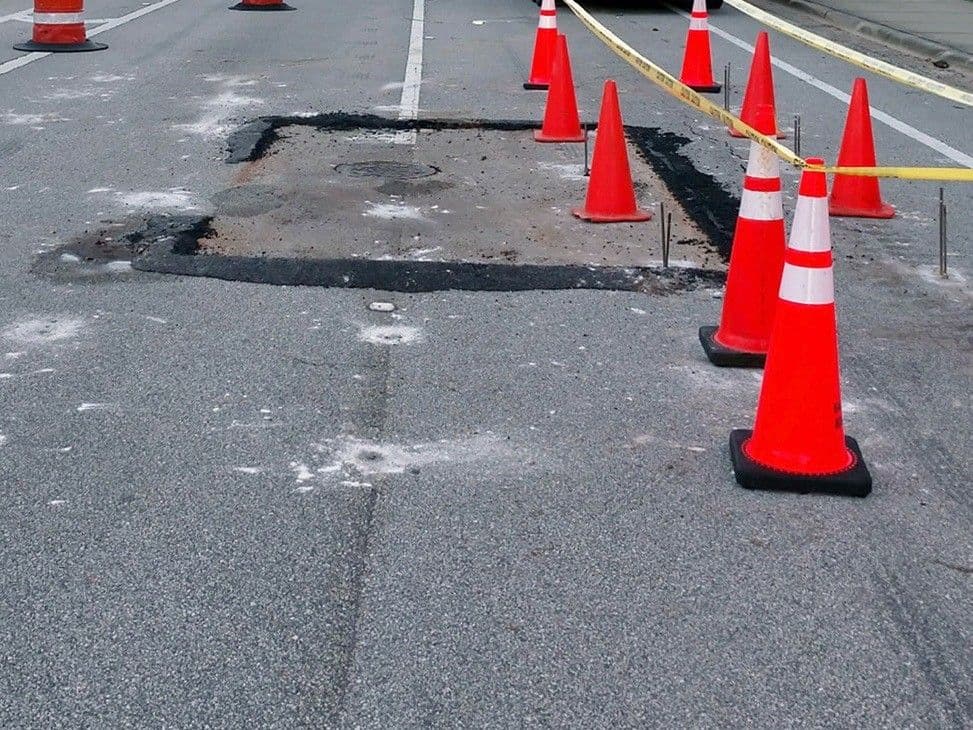
One of the two settled areas coned off for injection, with traffic shifted to the adjacent lane.
City crews had already repaired the leaking joints from inside the pipes using conventional patching. By the project account, that sealed the leaks and stopped further inflow and infiltration at those joints.
Sealing the joints stops new soil from leaving. It does nothing about the soil already gone. The voids outside the pipe were still there, the sand around it was still loose, and the pavement above was still settling onto it.
Excavating to the pipe would have meant cutting open a busy parkway at two locations, digging down to the pipe through loose sand, and rebuilding the backfill and pavement over a culvert that had just been repaired. The city and its contractor asked URETEK for a way to stabilize the ground from the surface instead.
The plan used URETEK Deep Injection (UDI) to treat around the entire pipe, from grade down to 12 feet, which the project account puts about a foot below the bottom of the pipe. Injection holes went in on 4-foot centers, and the expanding polymer fills voids and compacts and confines the surrounding sand into stabilized support zones.
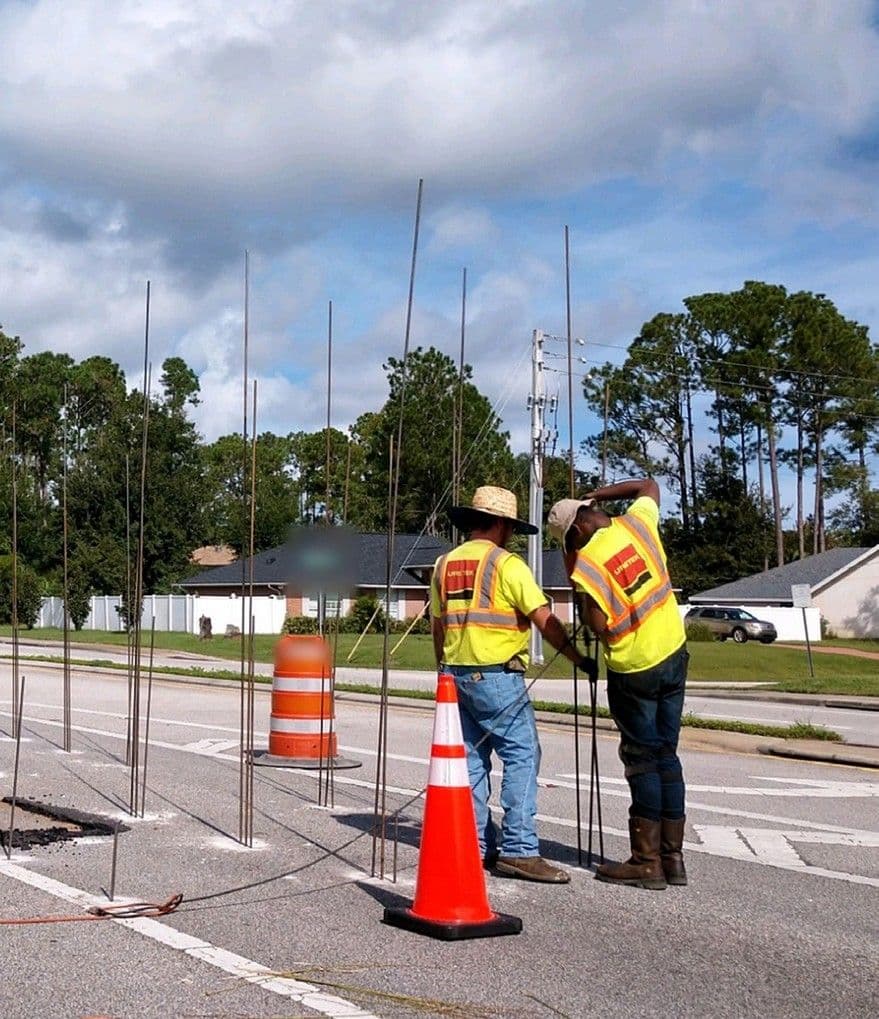
Crews setting injection tubes. Each one reaches a planned depth of 4, 8 or 12 feet beside the pipe, or 4 feet over it.
The layout extended in a wedge past the footprint of the visible settlement. The aim was to tie the stable soil at the edges into the weakened zone around the repaired culvert, so the treated block didn't end at a soft boundary.
At the first location, three rows: one on each side of the 60-inch culvert, injected at 4, 8 and 12 feet, and one row directly over the pipe at 4 feet. At the second location, five rows: two on each side of the 48-inch culvert at 4, 8 and 12 feet, and one over the pipe at 4 feet.
The work plan used the pavement as the gauge. Profile it before starting. Inject at each point until 1 mm of movement shows at the surface, the plan's confirmation that the soil below is adequately stabilized. Then profile it again after treatment as the baseline for the warranty.
The limits of the record belong here. The plan called for DCP testing before injection to confirm the depths, but those results and the profile readings are not in the project file, and no long-term monitoring is on record. Joint sealing was the city's work; URETEK's scope was the ground around the pipe.
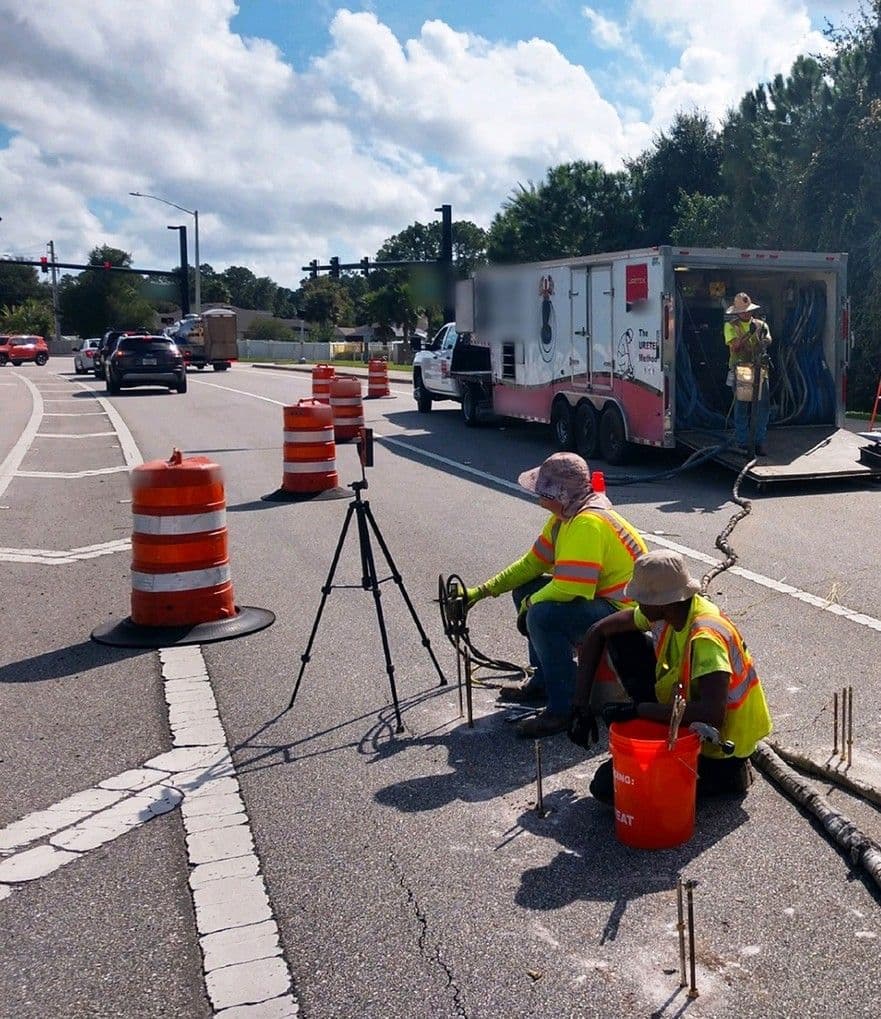
Injection under way, with a laser level on the tripod watching the pavement. The work plan stopped each injection at 1 mm of surface movement.
This is a design and production record. The layout, the depths and the schedule are documented. Post-treatment test figures are not, so the case rests on the method, the stopping criterion and the time it took.
The layout: holes on 4-foot centers, side rows injected at 4, 8 and 12 feet, rows over the pipe at 4 feet. Three rows at the first location and five at the second. The preliminary layout at the first location came to 56 injection points: 8 holes per row, three depths in each side row and one over the pipe.
The footprint: planned treatment areas of about 30 by 12 feet at the first location and 24 by 16 feet at the second, each extended past the visible settlement.
The schedule: the project was scheduled for 5 days, and URETEK finished both locations and left the site in 3, within the project budget, with at least one traffic lane open the whole time.
Two settled areas over leaking storm culverts were stabilized from the surface in 3 days, with the parkway open and the culverts left in place.
 Voids filled around both culverts. Injection from grade to 12 feet treated the ground around each pipe, filling the voids that fines migration had opened outside the joints.Sandy soils densified past the settlement. The wedge pattern carried treatment beyond the visible settlement, tying stable soil at the edges into the weakened zone around the pipe.Done in 3 days of a 5-day schedule. URETEK crews finished both locations and left the site 2 days early, within the budget set for the project.The parkway stayed open. At least one traffic lane remained open during the work, with no significant traffic delays reported.Ready for the overlay. With the ground stabilized, the prime contractor milled and overlaid the pavement over both locations.Backed by URETEK's two-year warranty against settlement. The project proposal carries URETEK's two-year warranty against settlement of more than 1/2 inch in the injected areas.
Seal the joint, then treat the ground. Patching a leaking joint stops the soil loss. It leaves behind the void the leak already made, and that void keeps working on the pavement until somebody fills it.
Treat around the whole pipe. Fines leave through the joints, but the loosened zone wraps the culvert. Injecting beside the pipe down to just below its bottom, plus a shallow row in the cover, reaches the ground that actually moved.
Extend past what you can see. The visible dip is the surface expression. Carrying the pattern past it ties the treated zone into sound soil, so the repair has no soft edge for the next settlement to start from.
Use the pavement as the stopping signal. Injecting until 1 mm of surface movement shows gives every hole a measurable end point, and the before-and-after profiles give the owner a record to hold the warranty against.
If a culvert has leaked fines and the pavement over it is sinking, the joint repair is only half the job. URETEK Deep Injection fills the voids and densifies the soil around the pipe from the surface, with the road open and the culvert left in place. We'll lay out the injection pattern around the pipe, extend it past the settlement, and get your plates off the road.

 800-240-7868


