

Location
New York, New York
Structure Type
Major vehicular tunnel serving a critical metropolitan river crossing, including both cut-and-cover and bored sections
Core Challenge
Periodic water ingress at cracks and joints threatening finishes, MEP assets, and long-term structural durability
Work Window
Two night-shift closures: first shift for installation and injection, second shift for verification and touch-up
Key Constraint
Strict reinforcement avoidance requirements, active conduits, and cover-sensitive zones throughout the injection areas
URETEK Scope
Positive-side crack and joint injection using hydrophobic polyurethane resin, with full QA/QC documentation and verification
Result
Active leaks arrested at all treated locations, verification completed within the planned closure window, and tunnel returned to full service on schedule
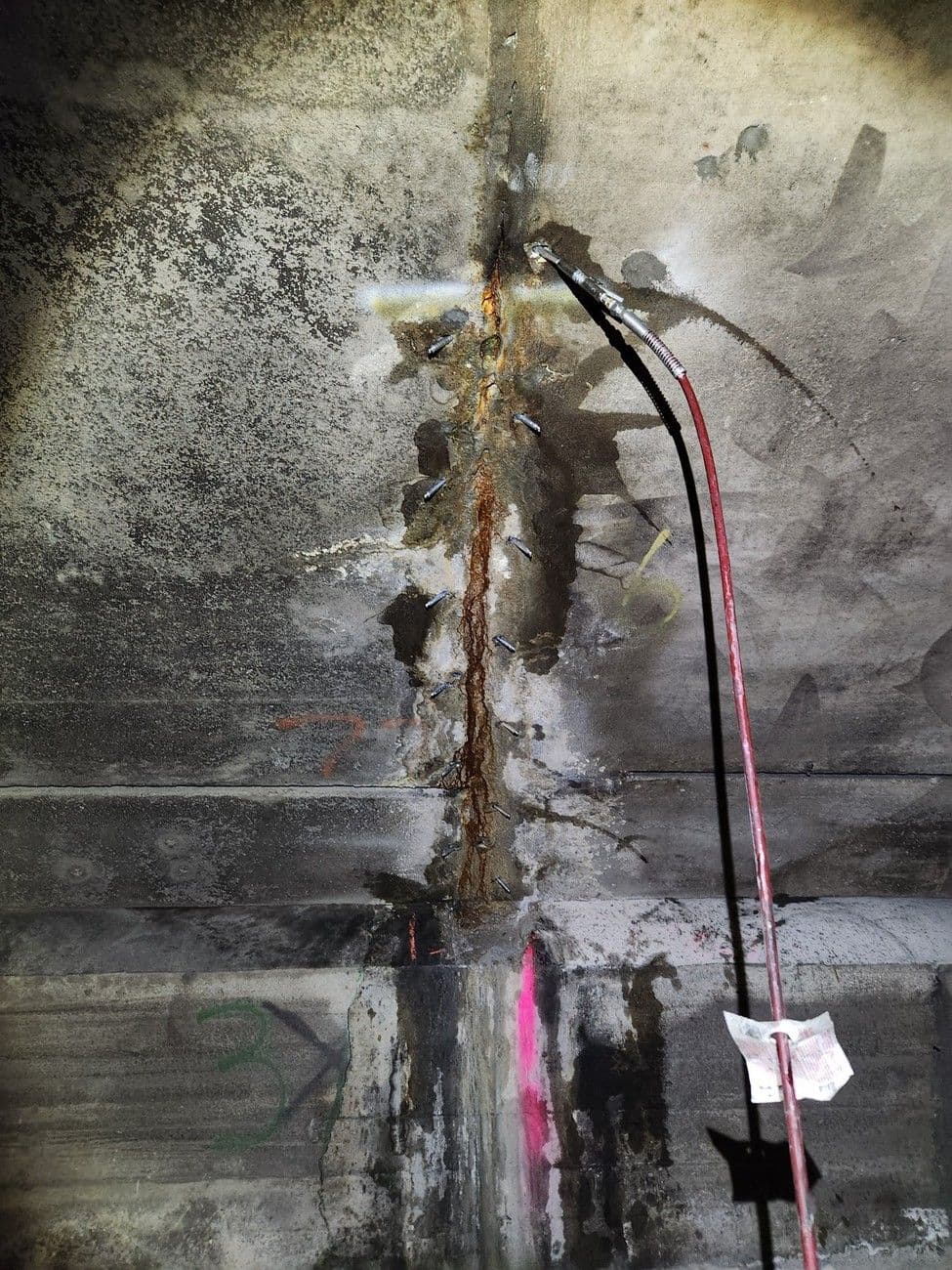
Active water ingress at a tunnel joint: rust staining and mineral deposits indicate long-term seepage, with injection ports installed and ready for treatment
A major vehicular tunnel beneath the waterways of New York City, one of the most heavily trafficked river crossings in the region, was experiencing periodic water ingress at select cracks and joints across both its cut-and-cover and bored sections. For infrastructure of this scale and criticality, water infiltration is never just a maintenance nuisance. It is a progressive threat.
Persistent leakage accelerates deterioration of the concrete liner, corrodes embedded reinforcement and structural steel, damages finishes and architectural elements, and creates conditions that compromise mechanical, electrical, and plumbing systems. Left unaddressed, what begins as a seeping crack can evolve into a durability problem that shortens the useful life of the structure and drives increasingly expensive repairs down the road.
The tunnel's operating authority needed the leaks stopped, but the constraints on how that work could be performed were as demanding as the problem itself. The entire scope had to be executed within two night-shift closures. There was no tolerance for extended lane closures, no opportunity for multi-week scaffolding campaigns, and no room for methods that would leave the tunnel out of service past the scheduled reopening. Every aspect of the work, from drilling to injection to patch-back, had to be planned, staged, and completed within that window.
Adding to the complexity, the injection work had to navigate reinforcement-dense concrete sections with active conduits and cover-sensitive zones. Drilling into rebar or severing an embedded conduit in a live tunnel would create a far bigger problem than the leaks being repaired. The methodology had to be precise enough to intersect crack planes at depth while avoiding everything that could not be touched.
URETEK served as the specialty injection subcontractor, working within the prime contractor's operations to deliver a positive-side crack and joint injection program at all mapped leak locations. The methodology was designed from the ground up for the realities of live-tunnel work: speed without shortcuts, precision without hesitation, and verification built into the schedule rather than left as an afterthought.
Before any drilling began, URETEK crews performed a systematic leak mapping pass to identify every active leak, define the full extent of each crack or joint, and mark injection targets. Surface preparation, including wire brushing and pressure washing as needed, ensured workable conditions at each treatment location. This upfront investment in mapping pays for itself many times over: it eliminates wasted ports, prevents missed targets, and gives the crew a clear execution plan before the clock starts on the closure window.
In reinforcement-dense tunnel structures, you cannot drill blind. URETEK's workflow incorporated scanning and mapping to locate rebar and embedded items before any hole was drilled, with field adjustment of hole patterns to avoid reinforcement and active conduits, and logging of drill cuttings where required to support real-time field decisions. This level of discipline is non-negotiable in infrastructure environments where a single misplaced drill hole can compromise structural capacity or sever a live utility.
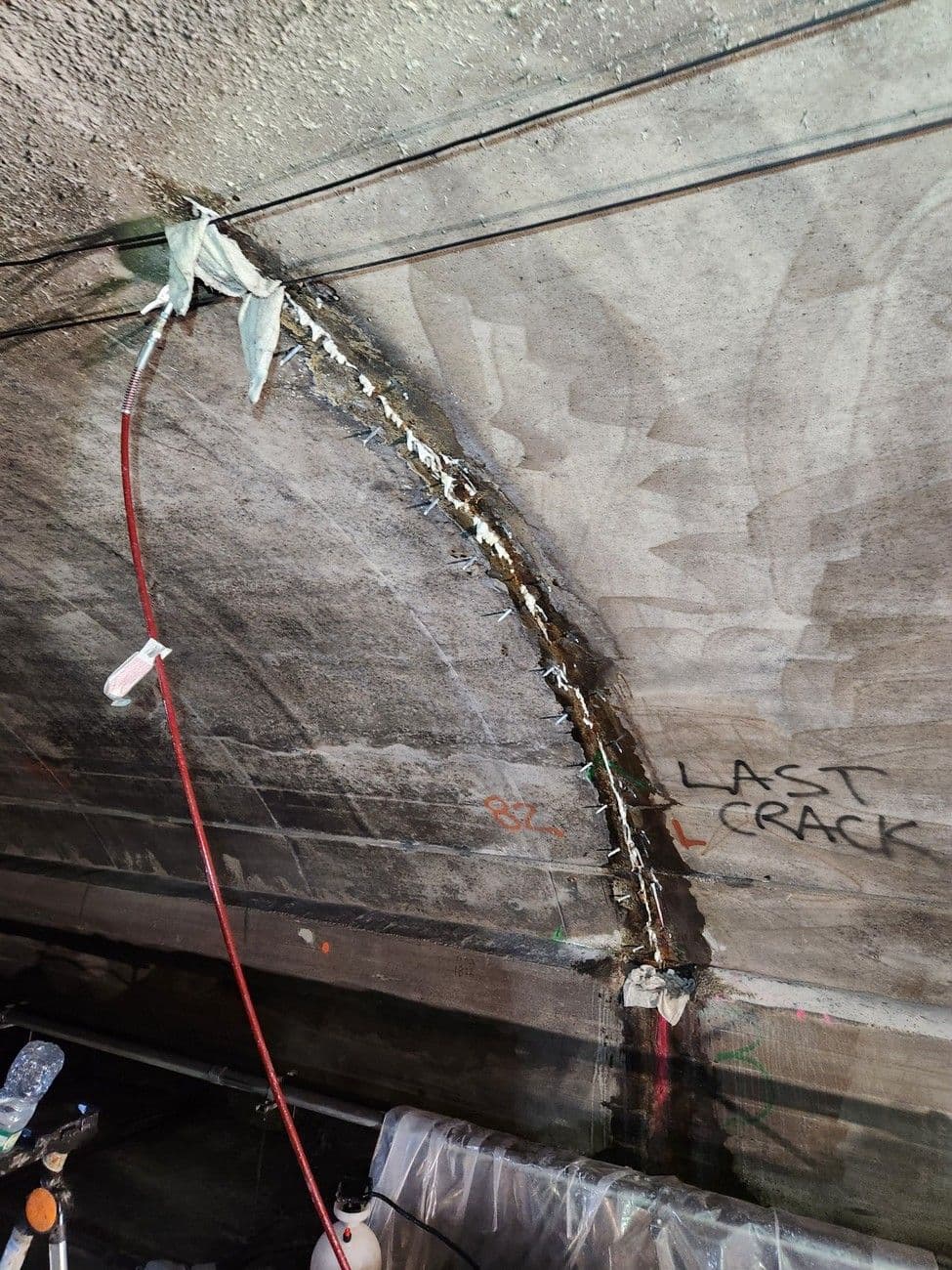
Alternating injection port pattern along an angled crack: the stitch grouting geometry ensures material reaches the full depth and length of the leak path
Mechanical injection ports were installed using angled drilling at approximately 45 degrees to intersect the crack or joint plane at mid-depth. The typical layout used a six- inch offset from the crack face with six-inch vertical spacing in an alternating pattern, a geometry designed to ensure the injected material reaches the full depth and length of the leak path, not just the surface expression.
Injection proceeded from low to high at each treatment location, using gravity and hydrostatic conditions to the crew's advantage. Material was advanced slowly until return was observed at an adjacent port or at the crack face, confirming continuity between injection points. If material flowed freely without developing backpressure, crews paused to allow the resin to react and set before continuing, a critical control that prevents material from running through the crack without sealing it.
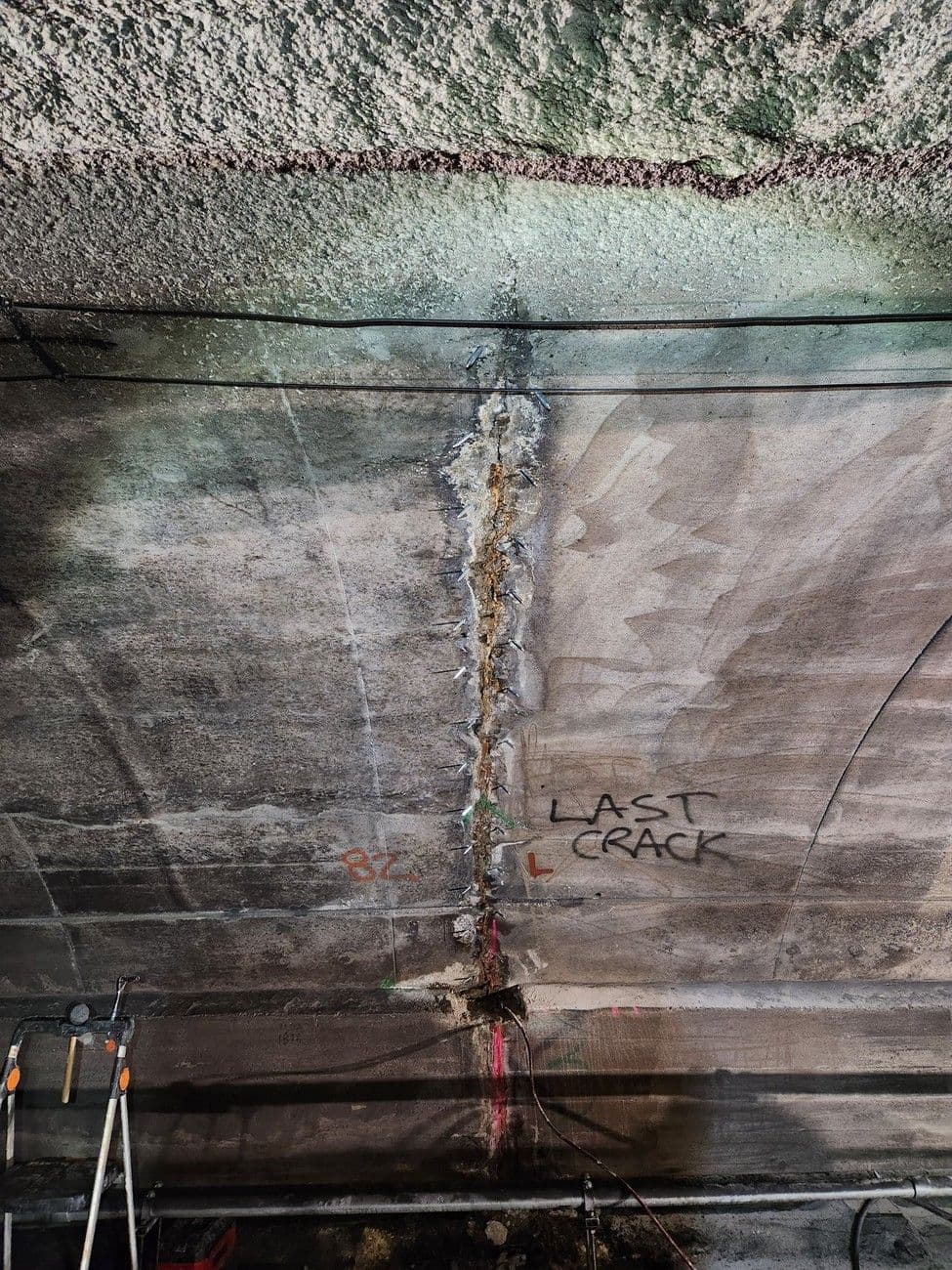
Full-length injection port pattern along a vertical crack with "LAST CRACK" marking: every port is placed to intersect the crack plane at mid-depth
After the resin cured, ports were removed, drill holes were patched with rapid-set hydraulic cement, and surface seals were applied where directed. This step is often underestimated in planning, but it is essential for returning the tunnel to service cleanly. A facility operator cannot accept exposed ports, open drill holes, or unfinished surfaces when traffic resumes, and the patch-back must be completed within the same closure window as the injection work itself.
URETEK selected a water-activated, single-component, hydrophobic polyurethane resin for this application, a material specifically engineered for active-leak arrest in concrete structures. Understanding why this material class was chosen helps illustrate why injection-based repair is so effective in tunnel environments.

Water-reactive sealing. The resin is designed to expand on contact with water, curing into a tough, flexible foam that creates a gasket-like seal within the crack or joint. This is the key advantage over dry-application repair methods: the material uses the water that is causing the problem as the catalyst that activates the solution. In an actively leaking tunnel crack, that is exactly what you need.
Low viscosity with controlled reaction. The resin's low viscosity allows it to penetrate deep into tight cracks, effective in openings as narrow as 0.02 inches. Reaction time is adjustable through a compatible catalyst system, giving crews the ability to tune set speed based on water flow rates, temperature, and site conditions. This field adjustability is what separates a controlled repair from a material that either sets too fast to reach the leak path or too slow to hold against flowing water.
Expansion and confinement behavior. When injected, the material follows the path of least resistance until it fills the available space, then continues to expand within the confined geometry of the crack, compressing into a dense, closed-cell foam that locks into place. Under unconfined conditions the material can expand up to approximately eighteen times its liquid volume, but in an actual crack or joint, the surrounding concrete confines the expansion, producing a tighter, denser seal with superior adhesion to the crack walls. The result is a flexible, durable seal that accommodates minor structural movement without losing contact or re-opening the leak path, an important characteristic in tunnel structures that experience thermal cycling, traffic loading, and long-term creep.
In tunnel infrastructure, the documentation is part of the deliverable, not an afterthought. Owners, engineers, and inspection programs need to know exactly what was treated, how it was treated, and what was observed afterward. URETEK's QA/QC program for this project was designed to satisfy that requirement fully.
Field controls. Adherence to a defined standard operating procedure for port placement, low-to-high injection sequencing, and re-grout decision triggers. Pressure and volume envelopes were monitored continuously at every injection point to prevent unintended displacement of material beyond the target zone. Reinforcement avoidance protocols were enforced at every drill location without exception.
Documentation and closeout. Shift-by-shift records included location-by- location injection logs, batch records, and post-work observation notes. The closeout package comprised the injection plan, a complete QA/QC packet, and a summary report, structured so that any reviewer could understand what was done, where, and with what result.
The built-in verification shift. The second night shift was a deliberate design element, not a contingency. Waterproofing injection can redirect water to new paths once primary leak points are sealed. By scheduling the second shift specifically for performance verification and targeted touch-up, the project plan acknowledged this reality and addressed it proactively, rather than leaving it for the owner to discover after the tunnel reopened.
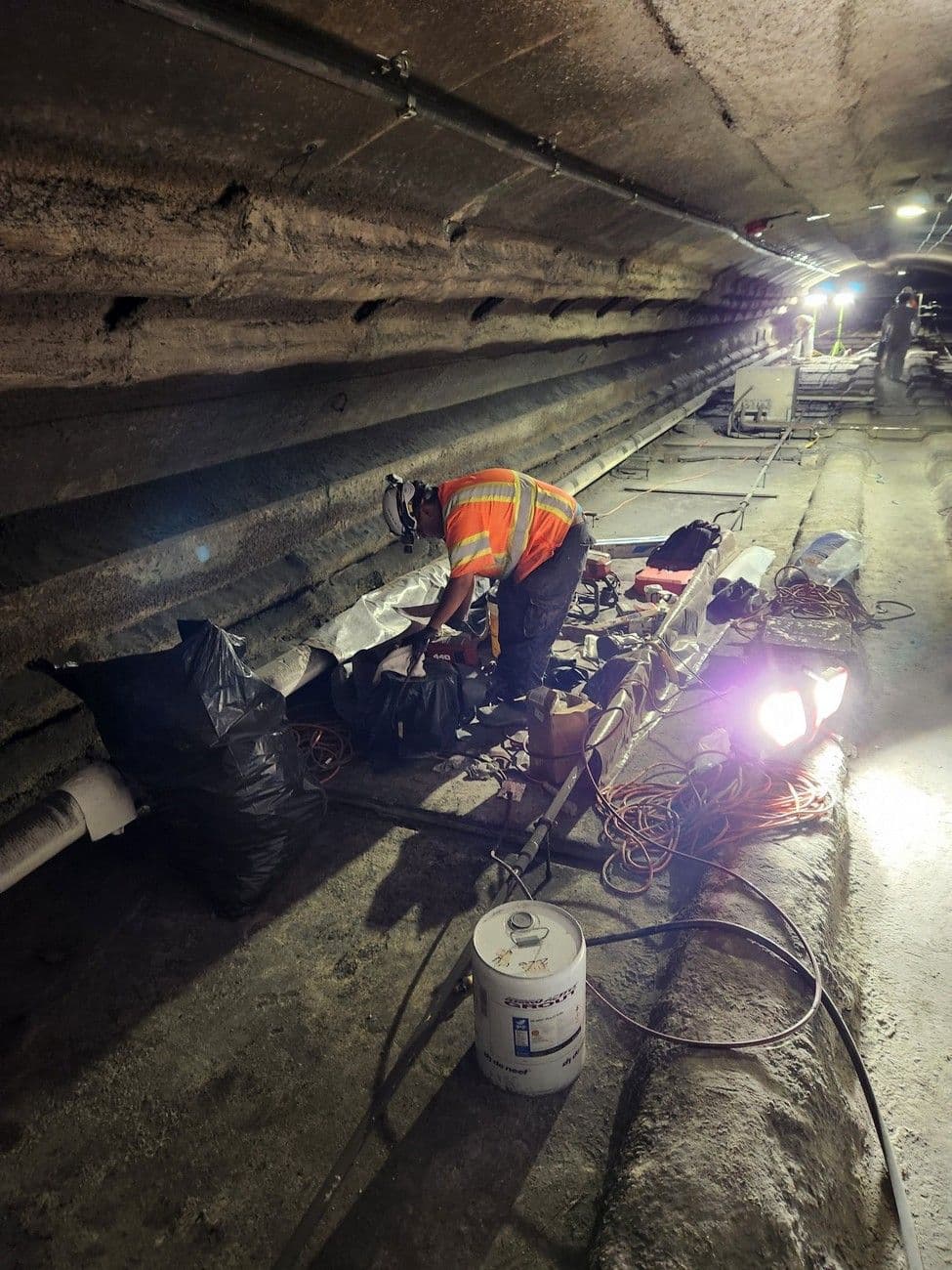
URETEK crew working during the overnight closure: confined-space conditions, full PPE, and portable lighting are standard for live-tunnel injection work
Active leaks at all treated locations were arrested or reduced to seepage, with performance verification and any necessary touch-up completed during the second closure shift. The tunnel returned to full service on schedule with no overrun of the planned work window.
For the tunnel's operating authority. Measurably improved watertightness at targeted defects and a complete, reviewable QA/QC record that supports future maintenance planning and inspection cycles.
For the prime contractor. Predictable execution under extreme constraints: a defined injection geometry, controlled pressures and volumes, verified reinforcement avoidance, and a specialty subcontractor team that is accustomed to short work windows and the discipline that sensitive infrastructure environments demand.
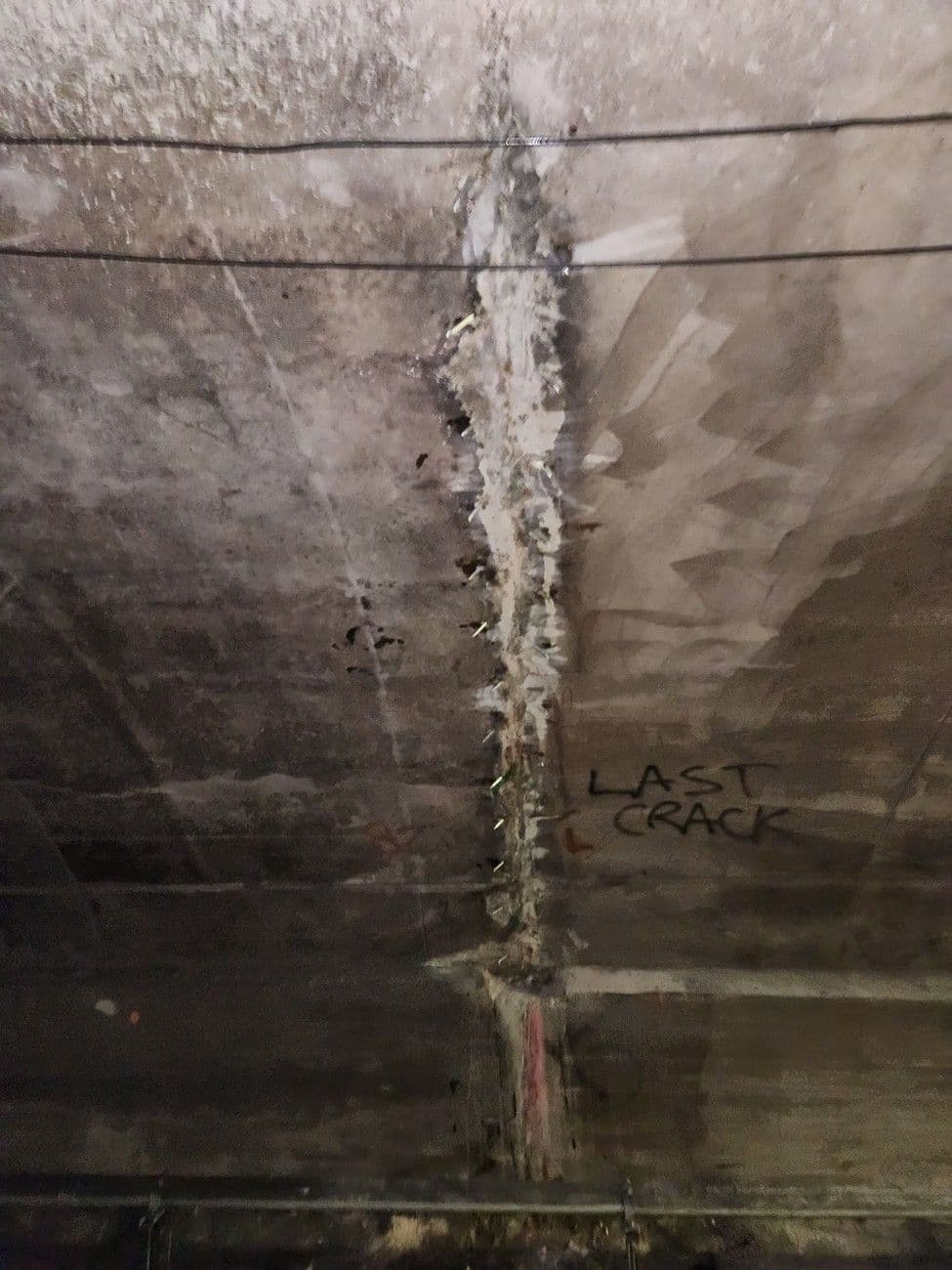
Treated crack after injection: cured polyurethane resin visible along the sealed joint, with the "LAST CRACK" marking confirming the mapped treatment boundary
Short work windows demand front-loaded planning. Systematic leak mapping, reinforcement scanning, and a pre-defined injection geometry allowed URETEK to maximize productive time during both closure shifts. In tunnel work, the hours you spend planning before the closure are worth more than the hours you have inside it.
The material must match the mechanism. A water-activated, expanding polyurethane resin turns the problem, active water, into the catalyst for the repair. Selecting a material that works with site conditions rather than fighting them is what makes injection-based repair viable in environments where dry-application methods cannot perform.
Verification is not optional. It should be scheduled. Building a dedicated verification shift into the project plan acknowledges the reality that sealing one leak path can redirect water to another. Proactive verification and touch-up during the closure window is dramatically less disruptive and less expensive than a callback after the tunnel has returned to service.
Documentation is a deliverable, not paperwork. For infrastructure owners subject to inspection standards and long-term maintenance programs, the injection logs, QA/QC records, and closeout reports URETEK provides are as valuable as the physical repair itself. They create a defensible record that supports future decision-making for years after the work is complete.
If you are managing a tunnel, culvert, underground utility vault, or any below-grade concrete structure experiencing water ingress at cracks, joints, or penetrations, and you need the work done within tight closure windows, with full reinforcement protection, and with documentation that satisfies inspection and maintenance requirements, URETEK has the methodology and the track record to deliver. We will assess your leak conditions, develop an injection plan that fits your access and schedule constraints, and execute a verified repair that holds up under the conditions your structure actually faces.

 800-240-7868


