

Location
New York, New York
Structure Type
Active vehicular tunnel beneath a major waterway
Triggering Event
Third-party investigative drilling unintentionally penetrated the tunnel lining, creating a direct inflow path for river water into an active tube
Work Window
Two consecutive overnight shutdown shifts: tunnel had to reopen for full operations each morning
Key Constraints
Confined-space conditions, strict traffic and safety controls, no exterior access permitted, and zero tolerance for operational disruption beyond the closure window
URETEK Scope
Interior-only emergency injection program: breach sealing, localized cutoff zone creation, and targeted treatment of connected cracking and migration pathways
Result
Inflow stopped by the end of the second shift, tunnel reopened on schedule each morning, and a documented QA/QC package delivered for engineering closeout and future asset management
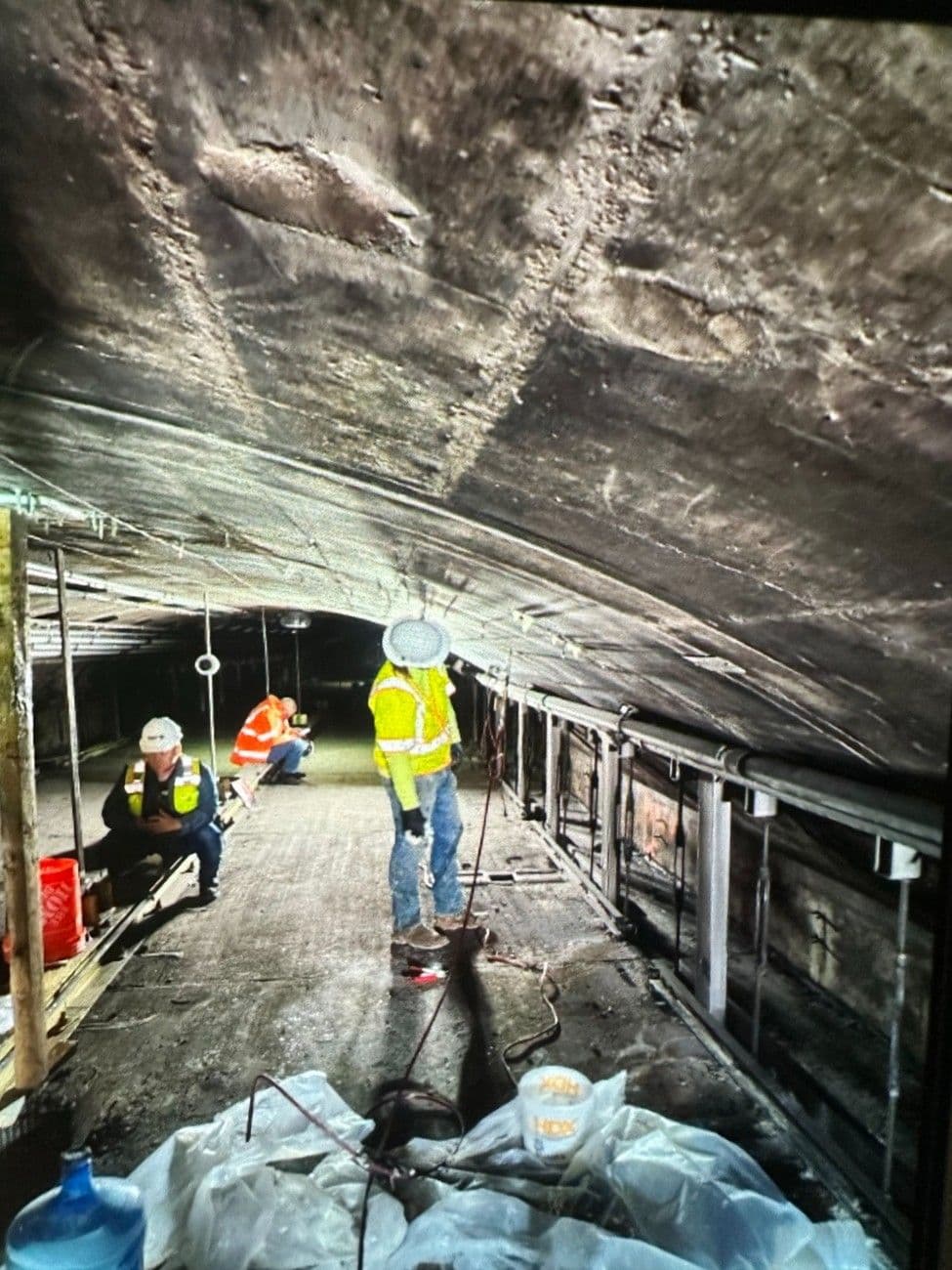
The interior of the vehicular tunnel during overnight operations: the curved crown and confined corridor define the working environment, with the crew coordinating between active injection zones and staging areas
In September 2024, a third-party investigative drilling operation made a critical mistake: the drill penetrated the tunnel lining of a major vehicular tunnel beneath a New York City waterway, creating a direct pathway for river water to enter an active tube. This was not a gradual seepage condition or a slow-developing maintenance issue. It was an immediate, active inflow from one of the largest water sources imaginable, entering through a focused breach in a structure that needed to carry traffic the next morning.
For engineers and tunnel operators, the severity of this scenario is self-evident: an uncontrolled water entry point connected to a virtually unlimited hydrostatic source, in a confined underground structure, with a hard reopening deadline measured in hours. Every minute the breach remained open increased the risk to the tunnel lining, the surrounding ground, the operational systems within the tube, and the safety of anyone working inside.
The constraints on the repair were as extreme as the problem. The work zone offered limited physical access and required full confined-space protocols. The overnight shutdown window was non-negotiable: the tunnel had to be returned to service each morning. Exterior access was completely off the table: no riverbed disturbance, no outside excavation, no external staging. And whatever solution was deployed had to leave the area stable and ready for longer-term follow-on work by the broader project team.
This was, in every sense, a situation where the wrong approach, or a slow one, could turn a serious problem into a catastrophic one.
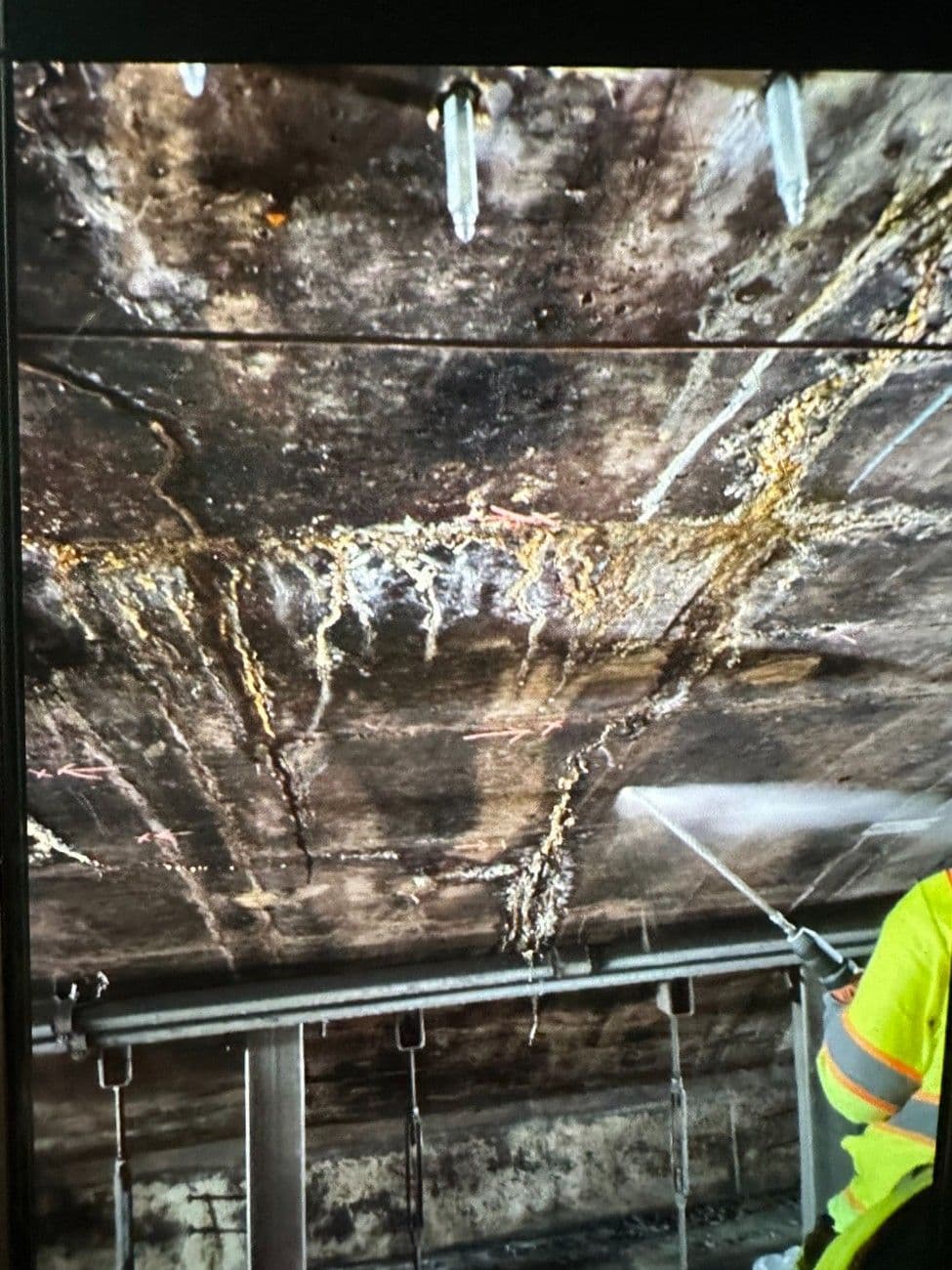
Active water inflow at the tunnel crown: the crack network radiating from the breach point, with weeping and staining visible across multiple lining panels, illustrates the immediate threat to the structure and the urgency that drove the emergency response
URETEK mobilized rapidly and executed a two-shift emergency injection program across two consecutive night closures, working within the prime contractor's operations and coordinating with the broader project team to restore safe, normal operations each morning.
The injection plan was designed to accomplish three objectives in sequence: seal the breach itself to stop the active inflow, create a localized cutoff and reinforcement zone around the penetration to prevent the water from finding alternative pathways, and treat connected cracking and migration pathways identified during the night-shift access periods.
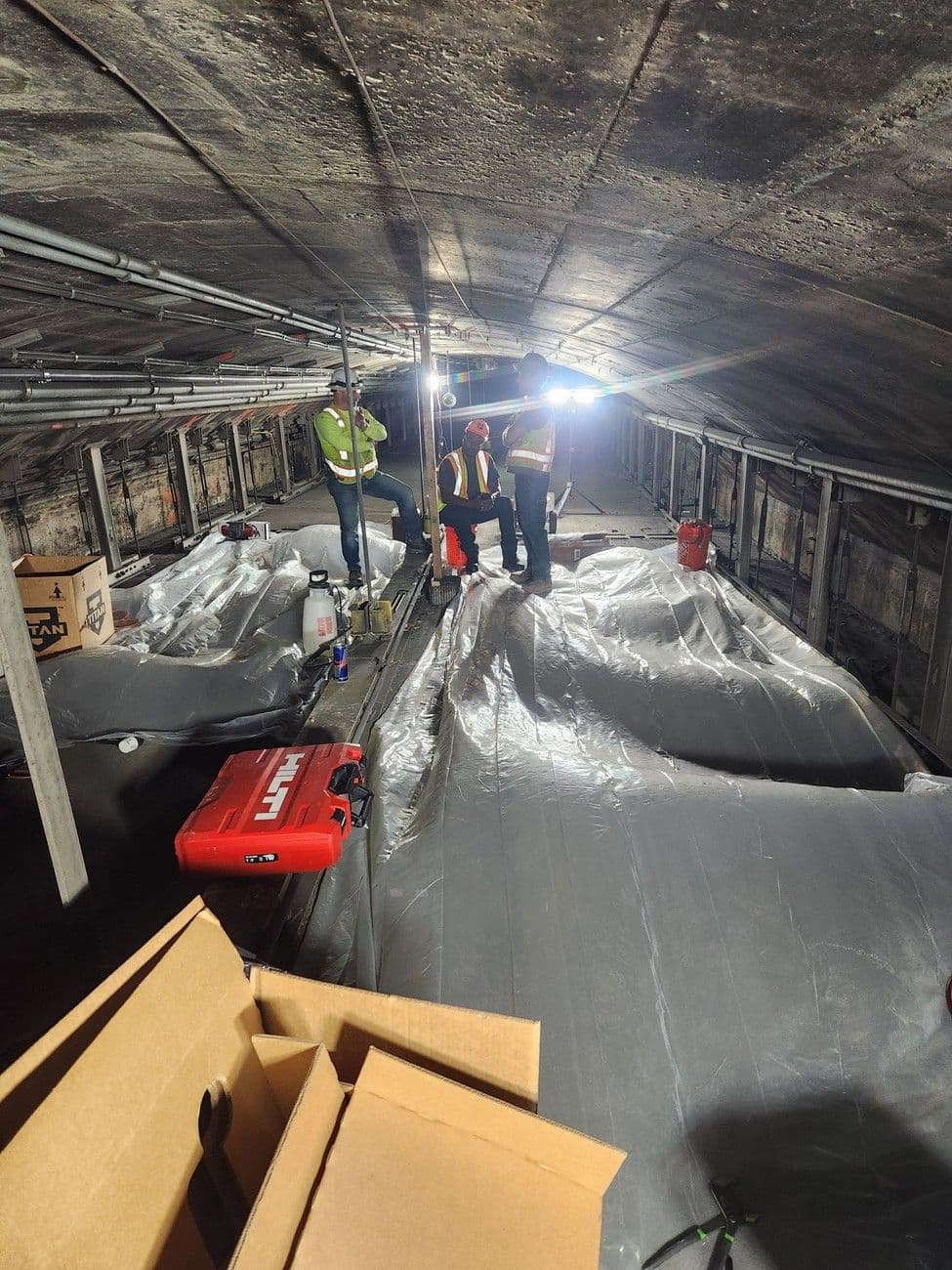
The tunnel interior staged for overnight operations: protective sheeting covers the invert and adjacent work zones, materials are positioned within reach of the injection area, and portable lighting extends the crew's working range into the tunnel corridor
The field program was structured as a fast, staged operation, designed for speed but governed by discipline. In an emergency response inside a live tunnel, the temptation to "just pump it full of grout" can be strong. URETEK's approach was the opposite: controlled, documented, and built around verifiable steps at every stage.
Small-diameter injection points (5/8-inch drill holes) were used throughout, with intentional drilling orientation, including angled probe holes, to intercept and confirm the target zone before injection. Drilling returns and cuttings were logged as part of the real-time assessment that guided each subsequent step.
Where the breach required an immediate cutoff, URETEK employed an all-around hole pattern designed to create a permeation zone encircling the penetration. The injection layout used a two-row, staggered configuration to ensure overlap and continuity, the same curtain-building principle used in URETEK's planned grouting programs, applied here under emergency conditions.
Where wet cracking radiated outward from the breach, the team executed stitch grouting patterns at six-inch spacing to shut down the migration pathways before they could develop into secondary leak points.
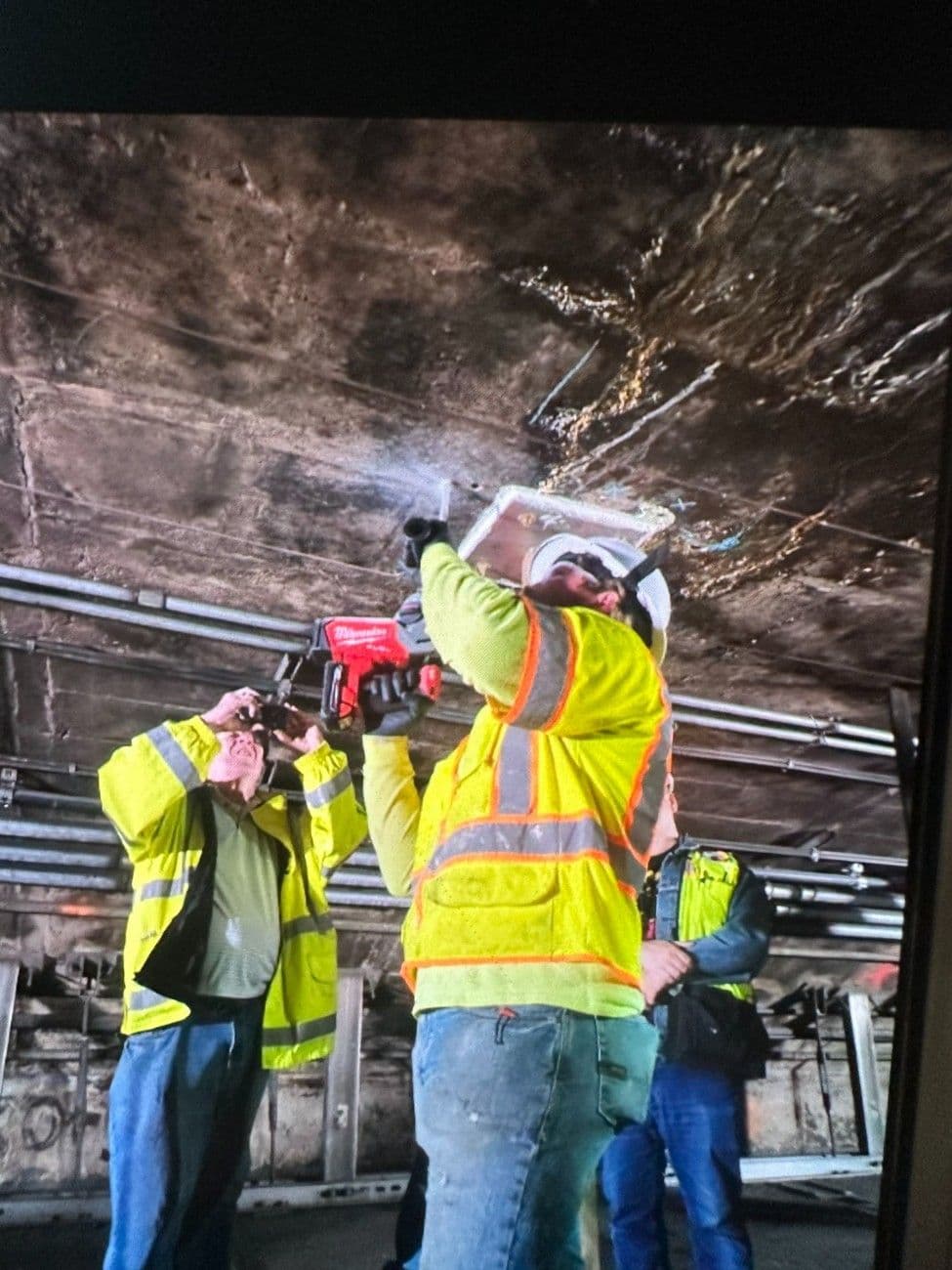
URETEK crew drilling 5/8-inch injection holes into the tunnel crown: the angled orientation of the drill is intentional, positioning probe holes to intercept the breach zone and confirm the target before injection begins
Injection termination criteria were built into the procedure from the start: a 15 psi maximum pressure increase or refusal, whichever came first. This is a critical detail for engineers reviewing the work. In a sensitive tunnel environment, especially one with a compromised lining, uncontrolled injection pressure can cause as much damage as the water it is meant to stop. URETEK's stop criteria ensured that every injection was governed by the structure's response, not by a volume target.
All work was performed entirely from inside the tunnel tube. No exterior disturbance of any kind was required.
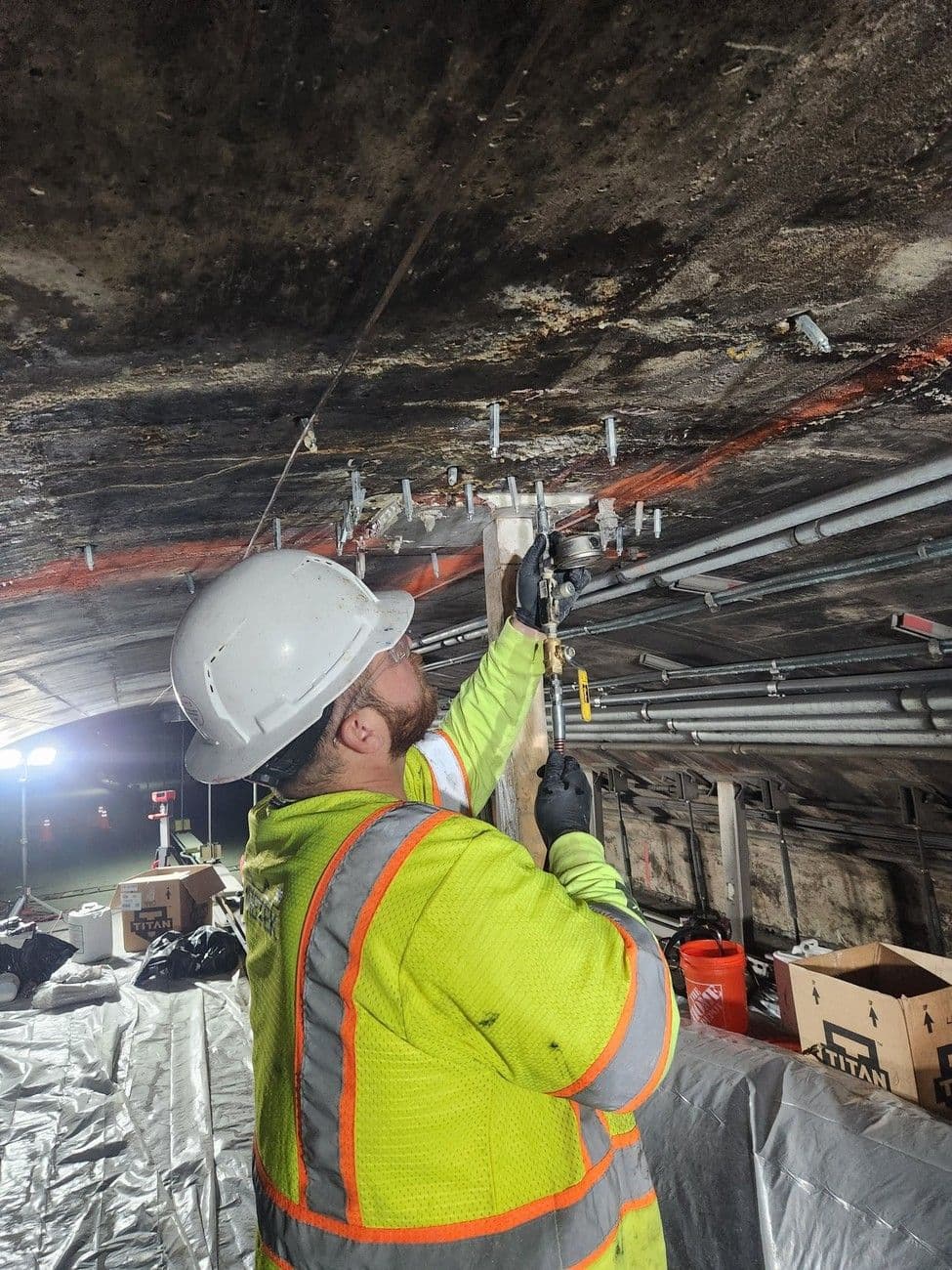
URETEK technician injecting into an overhead port at the breach zone: the injection gun, fitted with a pressure gauge visible at the nozzle, allows the crew to monitor resistance in real time and terminate at the 15 psi threshold that protects the compromised lining
URETEK selected a low-viscosity, water-reactive hydrophobic polyurethane grout system for this emergency application, a material specifically designed for crack repair and water cutoff in tunnel and infrastructure environments.

Water-reactive expansion. The resin reacts on contact with moisture to form an expanded closed-cell polyurethane foam that creates a physical barrier to water movement. Under the conditions encountered in this project, an active breach connected to a major water source, this reactivity is the mechanism that makes the repair possible. The material does not need the crack to be dry to work; it uses the water that is present as part of the curing process.
Volume expansion for irregular pathways. The material is capable of expanding up to approximately 25 times its initial volume, allowing it to fill voids, irregular fracture geometries, and connected leak paths that would be impossible to reach or seal with rigid, non-reactive materials injected from the interior. In a breach scenario where the geometry of the damage is unknown and likely irregular, this expansion behavior is what allows a repair installed from the inside to create a seal against water pressure coming from the outside.
Controllable reaction speed. An accelerator component allows experienced crews to adjust the reaction profile based on field conditions, with expansion initiating within tens of seconds and completing within minutes. This "fast but manageable" behavior is essential in emergency work: the material must set quickly enough to hold against active water flow, but not so fast that it gels in the injection line before reaching the target zone. URETEK's crews tuned the reaction in real time to match conditions at each injection point.
Long-term stability. The cured foam is hydrophobic, meaning it maintains its physical form without shrinkage through wet-dry cycles, an important durability characteristic in a tunnel environment subject to tidal variation and changing hydraulic conditions over time.
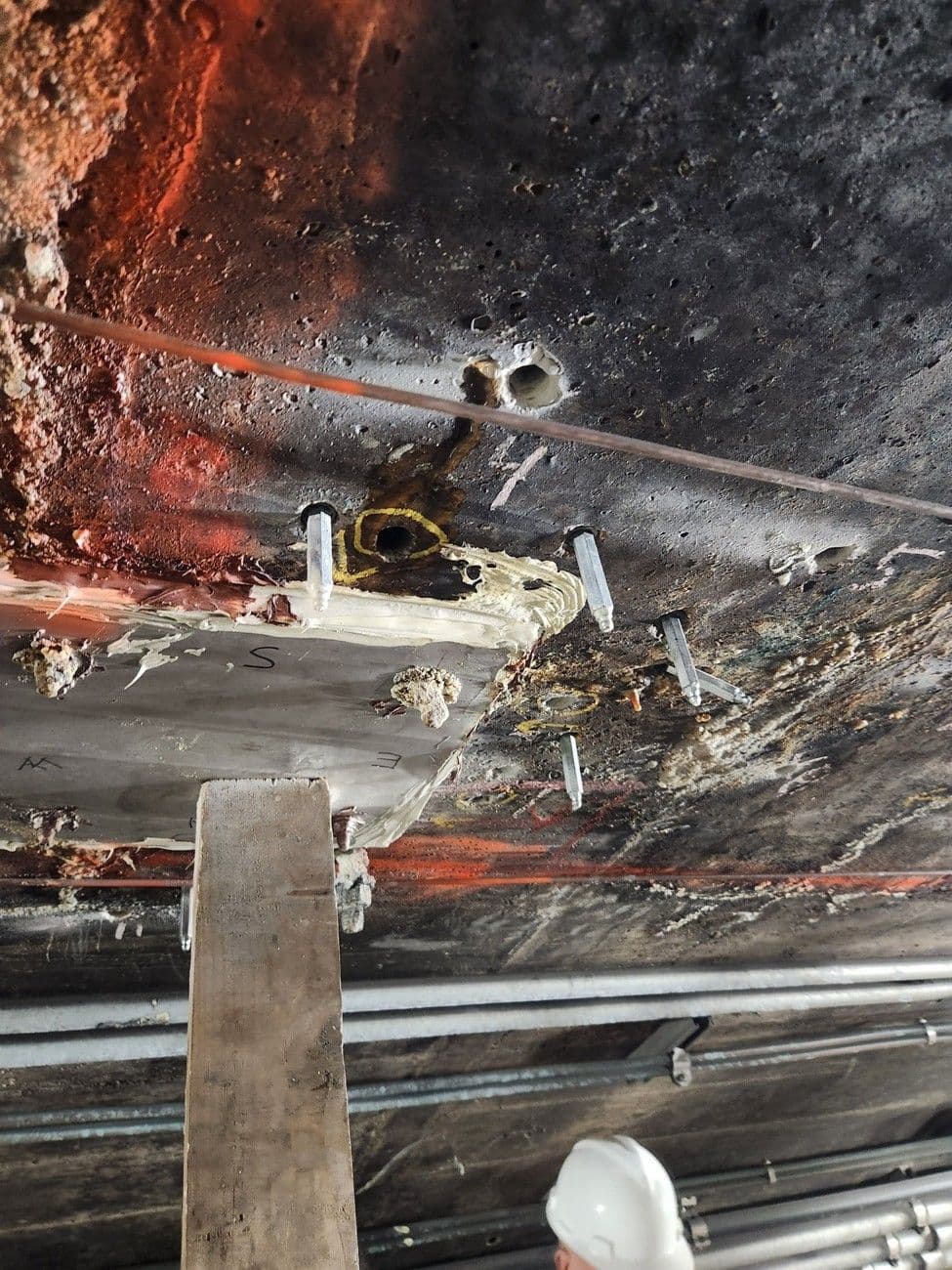
Injection ports installed across a crack network at the tunnel crown: the stitch pattern at closely spaced intervals is designed to intercept migration pathways before they can develop into secondary leak points, with cured material visible at the earliest-treated locations
Emergency repairs in tunnel environments carry inherent safety risks that must be managed with the same rigor as the injection work itself. Polyurethane reactions are exothermic, and the material requires PPE and ventilation management that are especially important when working in confined spaces under emergency conditions.
URETEK's team operated under a site-specific safety plan with full confined-space protocols, ventilation management, appropriate PPE, and coordination with the tunnel operator's safety requirements. The fact that this was an emergency did not reduce the safety standard. It raised it. Fast work in a confined, high-stakes environment demands more discipline, not less.
By the end of the second night shift, the inflow was stopped. The tunnel reopened for normal operations each morning with no overrun of the planned closure windows. The breach area was left stable and ready for longer-term follow-on work by the broader project team.
Active inflow eliminated. Active river water inflow eliminated within the two- shift access window, with the tunnel returned to normal operations on schedule each morning.
Cutoff zone established. A localized cutoff zone was established around the breach, preventing secondary leak development through connected cracking and migration pathways.
Zero safety incidents. Zero safety incidents or operational setbacks across both overnight shifts, with confined-space protocols, ventilation, and PPE maintained throughout.
Complete QA/QC package delivered. A complete QA/QC package was delivered documenting injection locations, materials, pressure parameters, and observations, converting an emergency response into an auditable repair record for future asset management. That last point deserves emphasis. In emergency work, it is common for the documentation to be an afterthought, or to not exist at all. URETEK's closeout package gave the owner and engineering team a defensible record of exactly what was done, where, and under what conditions. For a critical-infrastructure asset, that record has value far beyond the immediate repair.
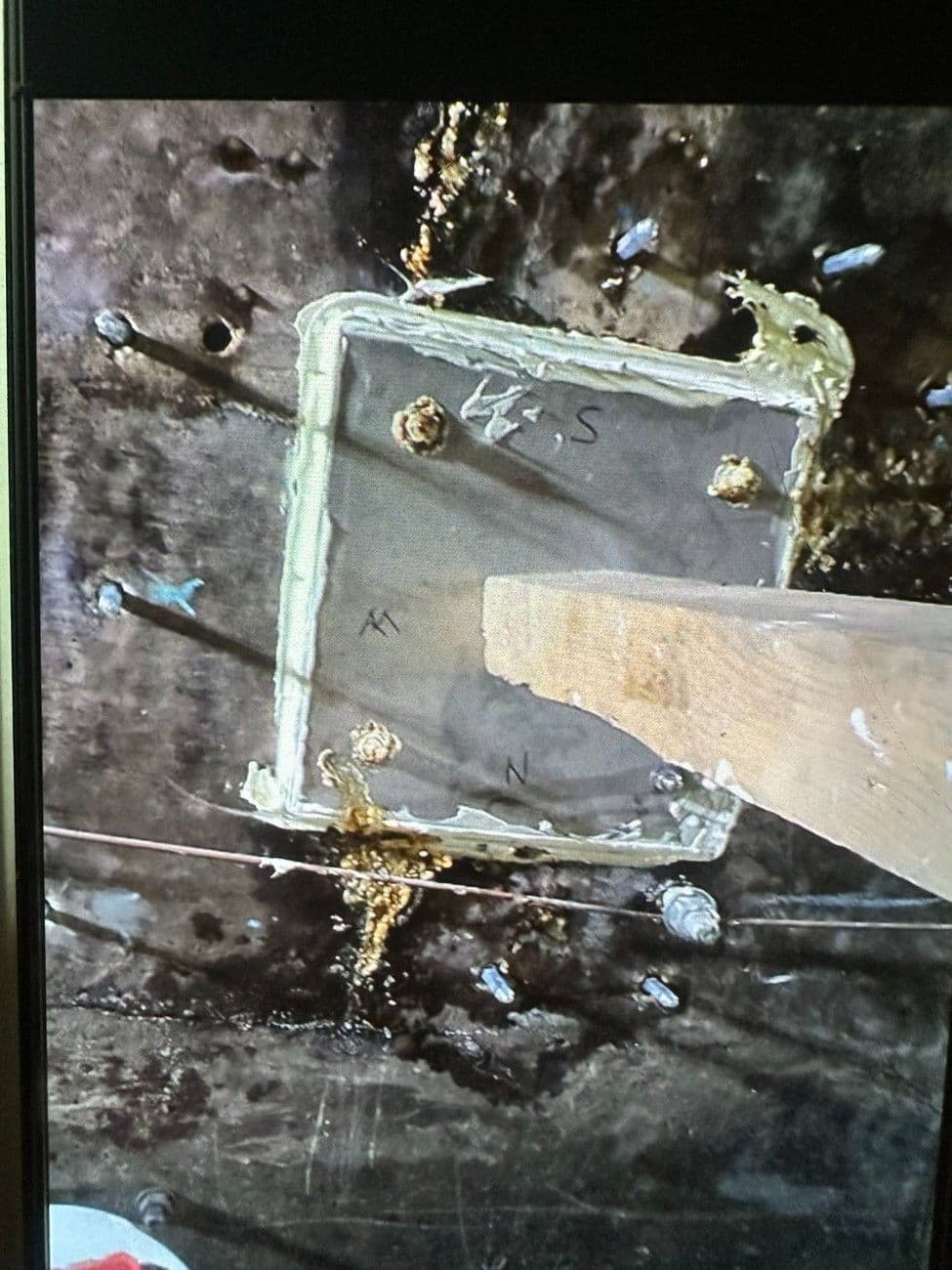
Completed repair at the breach location: the cured polyurethane material, visible at the perimeter and injection ports of the treated zone, has sealed the lining penetration and surrounding crack network; the adjacent tunnel surface remains accessible for follow-on work by the broader project team
Emergency does not mean uncontrolled. A staged injection plan with defined pressure limits, documented drilling returns, and verifiable steps at each location delivered a better outcome in two overnight shifts than an unstructured approach could have achieved in a week. Discipline under pressure is what separates a successful emergency repair from one that creates new problems.
Interior-only access can solve exterior problems. When a breach connects a tunnel to a major water source and exterior access is impossible, a properly designed injection program can create a cutoff zone and stop active inflow entirely from the inside. This case proves that interior injection is not a compromise. It is a proven, primary repair methodology for exactly this type of failure.
The material must work with the water, not against it. A water-reactive, expanding polyurethane resin turns the presence of active inflow, the very condition that makes the repair urgent, into the mechanism that activates the seal. Choosing a material that requires dry conditions in a situation where dry conditions do not exist is a plan for failure.
Documentation converts an emergency into an asset record. The QA/QC package URETEK delivered gave the owner and engineering team a complete, auditable record of the repair, not just a verbal assurance that "the leak stopped." For infrastructure subject to ongoing inspection and maintenance programs, that documentation is as valuable as the repair itself.
If you are dealing with an active water inflow in a tunnel, culvert, underground vault, or any below-grade concrete structure, especially under emergency conditions with limited access windows, confined-space constraints, and no option for exterior work, URETEK has the experience, the methodology, and the rapid-mobilization capability to respond.
We will assess the inflow condition, develop a staged injection plan with clear pressure and termination criteria, execute the work safely within your closure window, and deliver a documented repair record that supports your long-term asset management program. Contact us immediately if you have an active situation, or reach out to discuss preparedness planning for your critical infrastructure.

 800-240-7868


