

Location
Altamonte Springs, Florida
Structure Type
Subterranean parking garage beneath a multi-use commercial building
Triggering Event
Hurricane Ian (2022): catastrophic flooding and sustained groundwater migration
Core Challenges
Sub-slab voiding, footing undermining, active groundwater seepage, and zero tolerance for exterior excavation
URETEK Scope
Soil densification and void filling beneath footings, plus installation of a chemical grout curtain to intercept subsurface water pathways
Result
Bearing support restored, groundwater migration interrupted, and full building operations maintained throughout the work
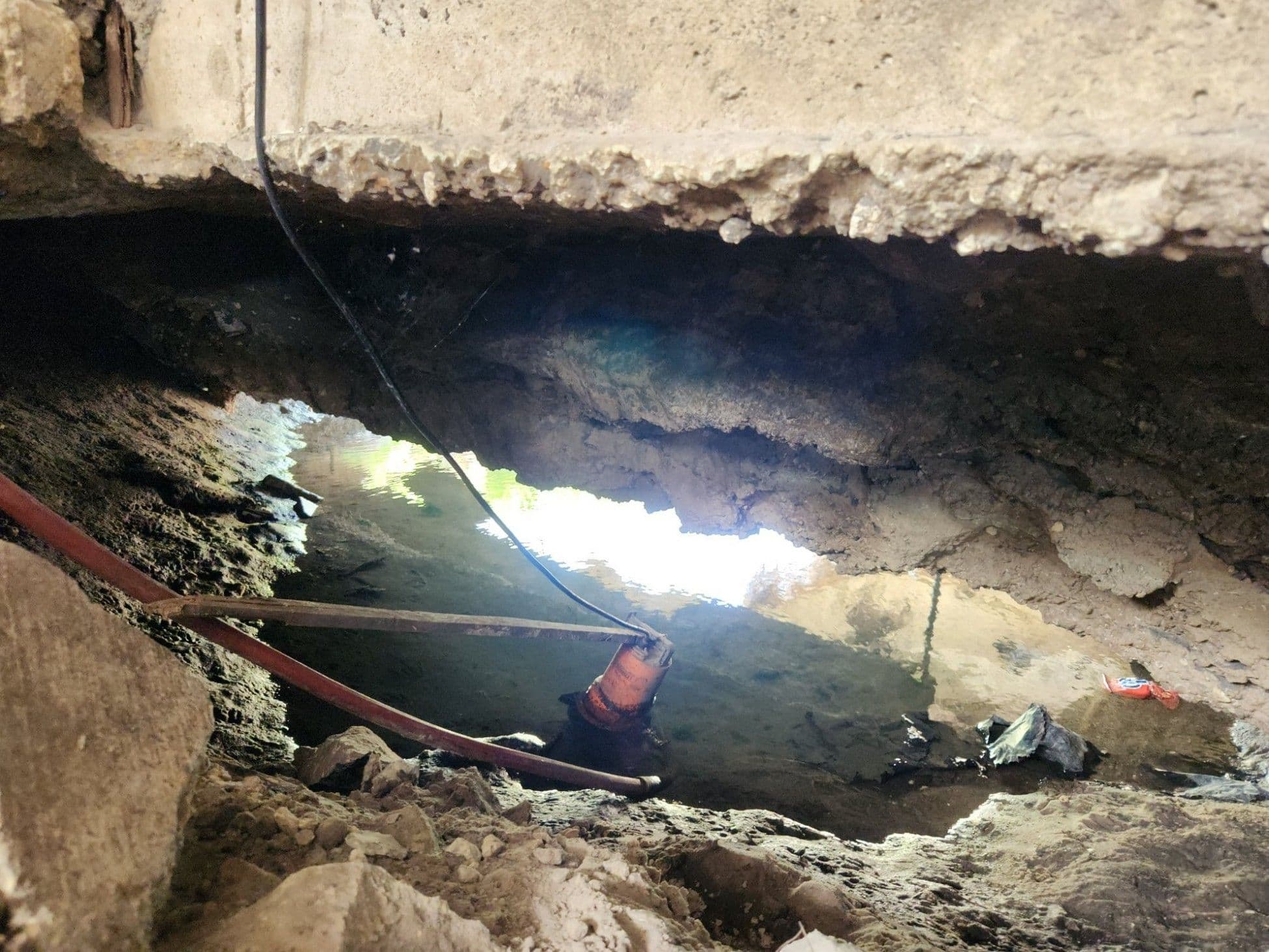
Exposed column footing revealing significant soil loss and undermining beneath the parking structure
When Hurricane Ian swept through Central Florida in 2022, the immediate damage was visible, but the subsurface damage was far more consequential. Floodwaters infiltrated the ground surrounding a subterranean parking structure at a commercial business center, washing away fine-grained soils from beneath both perimeter walls and interior footings. The result was a combination of voids, loss of bearing contact, and degraded soil conditions beneath a structure that was still very much in daily use.
What made this situation particularly challenging was that the flooding event was only the beginning. A nearby retention feature continued to drive groundwater toward the structure long after the storm had passed. Water was actively migrating through subsurface pathways, carrying additional soil particles with it and progressively worsening the undermining beneath the garage.
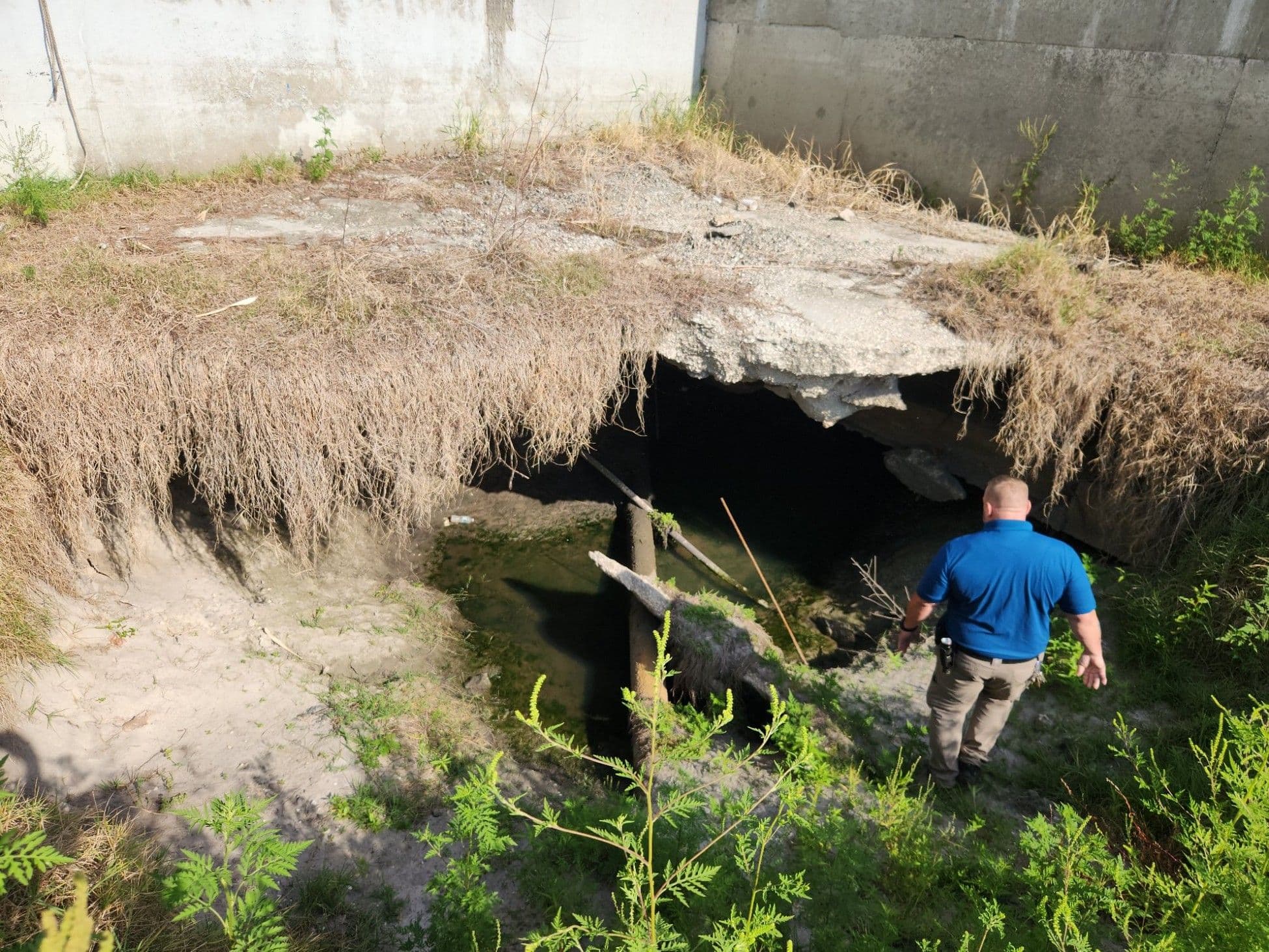
Exterior perimeter undermining with active standing water: visible soil loss and voiding beneath the structure caused by ongoing groundwater migration
This is a critical point that engineers and facility managers should understand: flood damage to below-grade structures is rarely a one-time event. If the water source or migration pathway is not addressed, what starts as localized voiding can evolve into an ongoing, progressive loss of structural support. Patching surface leaks or sealing visible cracks treats the symptom, not the cause.
In many soil stabilization scenarios, the conventional approach involves exterior excavation: digging down to the affected zone, removing compromised material, and replacing it with engineered fill. For this project, that approach was essentially off the table.
The parking structure was fully below grade, surrounded by other site improvements, utilities, and limited access corridors. Excavation would have required significant disruption to adjacent areas and risked further destabilizing soils that were already undermined. Equally important, the building needed to remain operational. An extended shutdown was not acceptable to the ownership.
The repair strategy had to satisfy three simultaneous demands: restore structural bearing support beneath the footings, reduce or eliminate the active groundwater seepage entering the garage, and accomplish both objectives from inside the building footprint with minimal disruption to ongoing operations. This combination of constraints is exactly the type of scenario where injection-based ground improvement becomes the most practical, and often the only viable, path forward.
URETEK designed and executed a two-phase repair program that addressed both the structural deficiency and the hydrogeologic driver simultaneously. This dual-system methodology is a hallmark of URETEK's approach to complex below-grade projects, treating symptoms and root causes together rather than in isolation.
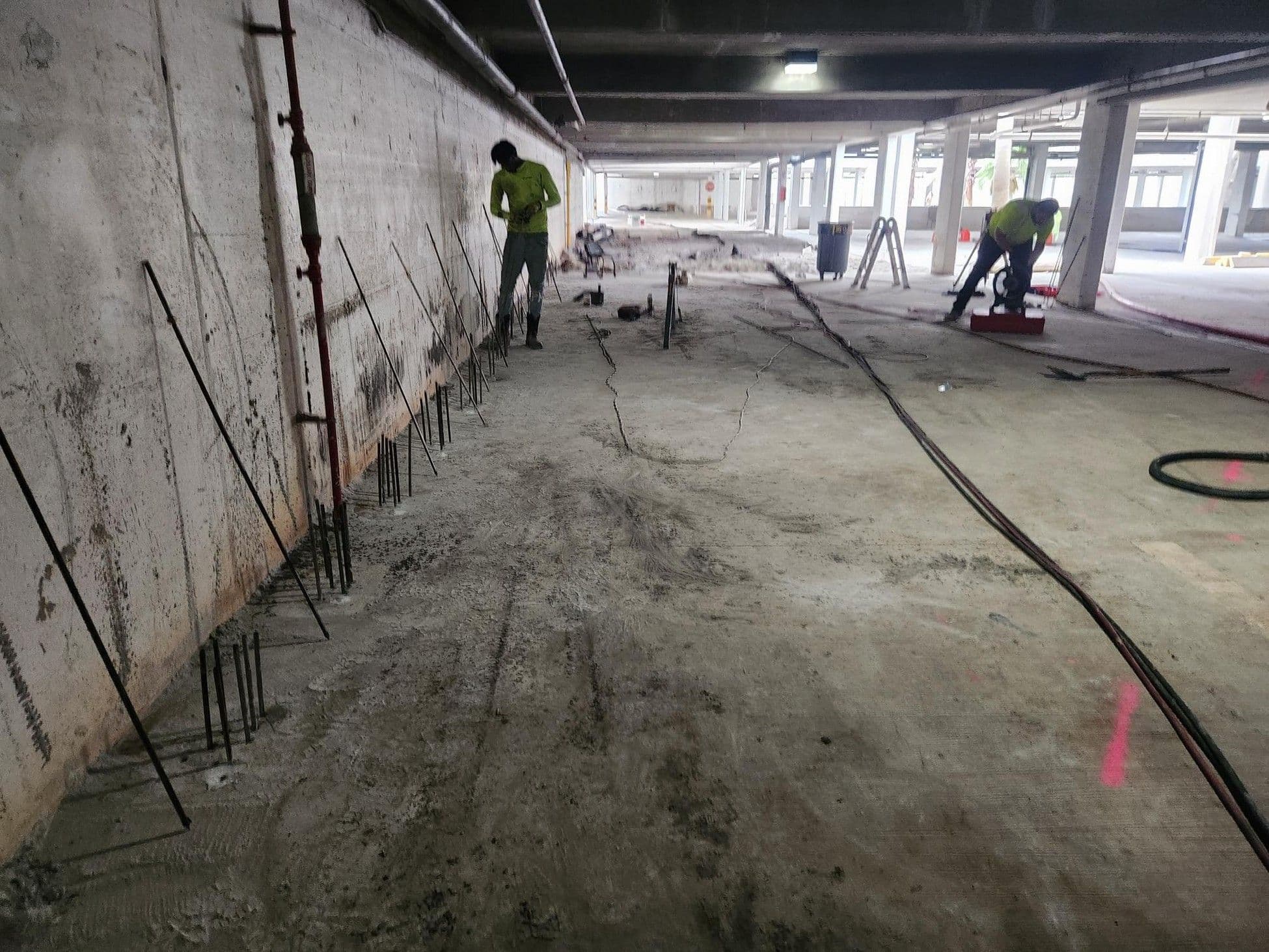
The first priority was re-establishing contact and support beneath affected perimeter and interior footings. URETEK performed precision injection through small-diameter ports drilled from within the parking structure. The proprietary expanding polymer material was injected at controlled pressures to fill voids, densify loosened soils, and restore load-bearing contact with the foundation elements above.
Injection probes installed around column footings for targeted soil densification and void filling
This process works by displacing air and water from void spaces while simultaneously compacting surrounding soils into tighter configurations. The material expands to fill irregular geometries that would be impossible to reach with conventional excavation and backfill, traveling into the exact spaces where support had been lost. All injection points, pressures, and volumes were monitored in real time to ensure precise, controlled delivery without overloading or displacing adjacent structural elements.
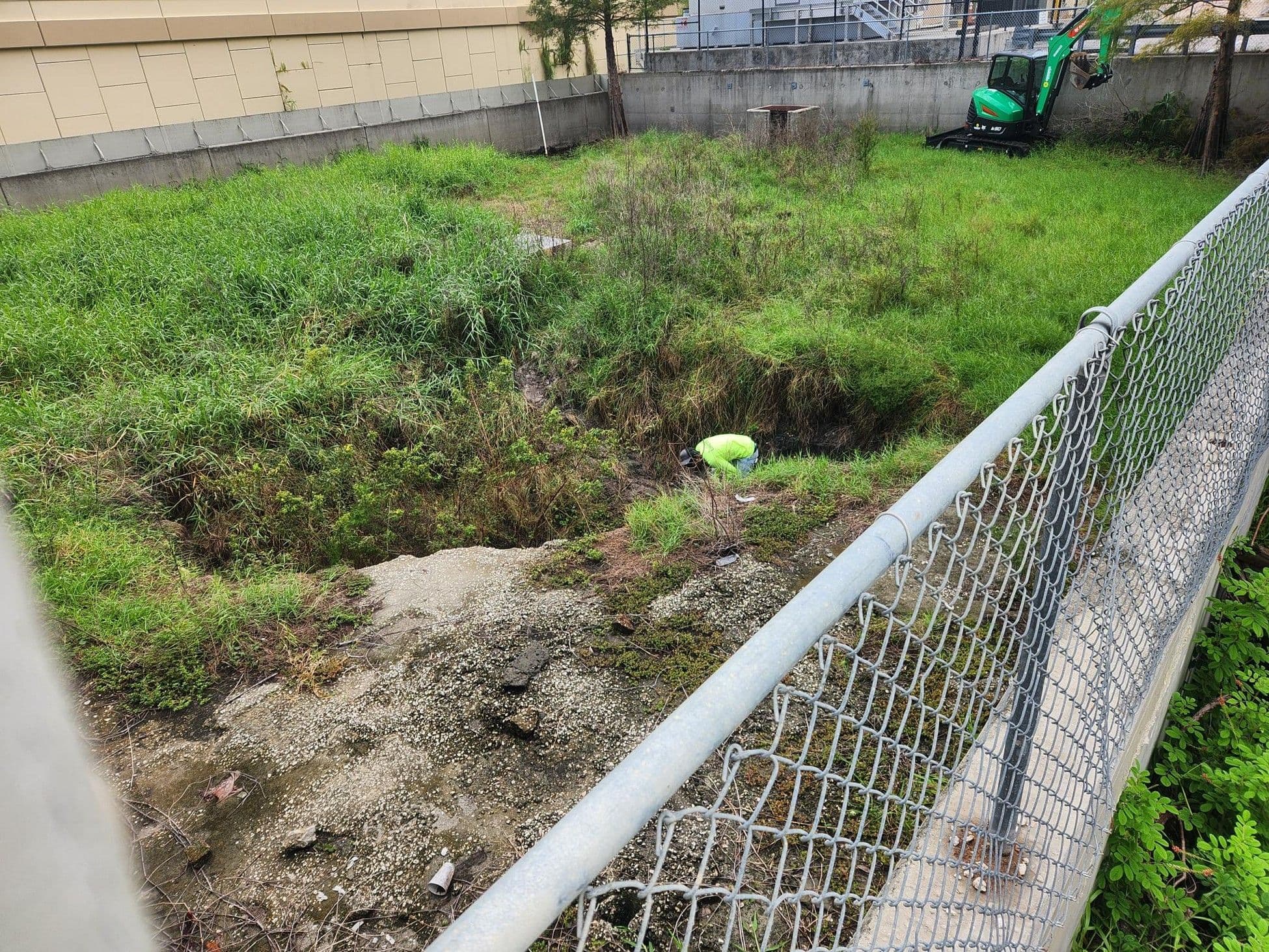
With bearing support restored, the second phase focused on stopping the ongoing groundwater migration that had been perpetuating the problem. URETEK installed a localized chemical grout curtain along the affected perimeter of the structure, creating a subsurface barrier to intercept water pathways before they could reach the building envelope.
URETEK crew performing chemical grout curtain injection along the perimeter wall of the parking structure
For this application, URETEK selected a hydrophilic acrylate resin system, a class of material specifically engineered for seepage control in saturated soils. This type of grout offers an exceptionally low viscosity, allowing it to permeate into fine soil pore spaces and hairline pathways that higher-viscosity materials cannot reach. The gel time is field-adjustable from seconds to minutes, giving the crew precise control over how far the material travels before setting.
Once activated, the material forms a flexible, crosslinked gel that conforms to the geometry of the soil matrix it occupies. The resulting barrier is non-toxic, non- flammable, and acrylamide-free, important attributes for work in occupied below- grade environments. The gel also exhibits reversible volume behavior in wet-dry cycles, meaning it swells in the presence of water and contracts as conditions dry, maintaining its sealing effectiveness over time.
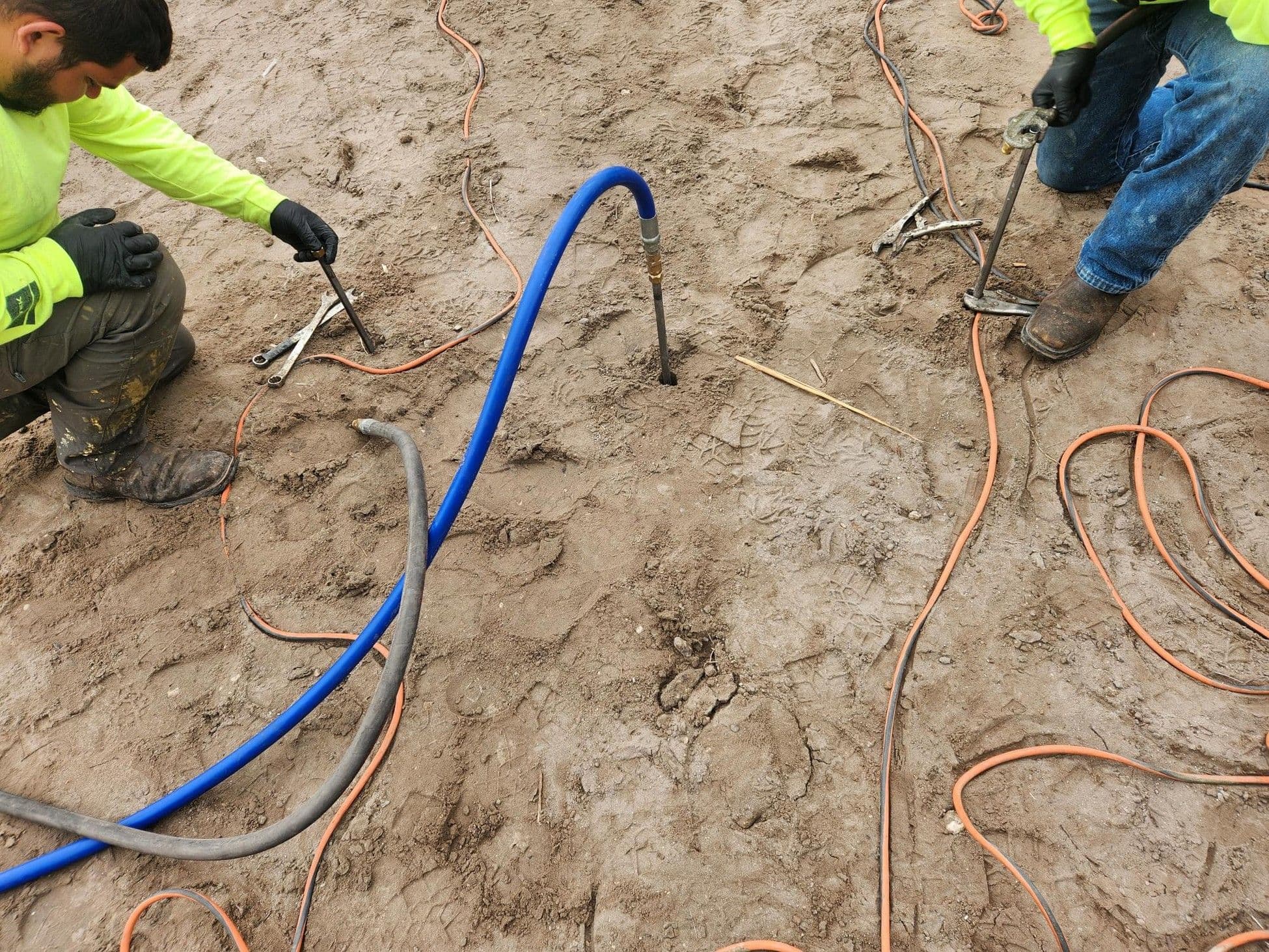
Overhead view showing the two-row curtain grouting probe pattern installed along the exterior perimeter wall
The practical takeaway for engineers and property owners is straightforward: URETEK created a continuous groundwater interruption zone from inside the structure, with no exterior trenching, no dewatering systems, and no extended shutdowns required.
Successful grouting is defined not just by the materials used, but by the controls applied during installation. Industry best practices emphasize defined objectives, active real-time monitoring, and thorough documentation, because subsurface injection can produce unintended consequences if pressures, volumes, and rates are not carefully managed.

Grout QC. Pre-injection batch testing of all grout materials confirmed performance specifications before any material entered the ground.
Movement monitoring. Continuous monitoring of structural elements during injection ensured that injection pressures remained within design limits and that no unintended displacement occurred.
Injection documentation. Detailed injection logs recorded pressures, volumes, and gel times at each port, creating a complete, verifiable record of every injection event.
Performance verification. Post-injection verification at targeted locations confirmed that the treatment achieved its intended objectives before the crew demobilized. Safety protocols were equally rigorous. The project operated under a site-specific safety plan that included ventilation and odor management consistent with material safety data sheet requirements, spill prevention and waste segregation procedures, utility and penetration permitting for all drill points, and daily job hazard analyses tailored to evolving site conditions. URETEK approaches every project with the understanding that working in occupied, below-grade spaces demands the same discipline as any confined-space or critical-infrastructure operation.
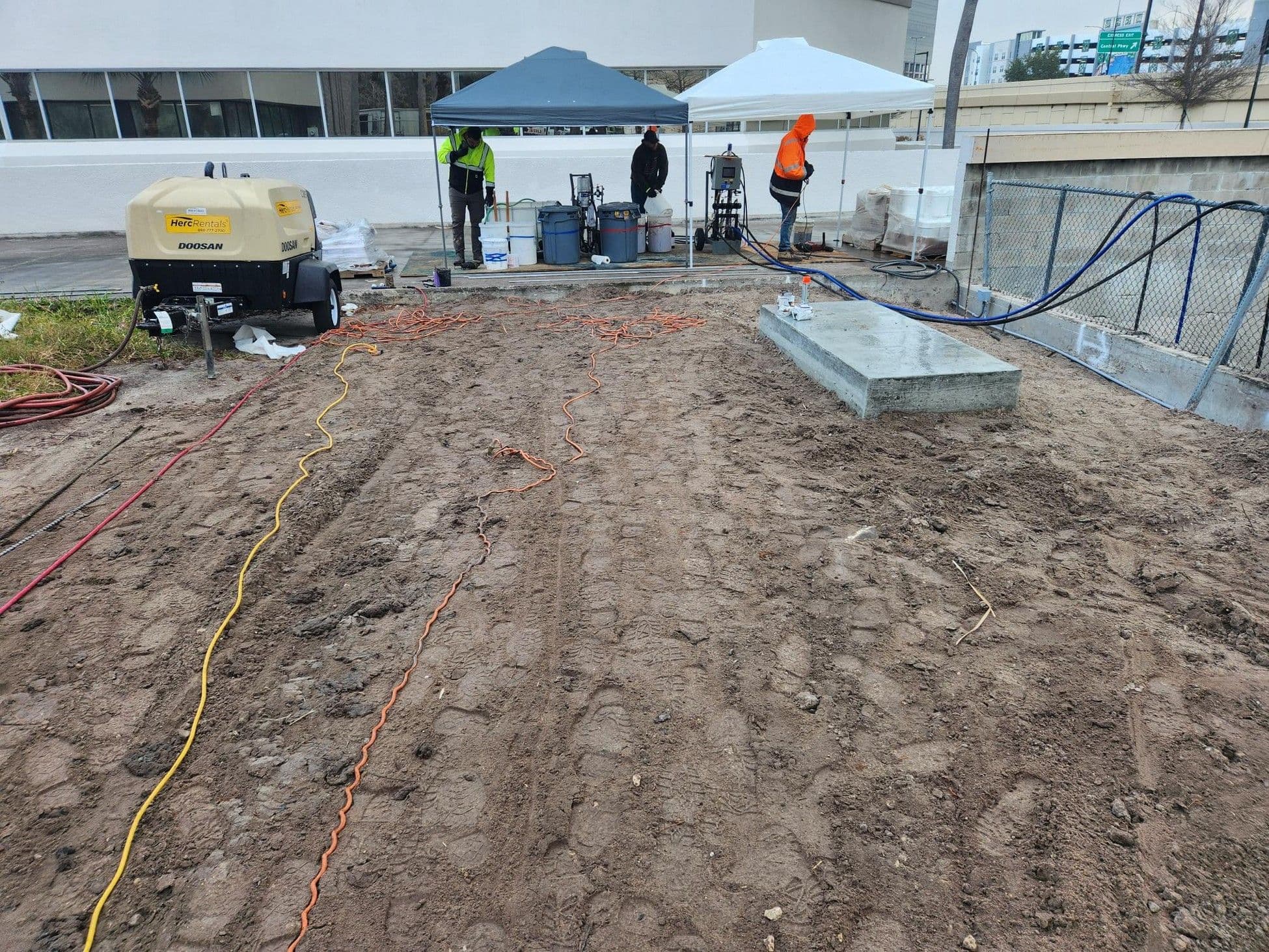
URETEK mobilized on site: the full scope was executed with a compact equipment footprint and no disruption to building operations
The combined approach delivered measurable improvements across every project objective.
Bearing support restored. Bearing support was fully restored at all treated footing locations, re-establishing the structural contact that Hurricane Ian had eroded.
Groundwater migration interrupted. A continuous groundwater interruption zone was established along the affected perimeter, stopping the active migration that had been perpetuating the problem.
Performance confirmed. Post-injection observations confirmed improved structural stability and significantly reduced seepage at all targeted areas.
No disruption to operations. The building remained fully operational throughout the entire scope of work, and no exterior excavation was required at any point.
Coordinated with broader repair program. The work was phased to coordinate with the owner's broader foundation retrofit schedule, demonstrating URETEK's ability to integrate with other trades and project timelines.
Address the root cause, not just the symptoms. Pairing rapid soil densification with a hydrophilic chemical grout curtain allowed URETEK to solve both the structural problem, loss of bearing support, and the hydrogeologic driver, ongoing groundwater migration, in a single mobilization. Treating one without the other would have left the facility vulnerable to recurring issues.
Precision matters in confined environments. Controlling the chemical grout's gel window and monitoring injection pressures in real time allowed URETEK to capture near-face water pathways with accuracy, particularly important when working from the interior with no ability to chase leaks from the outside.
Interior-access solutions protect operations and budgets. By executing the entire scope from within the building footprint, URETEK eliminated the cost, risk, and disruption associated with exterior excavation, keeping the facility in service and the project timeline on track.
If you are managing a below-grade structure dealing with any combination of post- flood settlement, active groundwater seepage, suspected sub-slab voiding, undermined perimeter elements, or limited access that rules out conventional excavation, URETEK has a proven track record of delivering results in exactly these conditions. We will evaluate your situation, explain your options, and, if injection-based repair is the right fit, design a solution tailored to your structure, your constraints, and your timeline.

 800-240-7868


