

Location
Bronx, New York
Structure Type
Coastal service building supporting a major metropolitan bridge: houses utilities and operational systems critical during storm surge and high-tide events
Project Context
Broader resiliency and power-redundancy upgrade requiring a continuous flood-exclusion envelope around the facility
Core Challenge
Unavoidable discontinuities in the floodwall system, utility penetrations and intentional gaps at sheet-pile transitions, that created preferential seepage paths under rising water levels
URETEK Scope
Localized permeation grout curtains installed at targeted openings and transitions using low-viscosity acrylate chemical grouting
Result
Treated gaps and transitions remained dry through tidal cycles, achieving a stable seal compatible with the facility's long-term flood-mitigation strategy, with no excavation and no disruption to ongoing operations
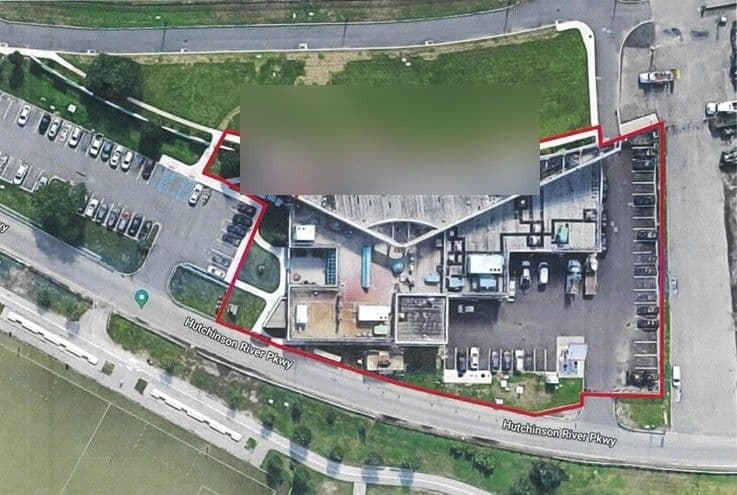
Aerial view of the coastal service facility: the flood-exclusion envelope had to account for every penetration and transition in the perimeter floodwall system
A coastal service building in the Bronx, one that supports critical utility and operational systems for a major metropolitan bridge, was undergoing a significant resiliency upgrade. The goal was to ensure the facility could remain fully functional during storm surge and high-tide events, which meant establishing a continuous flood- exclusion envelope around the entire site.
The floodwall system itself was robust. But floodwalls, by their nature, are not monolithic. They include penetrations for utilities, construction joints where materials change, and intentional gaps at sheet-pile transitions. Every one of these discontinuities is a potential seepage path, and under tidal or storm-driven hydraulic head, even a small gap can allow enough water through to compromise the systems the barrier was built to protect.
This is a reality that engineers working on flood-exclusion infrastructure understand well: the barrier is only as effective as its interfaces. You can build a flawless wall, but if water can find its way around a utility penetration or through the soil at a sheet-pile transition, the wall has not done its job. Mechanical seals alone are difficult to rely on at these locations because subsurface soil conditions can vary substantially over short distances, access is often constrained, and the actual flow paths under head may not follow the routes you expect.
The facility owner needed a solution that would seal these weak points durably and reliably, without excavation, without disrupting ongoing operations, and without compromising the existing utilities that passed through the very openings being treated.
The challenge at each discontinuity was not filling a visible void. It was reducing the permeability of the soil surrounding and adjacent to each opening so that water could no longer migrate through it under head. That distinction is important, because it drives the entire methodology.
Permeation grouting works by injecting a low-viscosity chemical solution into the soil at pressures low enough to avoid fracturing or displacing the ground. The grout migrates into the pore spaces between soil particles, displacing the groundwater already present, and then reacts to form a gel or solid that reduces the soil's hydraulic conductivity, designed for long-term performance when properly selected and installed. When injection points are spaced and sequenced so that treated zones overlap, the result is a continuous low-permeability curtain, a subsurface barrier that water cannot pass through, even under significant head.
For this project, permeation grouting offered several specific advantages over alternative approaches. The injection pattern and depth at each location could be adapted to the actual geometry of the penetration or transition being treated, critical when working around existing utilities in tight quarters. The work could be performed from the surface with minimal equipment footprint, keeping the facility operational throughout. And the treatment was localized and targeted, meaning URETEK could address each discontinuity individually rather than treating the entire perimeter.
URETEK selected a two-component acrylate (acrylic) solution grout for this application, a material class specifically designed for soil permeation and seepage control in fine- grained and variable soils.
Two material properties were decisive. Viscosity: acrylate grouts can be prepared at very low viscosities, allowing them to enter pore spaces in fine sediments that particulate or cementitious grouts simply cannot penetrate. This is essential when the soils surrounding a utility penetration or sheet-pile gap include silts or fine sands with small pore structures. Gel time: the reaction time is field-adjustable, from minutes down to seconds. This gives the crew direct control over how far the grout travels before it sets, a critical variable when treating localized features where you need the material to stay in the target zone rather than migrating away with groundwater flow.
From a durability standpoint, the cured acrylate gel forms a flexible, resilient mass within the soil matrix. That flexibility matters in a tidal environment where hydraulic pressures cycle daily and minor ground movements are expected over the life of the structure. A rigid seal would be prone to cracking and loss of contact at the soil- structure interface; a flexible gel maintains its integrity through those cycles.
URETEK's field execution was built around the priorities that matter most on operating critical-infrastructure sites: verify subsurface conditions before you drill, protect existing utilities at all times, control the injection process precisely, and document everything.
Before a single injection point was installed, URETEK located and confirmed the integrity of all utilities in the treatment zones. Injection points were then laid out per design, with field adjustments made as needed to avoid conflicts with existing infrastructure. This utility-first approach is non-negotiable on facilities where the penetrations being sealed are the same ones carrying live services.
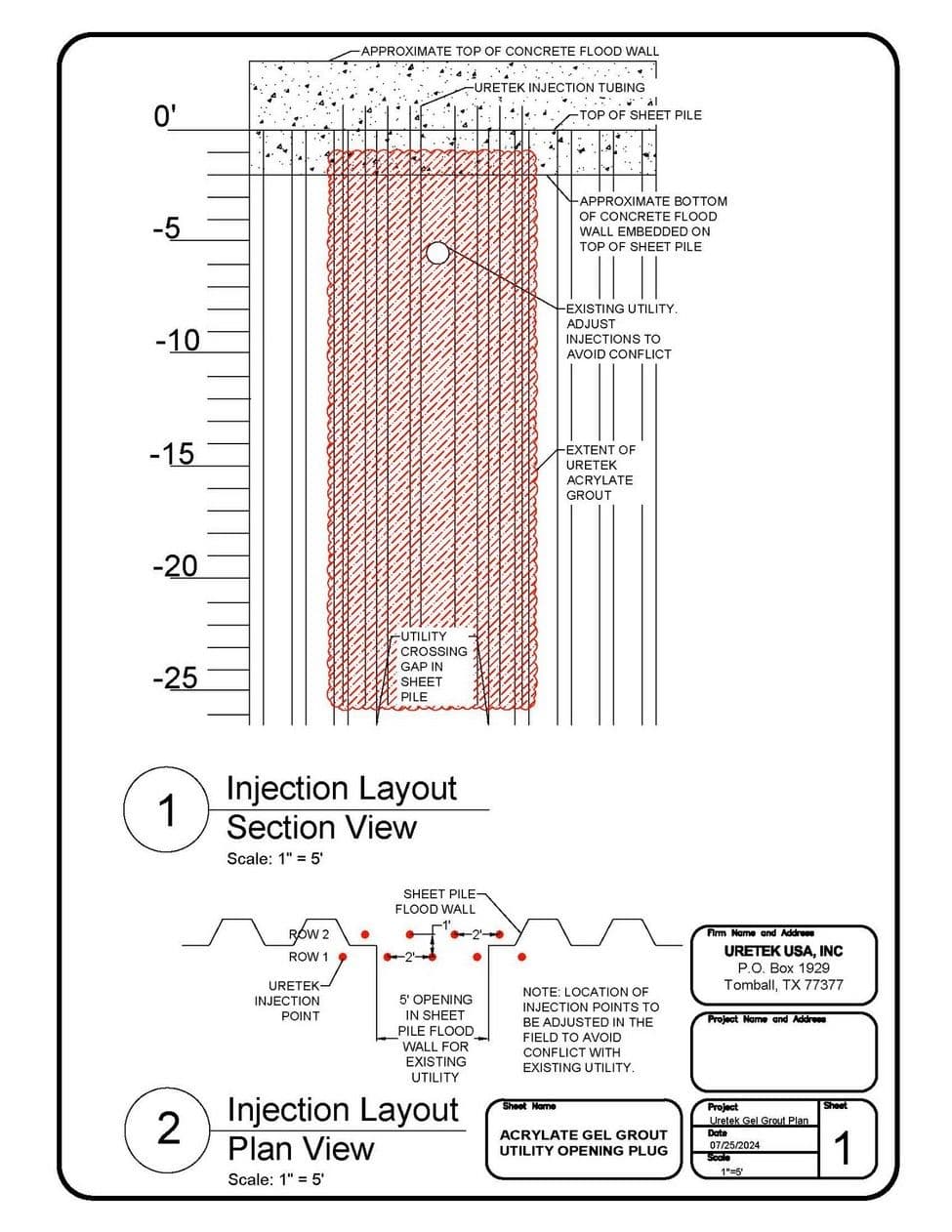
URETEK injection layout: section and plan views showing the two-row staggered probe pattern designed to create a continuous acrylate grout curtain around the utility crossing gap in the sheet-pile floodwall
Injection points were installed in two offset rows, with typical spacing on the order of two feet on center and a one-foot offset between rows, adjusted in the field based on actual conditions. Grouting proceeded from the lowest target elevation upward in incremental lifts of approximately twelve inches per stage. Initial grout volumes were established per vertical foot of treatment zone, then refined based on real-time field response.
Injection pressures were intentionally kept low, in the single-digit to low-teens psi range, to ensure the grout permeated the soil rather than fracturing it. This is a fundamental distinction in grouting work: high-pressure injection can create unintended pathways and displace soils in ways that make the problem worse. Low- pressure permeation fills pore spaces without disturbing the soil structure.
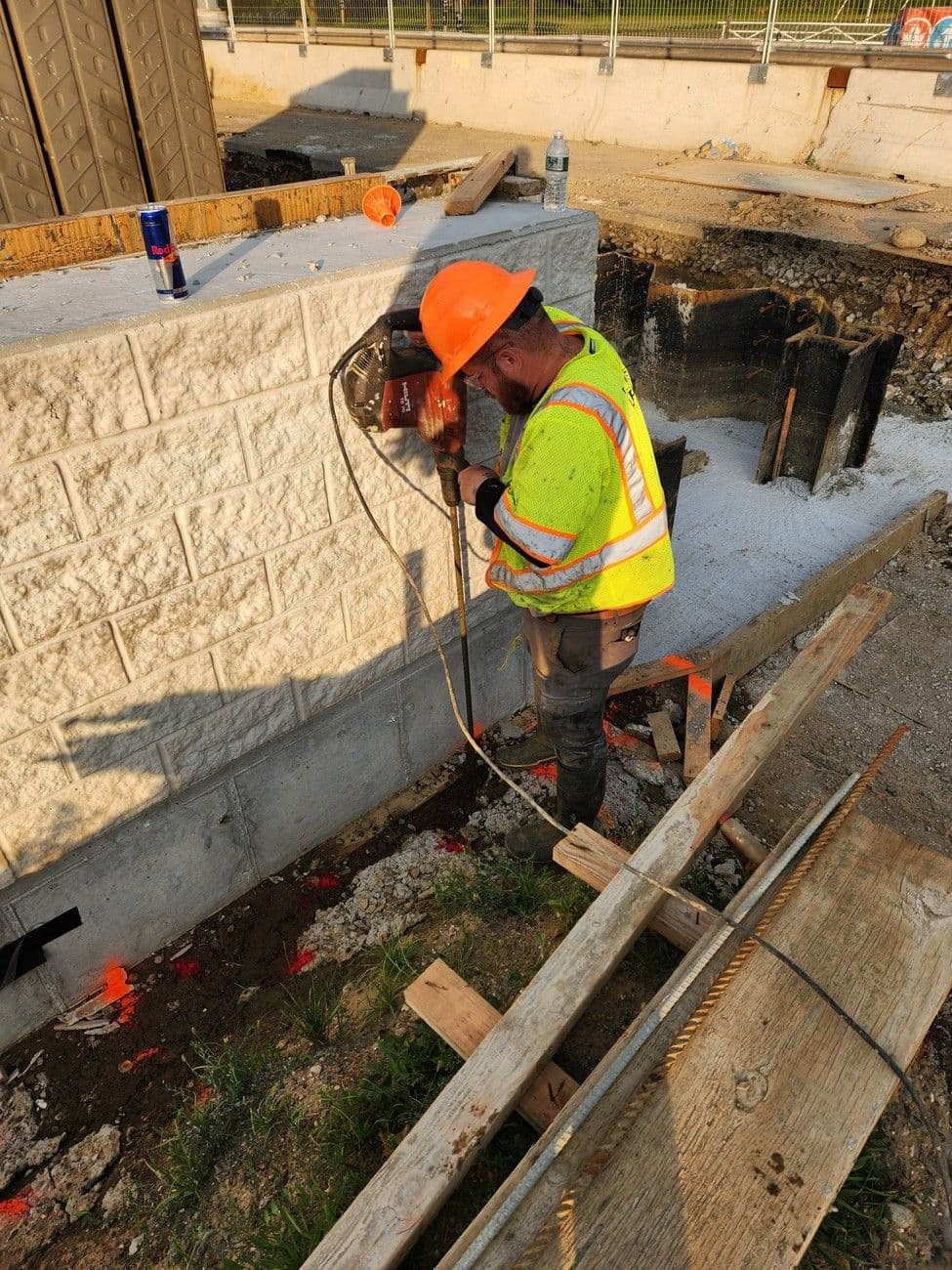
URETEK crew member installing injection points at a floodwall discontinuity: the sheet-pile transition and utility penetration zone are visible in the immediate work area
A multi-criteria refusal protocol governed each injection point, combining volume-based targets with secondary stop criteria such as pressure hold limits, signs of soil fracturing, or surface leakage. This layered approach prevented over-injection while ensuring adequate treatment at every location.
Because the site is tidally influenced, work sequencing was coordinated with tidal behavior. Performance was observed through tide cycles so that any residual damp areas could be identified and addressed promptly, rather than waiting for a post- construction surprise during the next high-water event. This kind of real-conditions verification is one of the advantages of working on a tidal site: you get natural performance testing built into every shift.
URETEK's quality assurance program for this project reflected the same principle that governed the injection methodology: control what goes in, measure what comes out, and document everything in between.

Grout batch testing. Batch testing records with reaction and gel time verification for every grout mix confirmed material performance before injection began at each location.
Pressure and volume tracking. Continuous tracking of injection pressures and volumes at each port provided a complete record of every injection event and flagged any anomalous responses in real time.
Daily production logs. Daily grout logs were maintained throughout the program, providing a verifiable production record for owner review and future maintenance reference.
Permeability verification testing. Rising-head permeability tests were performed at treated locations to measure hydraulic conductivity before and after grouting, quantifying the reduction achieved and confirming that the installed curtain met performance objectives.
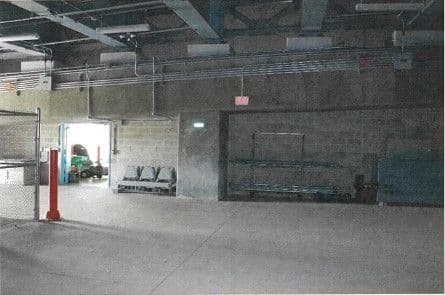
Interior of the service building after treatment: the treated perimeter remained dry through tidal cycles, confirming the grout curtain's effectiveness as a long-term flood-exclusion component
The results on this project spoke clearly: treated utility gaps and sheet-pile transitions remained dry during observation, including through tidal changes. The installed grout curtains provided a stable, consistent seal that integrated with the facility's broader flood-exclusion strategy. The work was completed with no excavation, no disruption to facility operations, and no compromise to existing utilities.
Flood barriers fail at their interfaces. Utility penetrations, sheet-pile transitions, and construction joints are the most likely seepage paths in any floodwall system. Addressing these discontinuities proactively, rather than waiting for a flood event to reveal them, is sound risk management for any critical-infrastructure operator.
Permeation grouting seals what mechanical methods cannot. When subsurface flow paths are uncertain, soil conditions vary, and access is constrained, a low-viscosity chemical grout curtain can create the continuous low-permeability barrier that gaskets, waterstops, and surface sealants alone cannot guarantee.
Low-pressure, staged injection protects what's already there. On a site with live utilities running through the very openings being treated, the injection methodology must be disciplined enough to improve the ground without damaging the infrastructure it surrounds. URETEK's staged, low-pressure approach with multi-criteria refusal protocols is designed for exactly this condition.
Tidal and real-conditions verification builds confidence. Observing performance through actual tidal cycles, not just measuring injection volumes, gives owners and engineers real evidence that the treatment works under the conditions it was designed to withstand.
If you are managing a floodwall, cutoff system, or flood-exclusion perimeter and you are seeing, or anticipating, seepage at utility penetrations, sheet-pile transitions, construction joints, or other discontinuities, URETEK can help. We will evaluate groutability at each location, develop an injection plan that works around your existing utilities and access constraints, execute the work with minimal disruption to operations, and provide the documentation that owners and engineers require for critical flood-mitigation infrastructure.

 800-240-7868


