

Location
Pelham, New York
Structure Type
Mixed-use development requiring deep excavation approximately 14 feet below grade in a dense urban setting
Subsurface Conditions
Approximately 12 feet of surficial fill over a thick, highly transmissive alluvial sand unit extending 40 to 70+ feet below grade, with groundwater several feet above planned subgrade
Core Challenge
Control groundwater inflow during active dewatering while preventing off-site drawdown that could trigger settlement beneath an immediately adjacent three-story building
Site Constraints
Limited working space, vibration and noise sensitivity, active neighboring properties, and no room for heavy drilling spreads
URETEK Scope
Chemical grout curtain installation using a low-viscosity acrylate resin system, paired with rising head verification testing and ongoing groundwater and structural monitoring
Result
Zero water infiltration at verification test locations, stable groundwater levels maintained outside the excavation throughout dewatering, and no recordable settlement at the adjacent structure
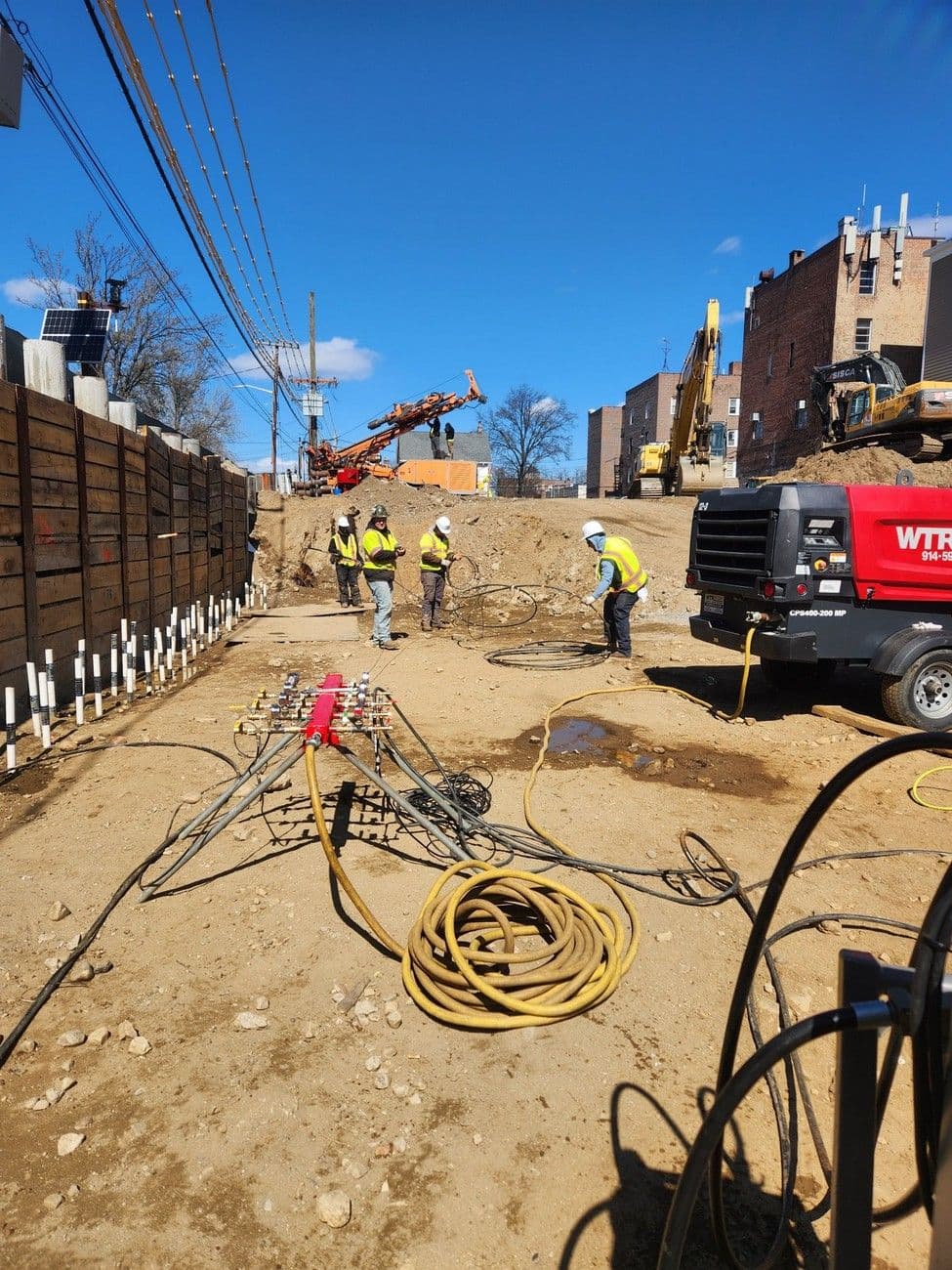
The excavation corridor: an urban tight-site environment with active neighboring structures, requiring a groundwater protection strategy that was as minimally disruptive as it was effective
A mixed-use development in Pelham, New York required a deep excavation, approximately 14 feet below grade, in a location immediately adjacent to an existing three-story building. That alone would make any geotechnical engineer pay close attention. But the subsurface conditions made it considerably more complex.
The site stratigraphy consisted of roughly 12 feet of surficial fill over a thick alluvial sand unit extending tens of feet below grade, a soil profile capable of transmitting significant volumes of groundwater. The water table sat several feet above the planned subgrade elevation, meaning the excavation would require active dewatering with approximately 10 feet of drawdown to reach and maintain working grade.
Here is where the problem becomes a risk management challenge rather than just a pumping exercise. In transmissive granular soils, dewatering does not stay neatly inside the excavation. Lowering the water table on one side of a boundary changes effective stresses on the other side, and when that "other side" is directly beneath an occupied three-story building, the consequences of uncontrolled drawdown, such as consolidation settlement, foundation movement, and structural damage, are serious and potentially irreversible.
The project's independent geotechnical consultant confirmed these concerns quantitatively. Seepage analysis established that even with support-of-excavation controls in place, groundwater drawdown of four to five feet could extend beyond the excavation footprint, potentially inducing consolidation settlement on the order of one inch at the adjacent property. The consultant recommended a low-permeability barrier system to reduce pumping volumes, limit subgrade instability risk, and mitigate settlement risk to neighboring structures, along with building monitoring and a protect-in-place strategy as essential components of the construction plan.
In practical terms: the project needed a groundwater cutoff that could be installed in a tight urban corridor with minimal disturbance, verified in the field to confirm it was actually working, and adjusted if verification showed performance was not yet meeting criteria. "Just dewater it" was not an acceptable plan.
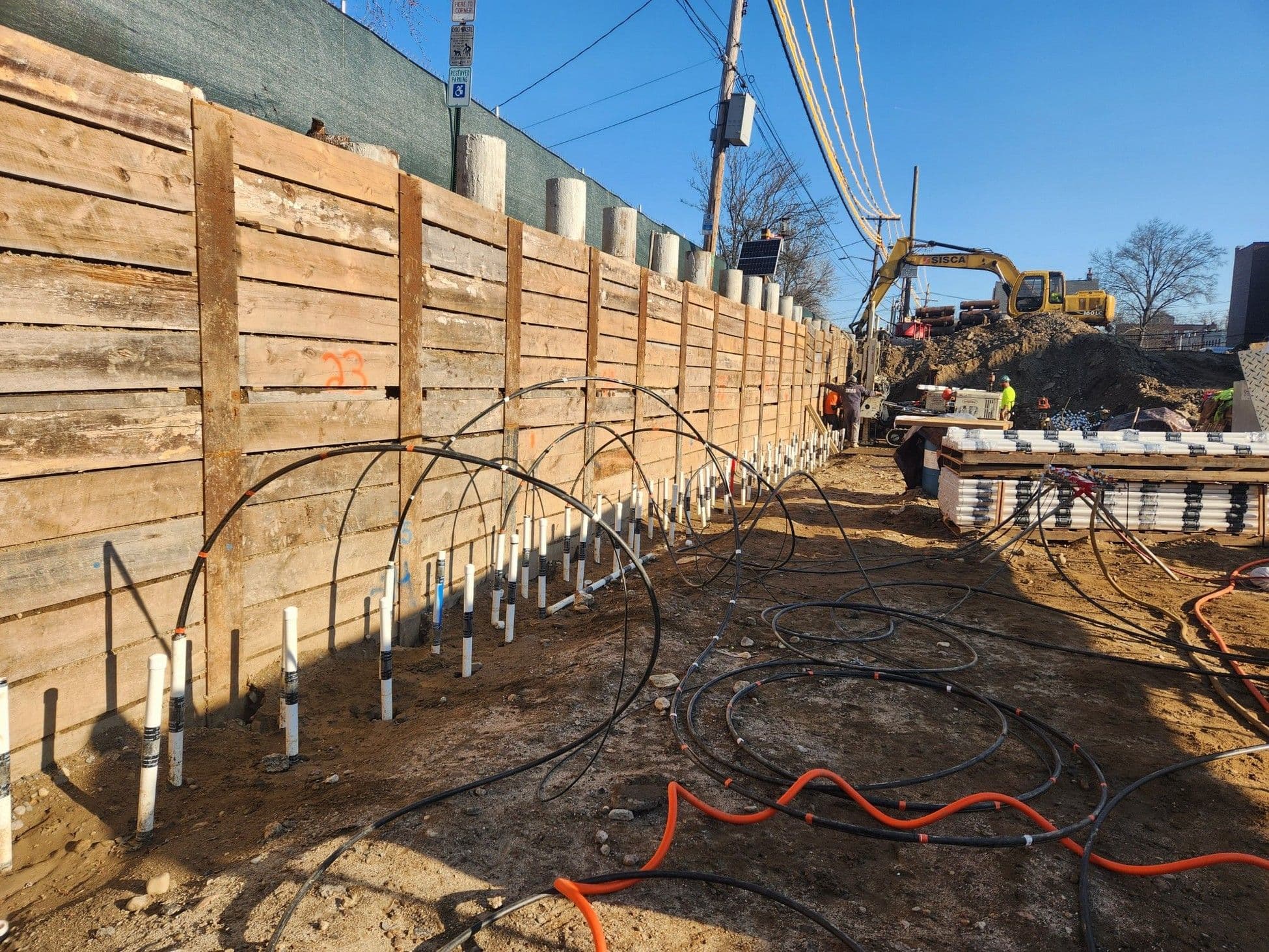
The installed injection port array along the excavation's shoring wall: closely spaced ports arranged in two offset rows to ensure overlapping treatment zones and a continuous, gap-free grout curtain
Engineers and contractors working in dense urban environments will recognize this scenario immediately. On constrained excavations in granular soils, dewatering is never just an excavation support issue. It is always a neighboring structure performance issue. The physics are straightforward: lower the water table in permeable soil, and the drawdown cone extends outward. If compressible layers or loose fills exist beneath an adjacent foundation, settlement follows.
On this site, the logistical constraints compounded the technical ones. Limited working space ruled out heavy equipment spreads. Vibration and noise sensitivity restricted what methods could be used and when. The work had to integrate with other active trades on a tight construction schedule. The project team needed a groundwater cutoff system that was effective, verifiable, and minimally disruptive, and they needed it to protect a building they did not own from damage they could not afford to cause.
URETEK installed a chemical grout curtain along the south side of the excavation to reduce soil permeability and limit groundwater inflow during dewatering operations. The approach was specifically selected for its ability to permeate the soil's pore structure and form a continuous low-permeability barrier with minimal surface disruption, a critical advantage in a setting where access, vibration sensitivity, and urban activity constraints made traditional high-disturbance methods impractical.
Before any injection work began, a licensed engineering firm conducted groutability and permeability analysis to support the curtain design. This front-end engineering step connected the actual subsurface conditions to a realistic injection strategy and defined verifiable acceptance criteria, establishing what "good enough" performance would look like before the first probe was drilled. This is a critical distinction from projects where grouting is performed to a volume target with no independent performance standard. On a project where an adjacent building's foundation is at stake, assumptions are not acceptable.
Field execution followed a planned injection layout using closely spaced injection points arranged in two offset rows to promote overlap and continuity of treatment. The two- row configuration ensures that treated soil zones connect into a continuous barrier, eliminating the preferential flow paths that would allow groundwater to bypass the curtain.
The curtain was installed using the Tube à Manchette (TAM) grouting method, a technique specifically suited for deep, precise chemical grout placement. Steel sleeve pipes fitted with pre-drilled injection ports are advanced to full target depth, and grouting is performed upward in staged lifts using an inflatable double packer. The packer straddles each set of sleeve ports in turn, isolating a discrete injection interval and allowing grout to enter the surrounding soil on a full 360-degree plane at that elevation before the packer is repositioned to the next stage. This bottom-up, stage-by- stage approach ensures controlled, uniform grout distribution at each depth increment, critical when the treatment zone extends well below the water table and precise placement at depth cannot be confirmed by surface observation alone.
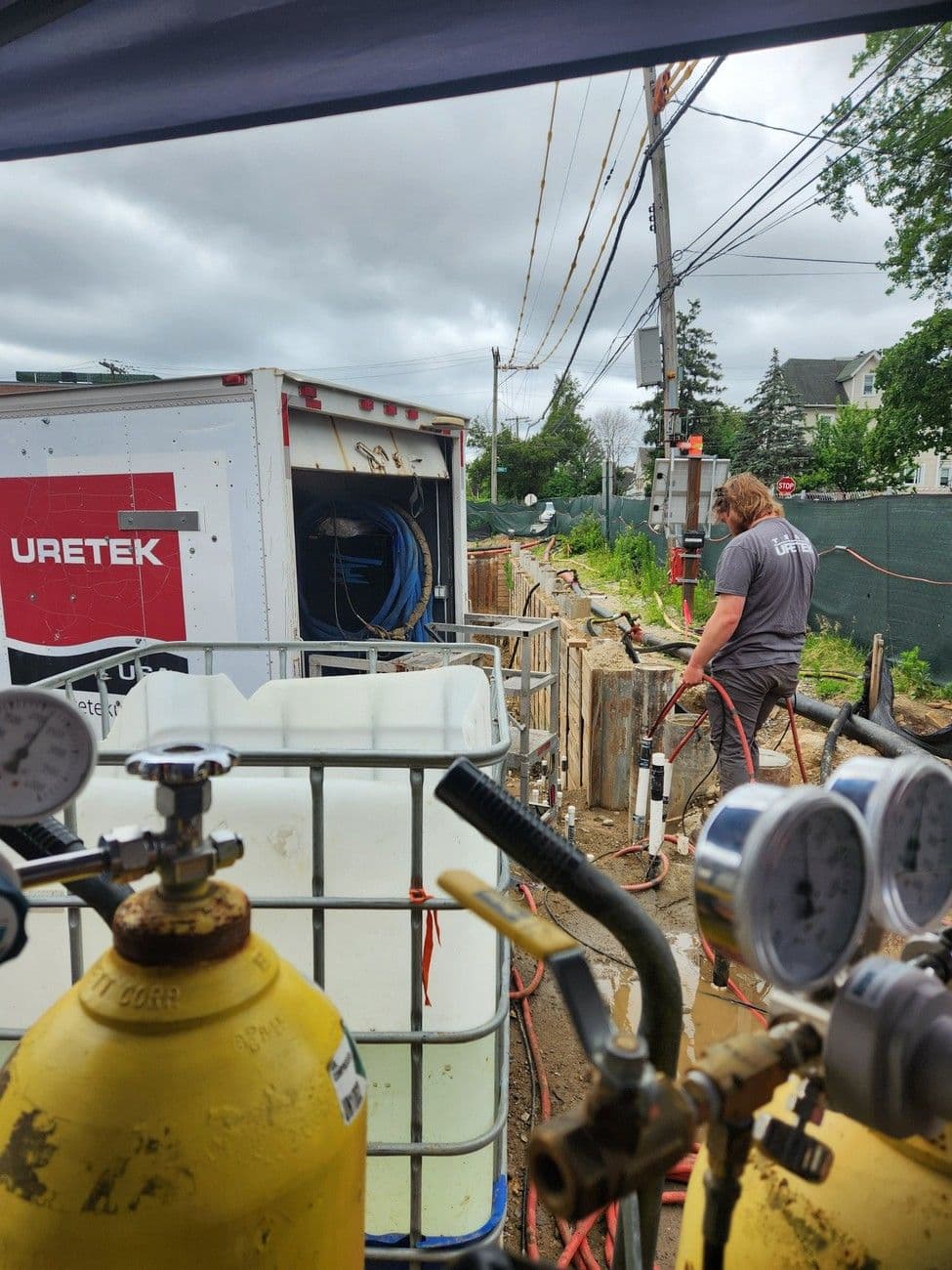
URETEK's mobile injection unit at the excavation perimeter: the bi-component pumping system allows the crew to control gel time in real time, adjusting resin and initiator ratios as soil and groundwater conditions change across the curtain
The grout system was a hydrophilic, acrylate-based chemical grout, a non-toxic aqueous solution that gels within seconds to minutes when activated, producing a soft, crosslinked gel that fills the soil's pore spaces and dramatically reduces permeability. The material was installed using a bi-component pumping approach at a 1:1 ratio, with separate resin and initiator streams that allowed the crew to adjust gel time in real time based on soil response, groundwater flow conditions, and injection sequencing requirements.
Acrylate grouts are specifically valued in this type of application for their very low viscosity, allowing them to permeate fine-grained and variable soils that higher- viscosity grouts cannot effectively penetrate, and their controllable gel times, which give crews precise command over how far the material travels before setting. In a transmissive sand unit where uncontrolled grout migration would waste material and compromise curtain continuity, that control is essential.
The selected grout has water-like viscosity, so it can travel into the same tiny pore spaces that groundwater flows through. It sets on a controllable timer, so crews can dial in exactly how long the material remains fluid before it locks into a gel. And the cured gel is durable across wet and dry conditions, exhibiting reversible swelling behavior that maintains its sealing performance as moisture conditions change with the seasons.
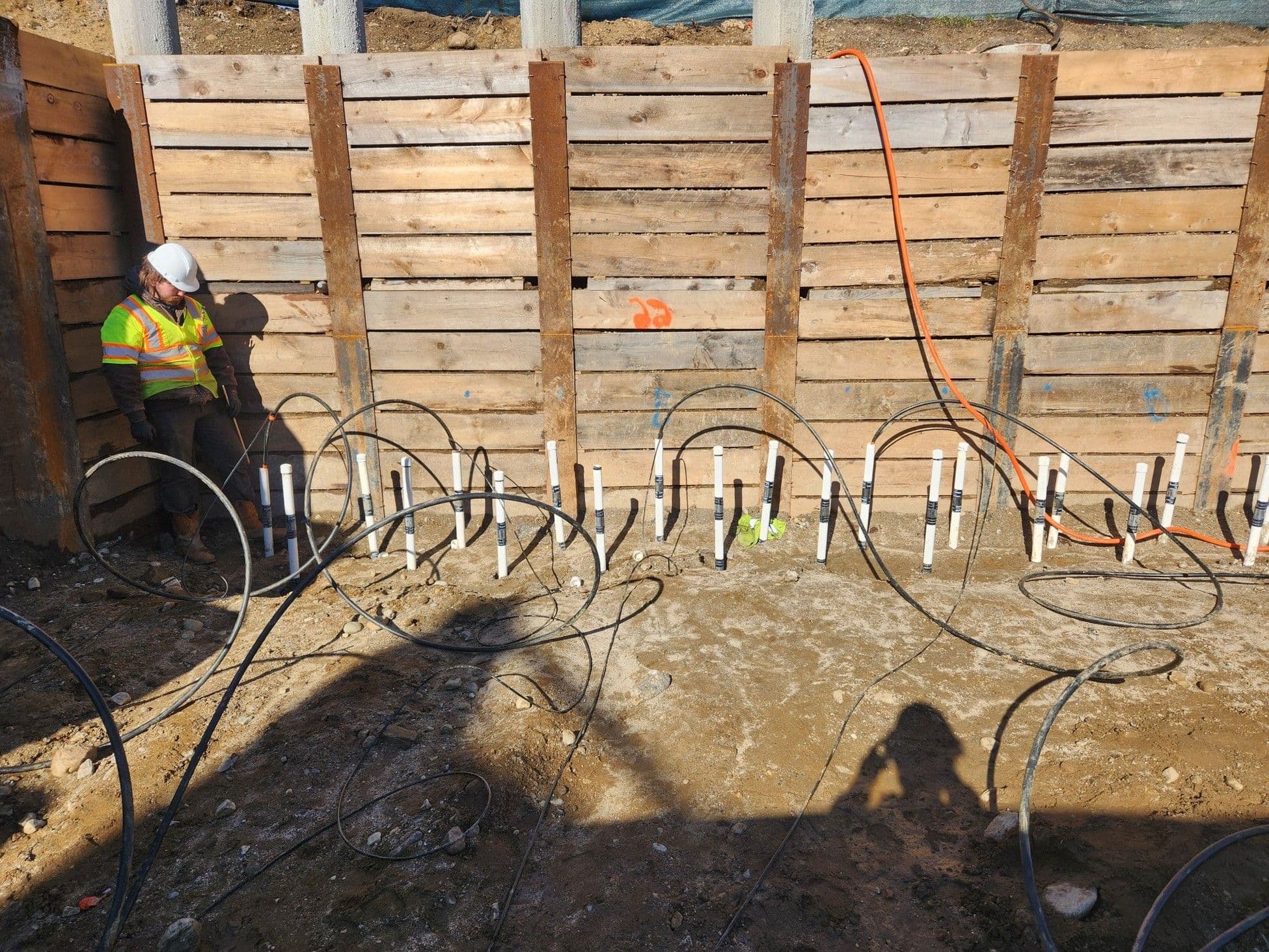
URETEK crew member threading injection lines into installed ports: each port is staged and connected in sequence to maintain controlled injection pressure and gel time across the full curtain length
What separates this project from a "pump grout and hope" approach is the verification program URETEK implemented to confirm the curtain was actually performing as a groundwater cutoff, not just installed as one.
URETEK performed rising head testing near the adjacent building to evaluate the effectiveness of the grout curtain. The procedure used a four-inch cased boring advanced to the target depth, with water level response monitored using a real-time data logging device. The test was explicitly outcome-based: if water level response did not meet the established criteria, secondary grouting would be performed and the area retested until the desired permeability reduction was achieved.
The result: monitoring over a one-hour period showed zero water infiltration into the borehole. No secondary grouting was required.
Beyond the point verification testing, monitoring wells were installed both inside and outside the excavation zone. Weekly readings began after completion of the curtain grouting, coinciding with the start of dewatering operations. The data told a clear story: groundwater levels outside the excavation remained stable while pumps drew levels down inside the excavation footprint. The grout curtain was doing exactly what it was designed to do: allowing dewatering to proceed on one side of the barrier without pulling the water table down on the other.
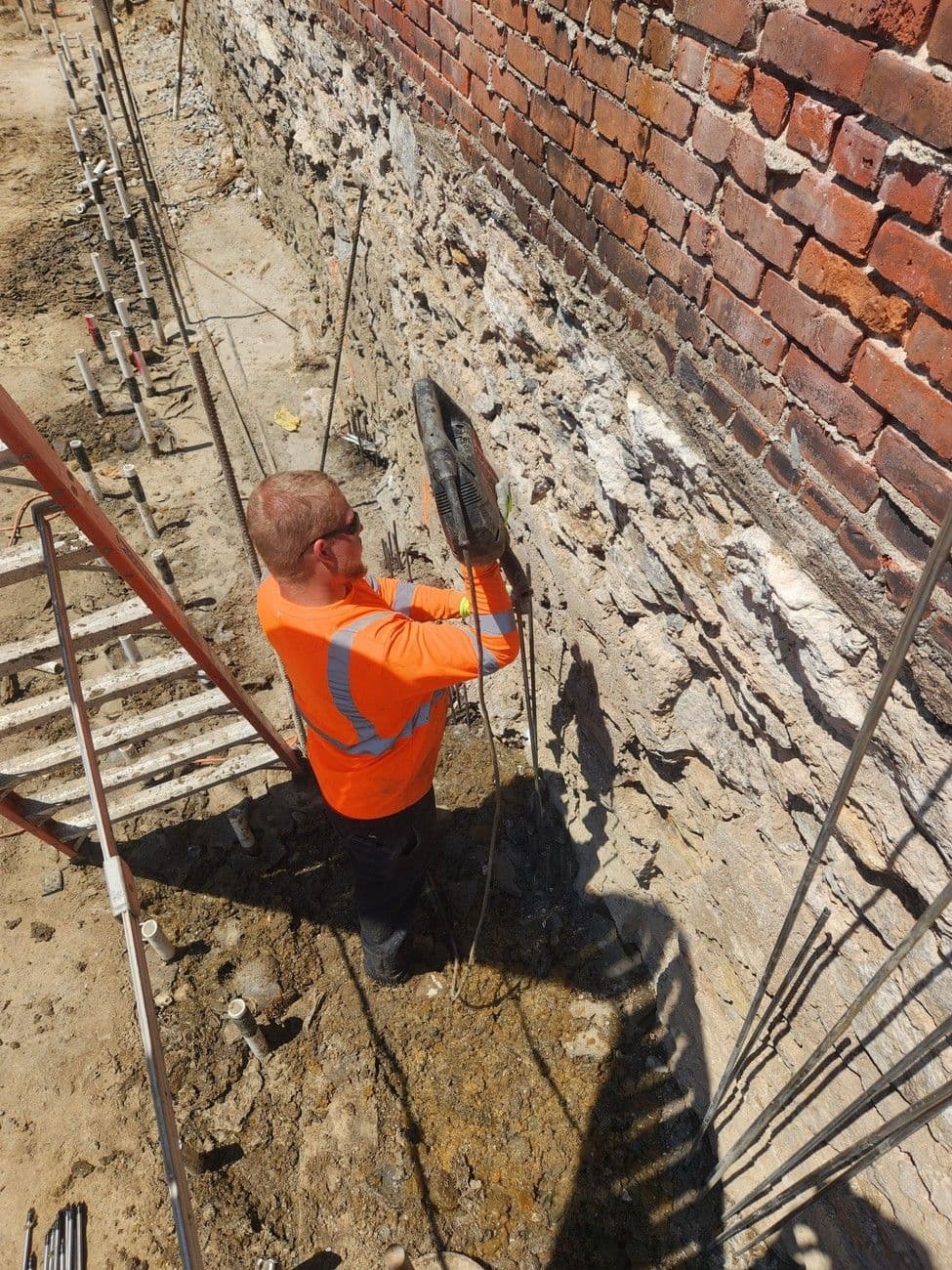
URETEK crew drilling into the adjacent structure's historic stone and brick foundation wall to install underpinning injection ports: the protect-in-place strategy extended beyond groundwater control to direct structural reinforcement at the neighboring building
Because the adjacent three-story structure was the primary risk receptor, optical monitors were installed on the building to track any movement throughout the construction program. The monitoring confirmed no recordable settlement following completion of underpinning with URETEK's expanding polymer ground improvement system.
This three-layer verification approach (point testing of the curtain itself, ongoing groundwater monitoring across the site, and structural monitoring of the building at risk) gave the project team objective, defensible evidence that the protection strategy was working at every stage of construction. That is the standard that projects adjacent to existing structures should be held to.
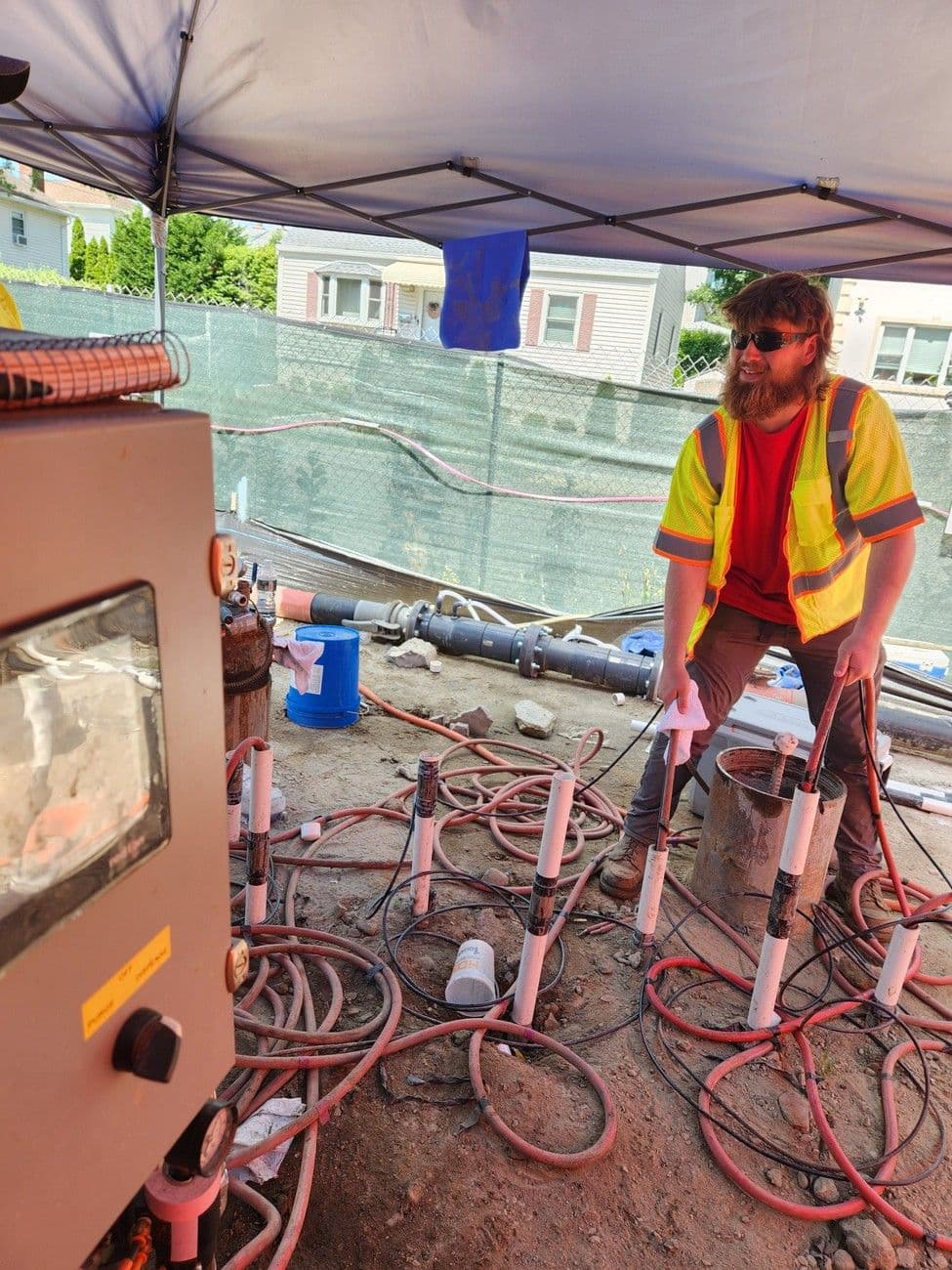
URETEK technician managing the injection control system: real-time monitoring of flow rates and pressures allows the crew to identify zones requiring additional treatment and confirm curtain performance as injection progresses
The measured outcomes confirmed the design intent across every performance objective.

Groundwater drawdown contained within the excavation footprint. External monitoring wells confirmed stable groundwater levels outside the curtain throughout active dewatering: the cutoff held, and off-site drawdown was effectively eliminated.
Zero water infiltration at verification test locations. Rising head testing confirmed effective permeability reduction without any secondary grouting requirement: the curtain passed on the first test.
No recordable settlement at the adjacent three-story structure. Optical monitoring confirmed the protect-in-place strategy performed throughout the construction program.
Full scope executed without heavy drilling equipment, disruptive
vibration, or noise. Construction activity at neighboring properties proceeded uninterrupted throughout the program. For the contractor and project team, the verified cutoff transformed what could have been an open-ended production risk (unpredictable inflow volumes, expanding treatment costs, potential instability) into a controlled operation. The project's independent geotechnical analysis had explicitly connected low-permeability support- of-excavation concepts to reduced pumping volumes, reduced subgrade failure risk, and reduced settlement risk from drawdown. The grout curtain delivered on all three.
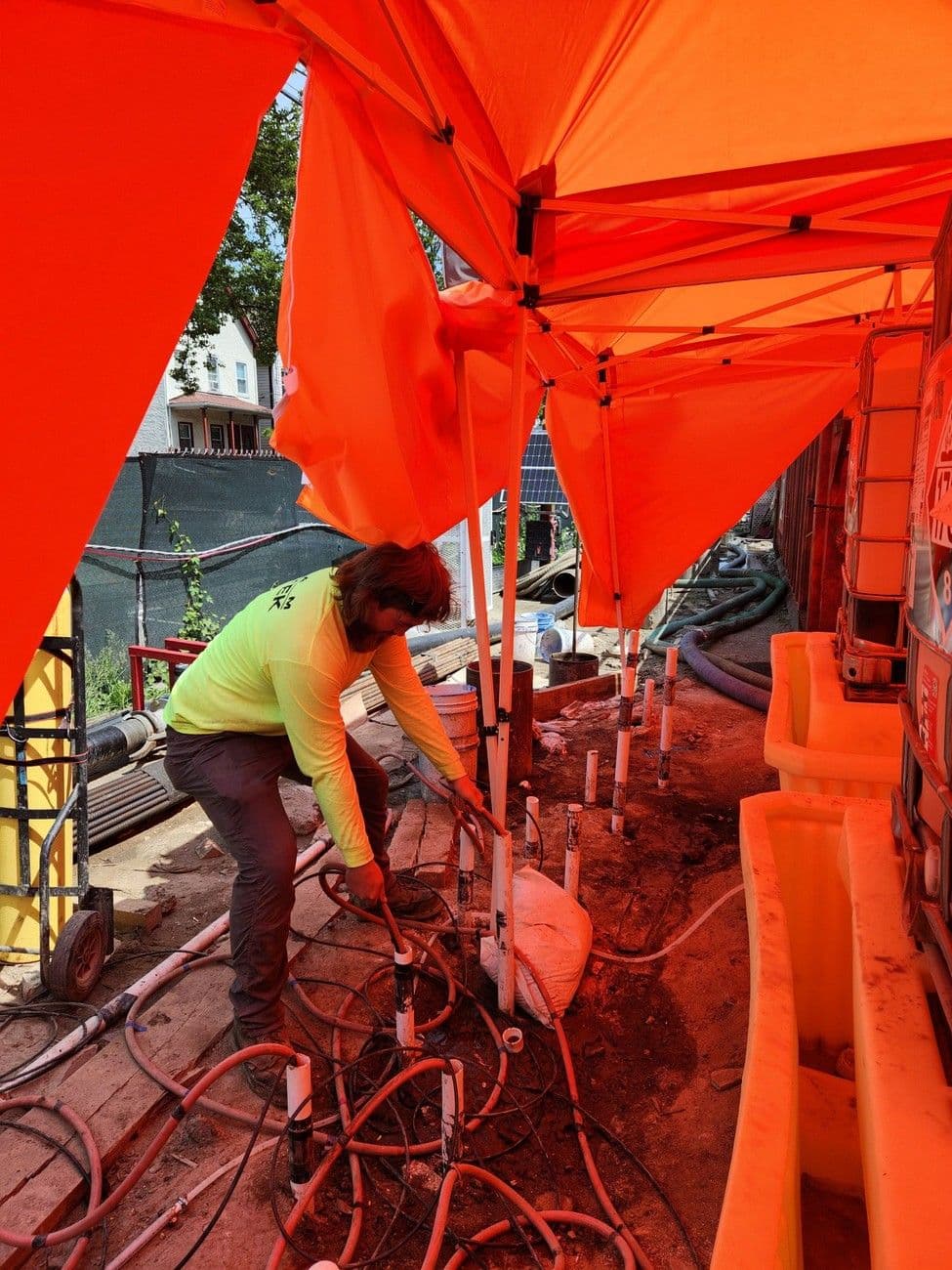
URETEK crew conducting injection operations under the site canopy at the adjacent building interface: controlled work conditions ensured precise material placement at the most sensitive zone of the project
Dewatering risk is always a neighbor's problem too. In permeable soils, drawdown extends beyond the excavation footprint. If adjacent structures sit on compressible soils or shallow foundations, uncontrolled dewatering can cause settlement that is expensive, contentious, and irreversible. A verified grout curtain converts that open-ended risk into a managed condition.
Front-end engineering defines the standard for success. Groutability analysis and permeability modeling before injection begins are what connect subsurface conditions to a realistic treatment strategy. Without them, grouting becomes a volume exercise with no performance benchmark, and on a project where an adjacent building's foundation is at risk, that is not acceptable.
Verification must be built into the program, not bolted on. Rising head testing, groundwater monitoring wells, and structural instrumentation gave this project team objective proof that the curtain was performing, not just installed. If the test had failed, the plan called for secondary grouting and retesting. That commitment to outcome-based execution is what makes the difference between a grouting program and a protection strategy.
Low-disturbance methods open doors that heavy equipment closes. Chemical permeation grouting allowed URETEK to install an effective groundwater cutoff in a tight urban setting without the heavy drilling spreads, vibration, and disruption that alternative methods would have required. For projects constrained by access, noise, or proximity to sensitive structures, that is often the deciding factor.
If you are planning a deep excavation in permeable soils with groundwater above subgrade, especially adjacent to existing buildings that cannot tolerate drawdown- induced settlement, URETEK's Specialty Grouting Division can help. We support early-stage groutability evaluation, define verifiable acceptance criteria, and execute field-confirmed grout curtain and stabilization programs coordinated with your support-of-excavation, underpinning, and dewatering teams.

 800-240-7868


