

Location
Baltimore, Maryland
Structure Type
Municipal courthouse: approximately 170,000 SF renovation including courtrooms, offices, detention areas, and a partially below-grade parking garage
Project Phase
Active renovation with new façade installation, enclosure testing, and interior buildout underway simultaneously
Core Challenge
Persistent groundwater infiltration along approximately 280 linear feet of below-grade exterior wall, threatening enclosure milestones and interior fit-out
Site Constraints
Dense urban corridor with adjacent structures, active utilities, and multiple trades working concurrently: no room for open-cut excavation
URETEK Scope
Surface-installed curtain grouting program with verification testing, secondary targeting, and supplemental interior joint sealing
Result
No water ingress observed along the treated wall section after treatment and all verification tests passed, without delaying the construction schedule
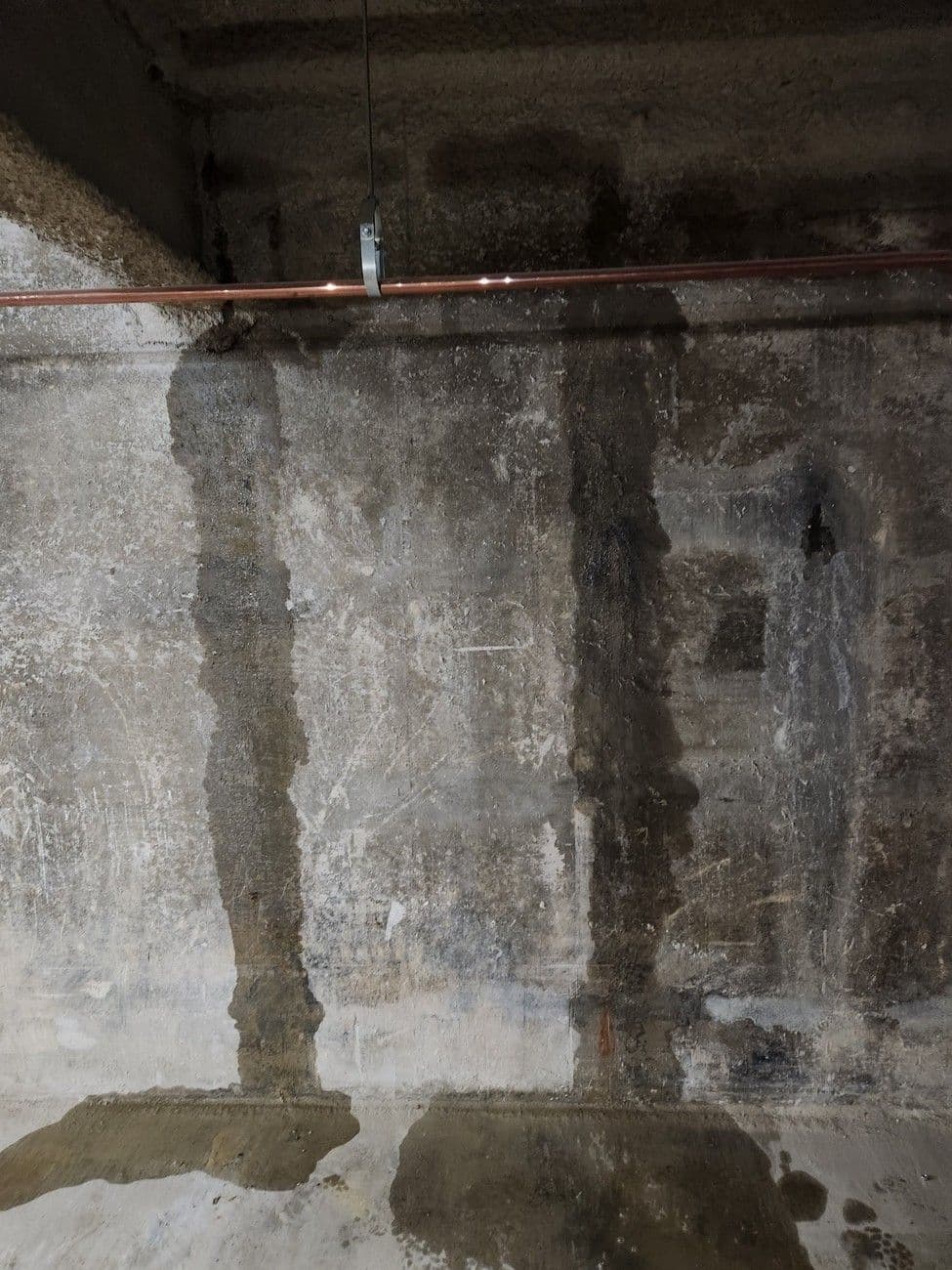
Active groundwater seepage staining on the below-grade interior wall: the persistent moisture that threatened enclosure milestones and interior fit-out
A large-scale courthouse renovation in downtown Baltimore was converting an aging state building into a modern judicial facility. The scope was ambitious: new courtrooms, administrative offices, secure detention areas, and a partially below-grade parking structure, all behind a completely new building façade. As construction advanced toward enclosure testing, commissioning, and interior buildout, one problem threatened to stall the entire timeline: groundwater was actively infiltrating the below- grade structure.
Water was entering through soils and localized pathways at joints along the existing exterior wall. This was not a minor nuisance leak. Persistent moisture at this stage of construction creates cascading risk: it delays enclosure verification, compromises MEP spaces, damages finish materials before they are even installed, and can force costly rework across multiple trades that are already mobilized and sequenced.
For engineers and contractors who have managed dense urban renovation work, this scenario is immediately recognizable. The need for below-grade water control is urgent and undeniable, but the conditions on the ground make the conventional solution, open-cut exterior waterproofing, essentially impossible.
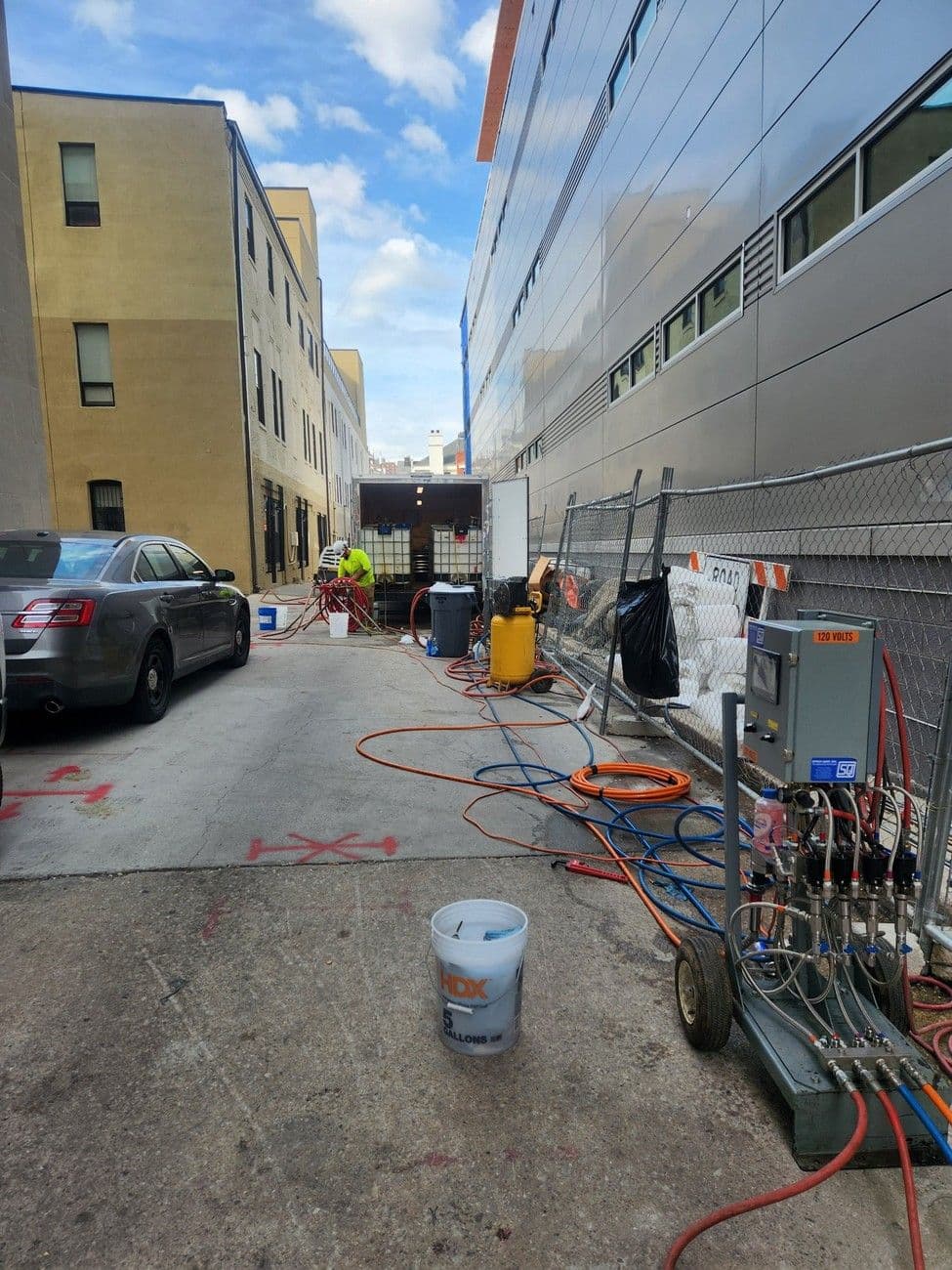
The constrained urban corridor between the courthouse and adjacent structures: URETEK's equipment staged in the only available access path
The courthouse sits in a tight urban corridor. Adjacent structures, existing underground utilities, and constrained site access surrounded the affected wall on all sides. Excavating along 280 linear feet of below-grade wall would have meant navigating utility conflicts, managing risk to neighboring foundations, and disrupting an already congested construction site, all while security operations and multiple active trades continued around the work.
Beyond the physical constraints, there was a schedule reality. The project was in a critical phase. Enclosure testing and interior fit-out were advancing on a timeline that could not absorb the weeks or months an excavation-based waterproofing approach would have demanded. The project team needed a method that could achieve a verified water cutoff from the surface, without opening the ground, and without pulling the schedule apart.
URETEK designed and executed a curtain grouting program that created a continuous low-permeability barrier in the soils immediately adjacent to the building, all installed from grade level, with no excavation required.
The concept is straightforward: instead of digging down to the exterior face of the wall to apply a waterproofing membrane, URETEK built a subsurface water barrier from above. Using a controlled pattern of closely spaced injection probes installed from the surface, the team injected chemical grout into the soil to reduce its permeability and seal the pathways through which water had been reaching the wall. When the treated zones overlap, by design, they form a continuous curtain that eliminates preferential flow paths and prevents groundwater from reaching the building envelope.
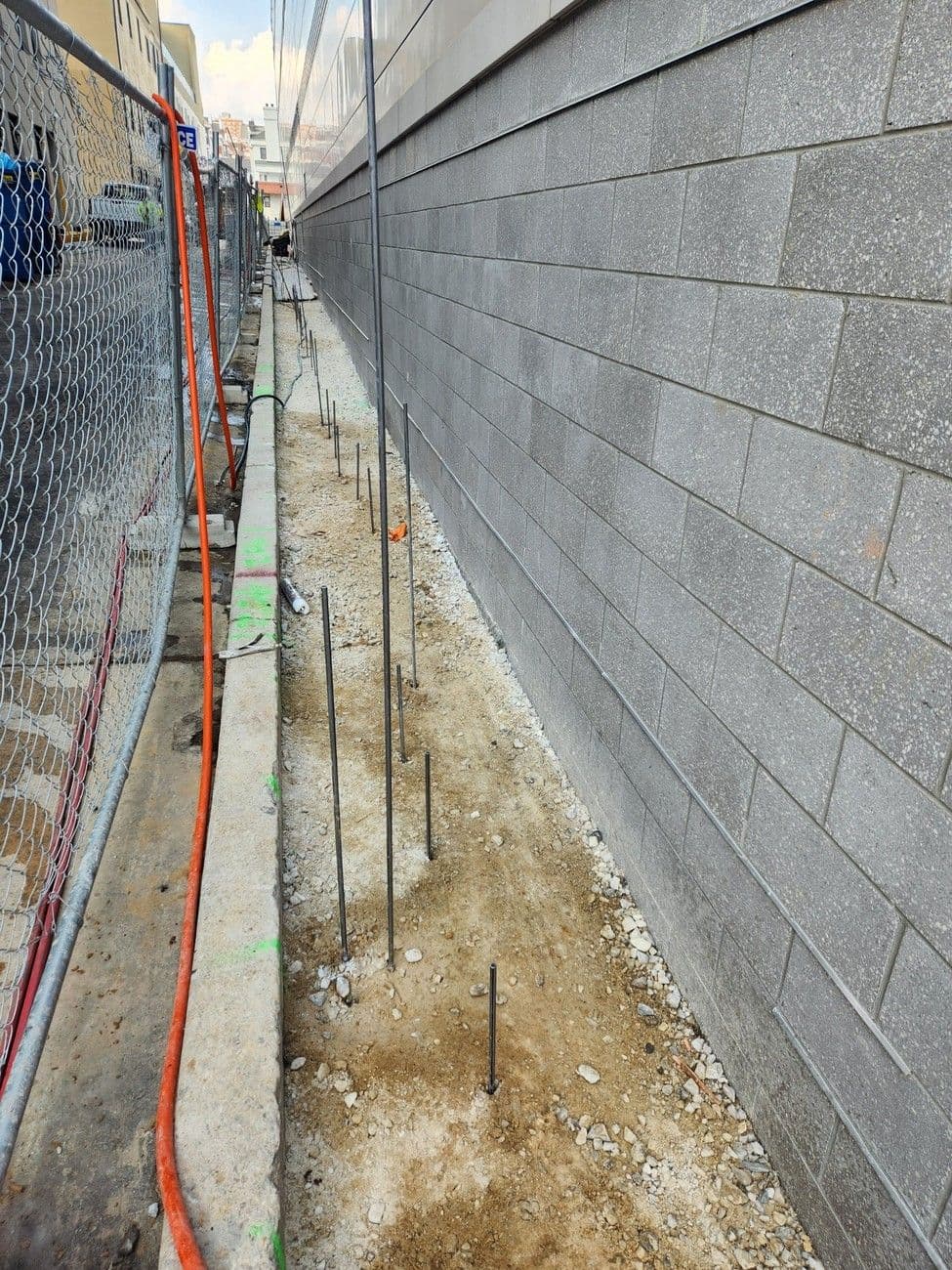
Two-row staggered curtain grouting probe pattern installed along the exterior wall: closely spaced injection points designed to create overlapping treated zones
Material selection is critical in curtain grouting work, and the choice depends entirely on what the soils and site conditions demand. For this project, URETEK selected a hydrophilic, acrylamide-free acrylic resin system, a material specifically engineered for soil permeation and seepage control.
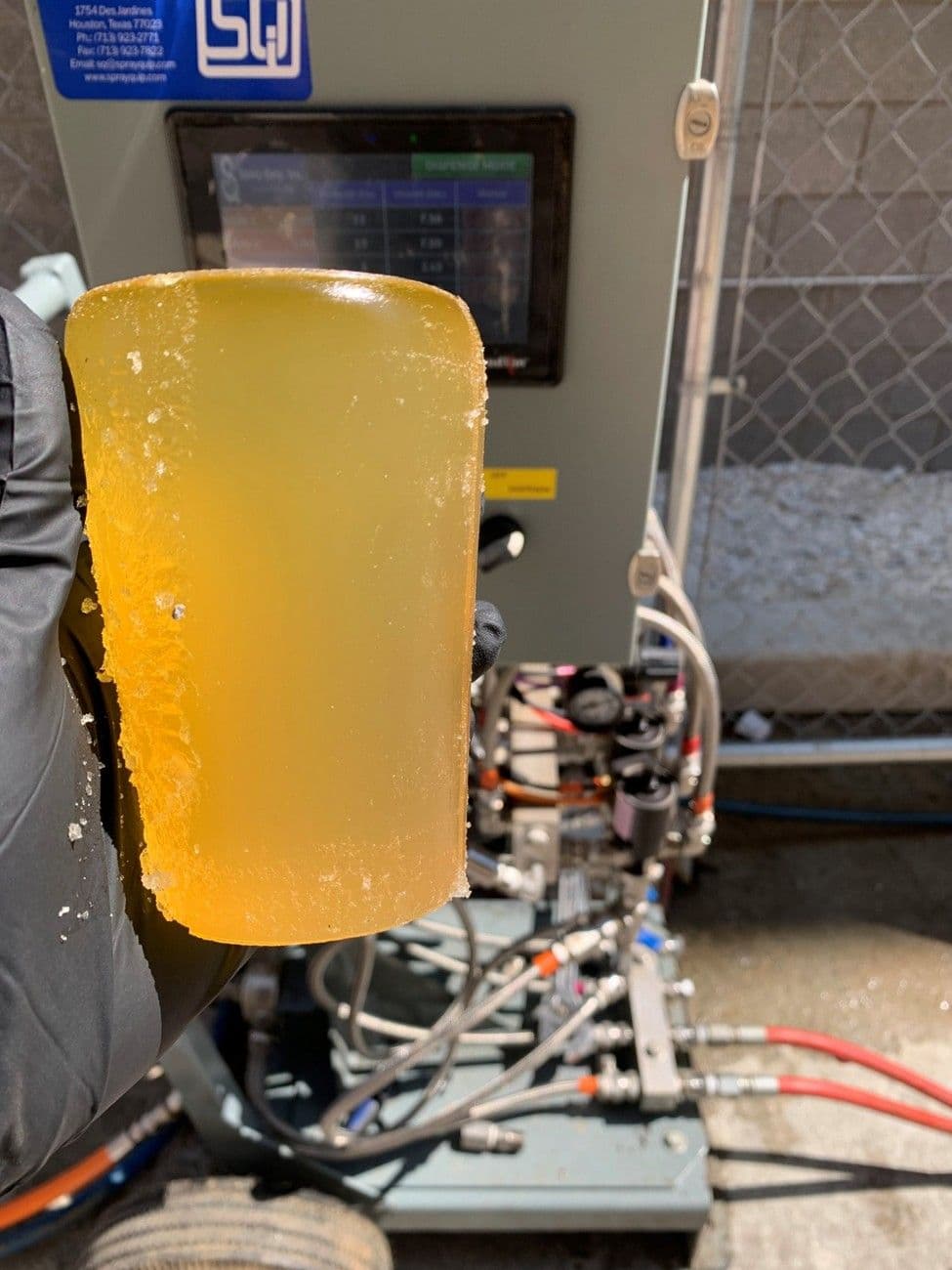
Cured acrylate gel sample: the flexible, crosslinked material that forms the low-permeability barrier within the soil matrix
Two properties made this material the right choice. Viscosity: the grout has a water-like viscosity that allows it to permeate into fine soil pore spaces and travel along narrow seepage pathways at low injection pressures, reaching zones that thicker cementitious grouts simply cannot enter. Gel time: the setting time is field-adjustable from seconds to minutes, giving the crew precise control over how far the material migrates before it locks in place. In active groundwater conditions, this control is essential: without it, flowing water can carry grout away from the intended treatment zone before it has a chance to set.
Once cured, the material forms a highly flexible gel with strong adhesion to wet and damp substrates. It also exhibits a re-swelling characteristic in the presence of water, meaning it can accommodate seasonal moisture fluctuations and minor ground movement without losing its seal. These properties are non-negotiable when the goal is long-term water control in soils that will continue to experience changing hydraulic conditions.
One of the distinguishing features of this project, and of URETEK's approach to curtain grouting generally, was a rigorous, verification-based execution model. This was not a "pump and hope" operation.
After the initial injection program was completed, independent third-party verification testing was performed to evaluate the effectiveness of the grouted barrier. Where testing identified any remaining seepage, URETEK returned with targeted secondary injections to close those specific pathways. In areas where isolated leak paths were traced directly to the wall interface, URETEK performed precision through-wall injections to seal them at the source. Final re-testing confirmed performance at all locations.
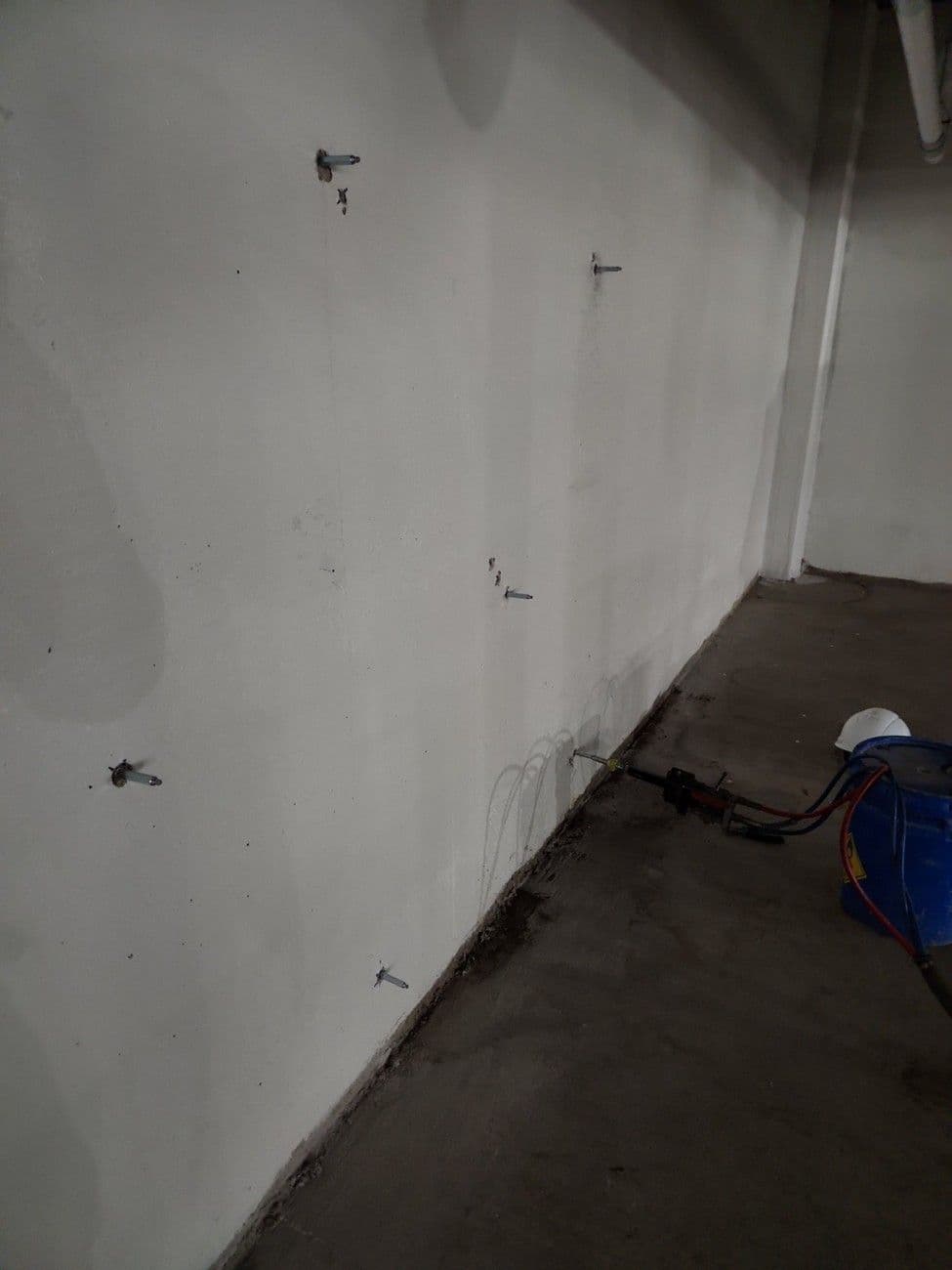
Interior through-wall injection ports installed to seal isolated leak paths identified during verification testing
This step-and-verify methodology is critically important for engineers and owners to understand, because it fundamentally changes the risk profile of the work. Rather than relying on assumed coverage based on injection volumes alone, the program was designed to prove performance at each stage before moving forward. If a zone did not pass verification, it was retreated and retested, not left to become someone else's problem during occupancy.
Later in the project, a separate interior construction joint began exhibiting seepage as slab work progressed. URETEK executed a focused joint-sealing scope using a flexible chemical injection grout to eliminate the leakage without impacting adjacent trades or requiring any schedule adjustment. This kind of responsive, targeted follow-through is a practical advantage of having a qualified injection contractor already integrated into the project team.
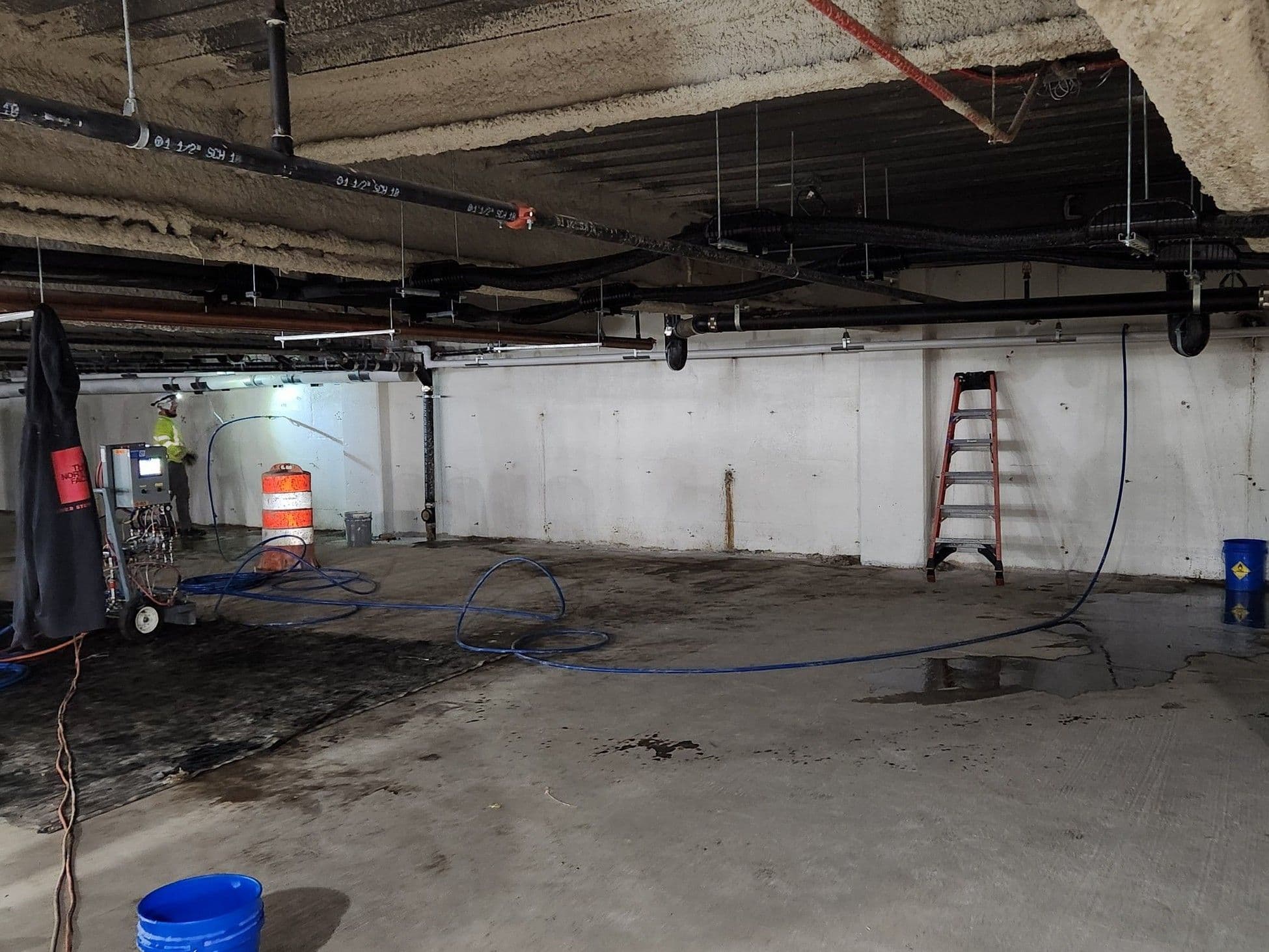
URETEK injection equipment staged in the below-grade space during the interior treatment phase: injection ports visible along the treated wall
The curtain grouting program delivered verified results across every performance metric the project required.

No water ingress observed. No water ingress was observed along the full 280 linear feet of treated wall after treatment, confirmed through independent third-party verification testing.
All verification tests passed. All third-party verification tests were passed after secondary targeting was completed, not just injection logs, but proven performance.
38 shifts, zero schedule disruption. The work was executed across 38 initial shifts, with secondary verification and supplemental joint sealing integrated seamlessly into the broader construction schedule.
No excavation required. No excavation was performed at any point during the scope: the entire program was delivered from grade level through closely spaced probe installations.
Critical path protected. Enclosure testing, commissioning, and interior buildout proceeded without delay: the injection program protected the critical path on a major civic renovation.
Surface-access curtain grouting eliminates the excavation bottleneck. When site constraints, adjacent structures, or active operations make open-cut waterproofing impractical, a properly designed injection program can achieve the same water-control objective from grade level, without utility conflicts, shoring, or schedule resets.
Verification testing turns grouting from an assumption into a documented result. By building third-party testing directly into the execution plan, the project team had objective proof of success at every stage, not just injection logs and volume records. This is the standard owners and engineers should expect.
Material selection must match the mechanism. Low-viscosity, adjustable-set chemical grouts exist for a reason: they can reach soil pore spaces and active seepage pathways that other materials cannot. Choosing the right grout system for the subsurface conditions is what separates a successful curtain from a costly callback.
Responsive follow-through protects the schedule. When new seepage emerged at an interior joint later in construction, URETEK was able to mobilize and resolve it quickly because the team, equipment, and methodology were already established on site. Building that capability into the project plan from the start is a smart risk management decision.
If you are dealing with groundwater infiltration at a below-grade wall, slab, or construction joint, especially on a site where excavation is not feasible due to adjacent structures, utilities, active operations, or schedule pressure, URETEK has the experience and methodology to solve it with little or no excavation where conditions permit. We will assess your site conditions, develop a probe and injection plan tailored to your specific seepage mechanisms, and execute a verification-driven program designed to deliver proven results on your timeline.

 800-240-7868


