

Location
Coastal Massachusetts
Structure Type
Decades-old concrete seawall along a busy municipal roadway, subject to nearly 12-foot tidal swings at full moon
Core Challenge
Tidal scouring had opened voids behind the seawall, producing a sinkhole directly landward of the wall and contributing to the failure of an adjacent stormwater outfall, threatening the stability of the roadway above
Failure Mechanism
Twice-daily tidal energy directed against the base of the wall was scouring sand from beneath and behind the structure, transporting fine sediment through cracks and joints and creating expanding subsurface cavities
URETEK Scope
Deep-injection polymer stabilization through small-diameter ports drilled through the pavement and seawall base, filling all voids and re-consolidating the eroded backfill
Work Window
Injection timed to low-tide periods over approximately one week, with only brief lane restrictions on the adjacent roadway
Result
Voids behind the wall filled, backfill re-consolidated, and the sinkhole repaired, preserving the existing seawall and roadway. No new sinkholes have appeared since treatment
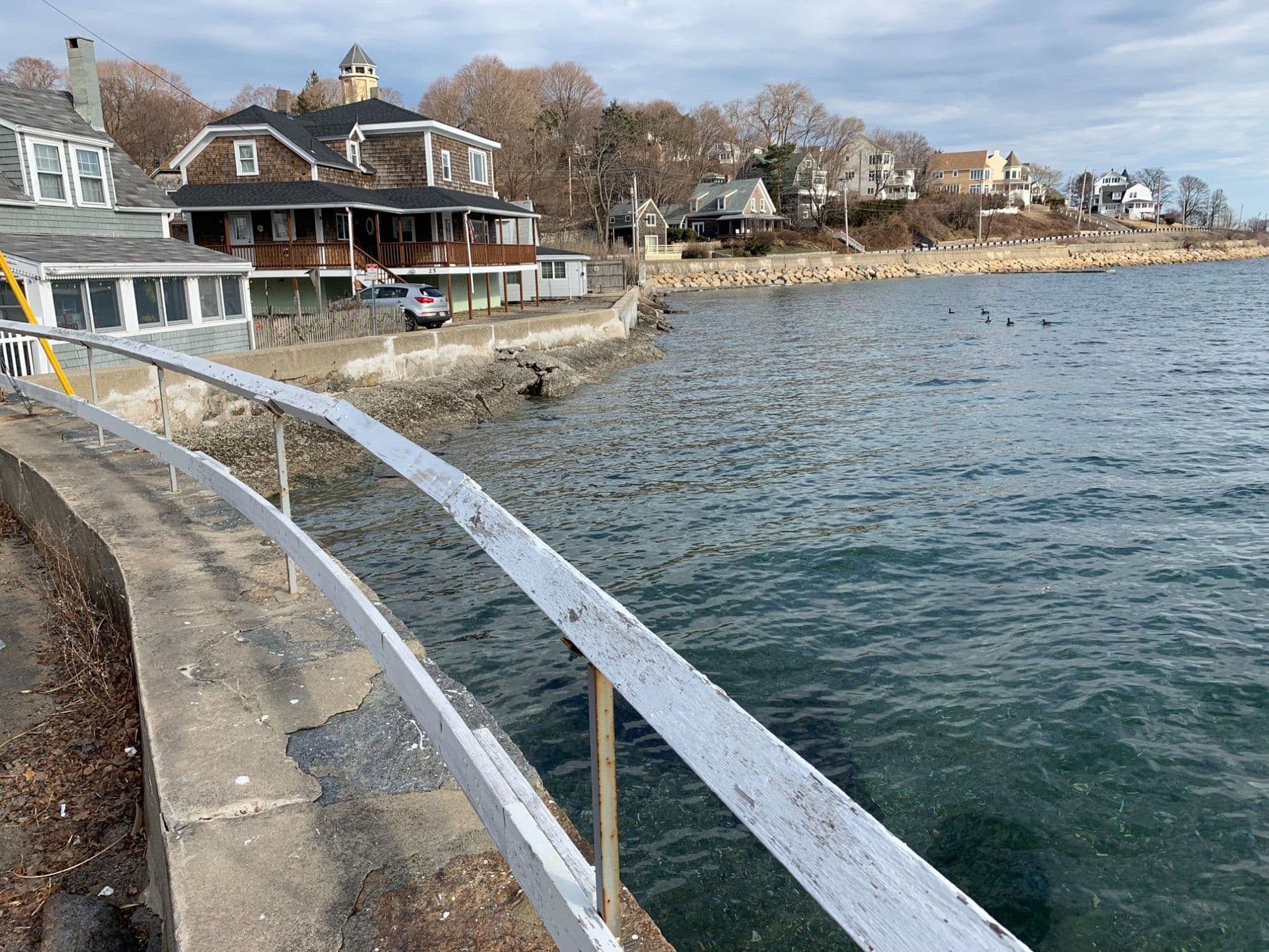
The aging concrete seawall along the coastal corridor: the wall separates the municipal roadway from the tidal zone, with the residential community immediately behind; the concrete face shows staining and joint deterioration consistent with years of tidal scouring
A concrete seawall along a busy coastal roadway in Massachusetts had been protecting the road and its users for decades. But the ocean had been quietly winning the fight beneath the surface.
The mechanism was scouring: a process in which waves and tides direct energy downward and scoop soil out from the base of the seawall. Twice daily, tidal swings of nearly 12 feet at full moon drove enormous hydraulic energy against the wall's base. That energy did not just push against the concrete. It reached beneath it and behind it, flushing fine sandy sediment out through cracks and joints in the aging structure. With every cycle, a little more sand left. Over years of accumulation, the result was a network of expanding voids behind the bulkhead that the surface had no way to reveal, until it did.
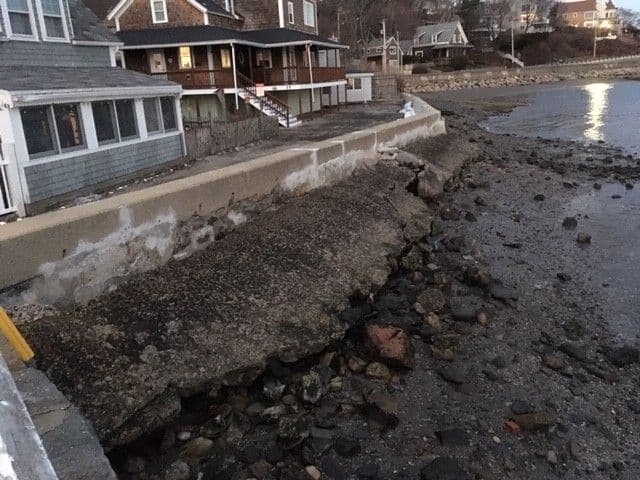
Visible seawall damage and collapse at an adjacent section: broken concrete panels and scattered rock illustrate the consequence of unchecked tidal scouring, providing a direct precedent for what the treated section was at risk of becoming
A sinkhole formed directly landward of the wall, and a nearby stormwater outfall began failing: two surface symptoms of the same subsurface problem. The undermined soils could no longer support the pavement above, and the road that hundreds of residents and visitors used daily was no longer sitting on solid ground.
For the municipality, the threat was immediate and the question was straightforward: how do you stop the soil loss, fill the underground voids, and stabilize the roadway, without the enormous cost, extended closure, and community disruption of rebuilding the entire seawall?
The seawall itself was not collapsing. The concrete structure, while aging, was still performing its primary function: retaining the embankment and protecting the shoreline. The problem was the ground behind it. Tidal scouring had removed the soil that the wall was supposed to be retaining, and the voids that resulted were the direct cause of the sinkhole and roadway distress.
A full seawall rebuild would have been a multi-million-dollar project requiring extended road closure, demolition, excavation in an active tidal zone, and reconstruction of a structure that was still fundamentally sound. It would have shut down a busy coastal roadway for months in a community where that road is essential for daily life, tourism, and emergency access.
What the town needed was a targeted repair that addressed the actual problem, the eroded soil and subsurface voids, without dismantling the infrastructure that was still working. The solution had to fill the voids, re-consolidate the loosened backfill, seal the pathways water was using to transport sediment, and do all of it in a tidal environment where the water table rises and falls 12 feet twice a day.
URETEK designed and executed a deep-injection polymer stabilization program to restore the ground behind the seawall from below, without excavation, without demolition, and without rebuilding the wall.
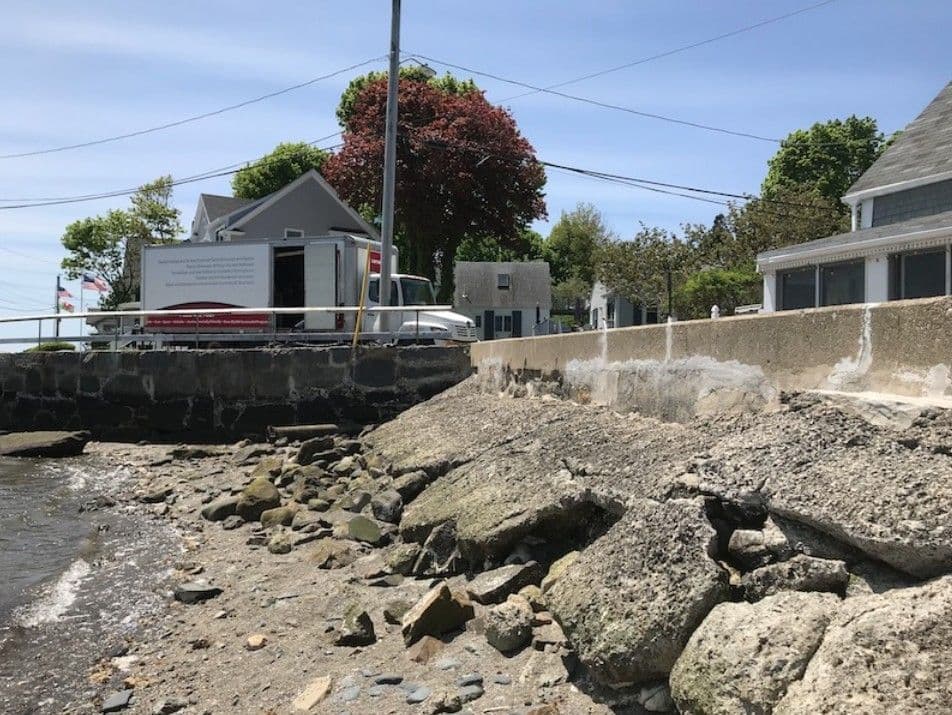
URETEK equipment staged at the seawall during a low-tide access window: the truck is positioned along the roadway above while the exposed tidal zone below reveals the base of the wall; injection work was timed to low-water periods to maximize treatment effectiveness
The crew drilled a grid of small-diameter injection ports through the existing pavement and the base of the seawall in the affected area. Through each port, a two-part hydrophobic polyurethane resin was injected under controlled pressure. The expanding material flowed into the washed-out zones behind the bulkhead, filling the cavities that tidal scouring had created and pressing the loose sand grains back into a consolidated mass.
Because the resin bonds to both soil particles and concrete, it sealed the leakage paths at the seawall joints as it cured, closing the very pathways that water had been using to transport sediment through the wall. This is a critical dual function: the injection fills the damage that has already occurred while simultaneously eliminating the mechanism that was causing it.
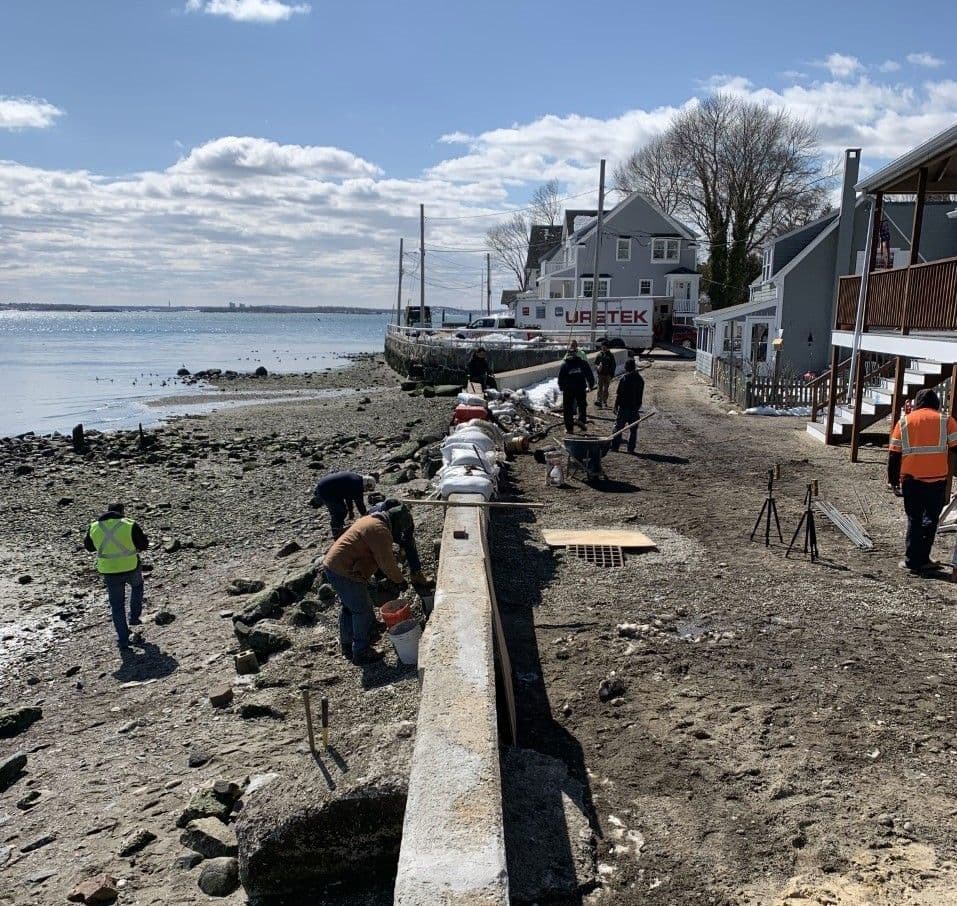
URETEK crew working along the full seawall treatment zone during a low-tide access window: the URETEK truck is visible in the background as multiple technicians coordinate drilling and injection operations along the exposed base of the wall
Material selection was driven by the site's defining condition: a nearly 12-foot tidal range that saturates the treatment zone twice daily. The injected resin is inherently hydrophobic: it repels water, cures in wet conditions, and forms a solid, water- resistant foam designed to resist washout and degradation in sustained tidal exposure. Once cured, the material resists the same hydraulic forces that caused the original erosion, providing durable protection in an environment that will never stop testing it.
This hydrophobic behavior is not a secondary feature. It is the reason the repair works in a setting where other materials would fail. A grout that absorbs water, softens in tidal cycling, or loses adhesion in saturated conditions would eventually be eroded by the same scouring process that created the problem. The hydrophobic resin is designed for long-term performance in exactly those conditions.
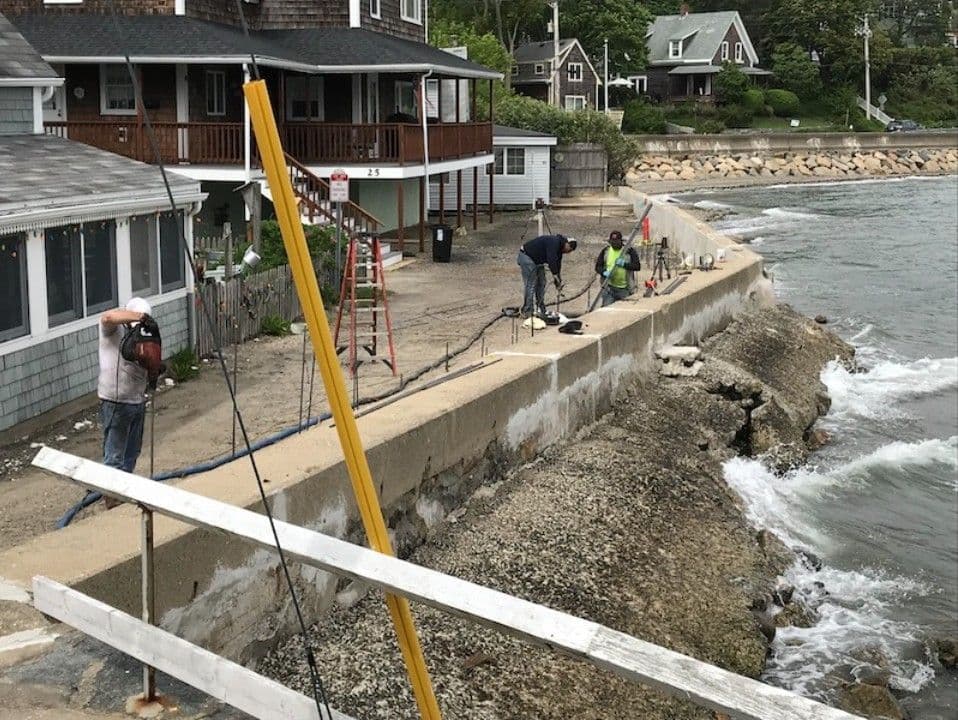
Active injection operations at the seawall crown: crew members drill and manage injection lines at the top of the wall while equipment monitors pressure and volume; working conditions in this tidal environment required careful coordination of drilling, injection, and monitoring within each low-tide window
To work effectively in a 12-foot tidal range, the crew scheduled injections during low- water periods, treating the most critical zones when hydraulic conditions were most favorable and the treatment had the best opportunity to cure before the next tidal cycle. This kind of tidal sequencing is standard practice on URETEK's coastal projects, but it requires experienced crews who understand how to read the site and time the work to match the conditions that nature dictates.
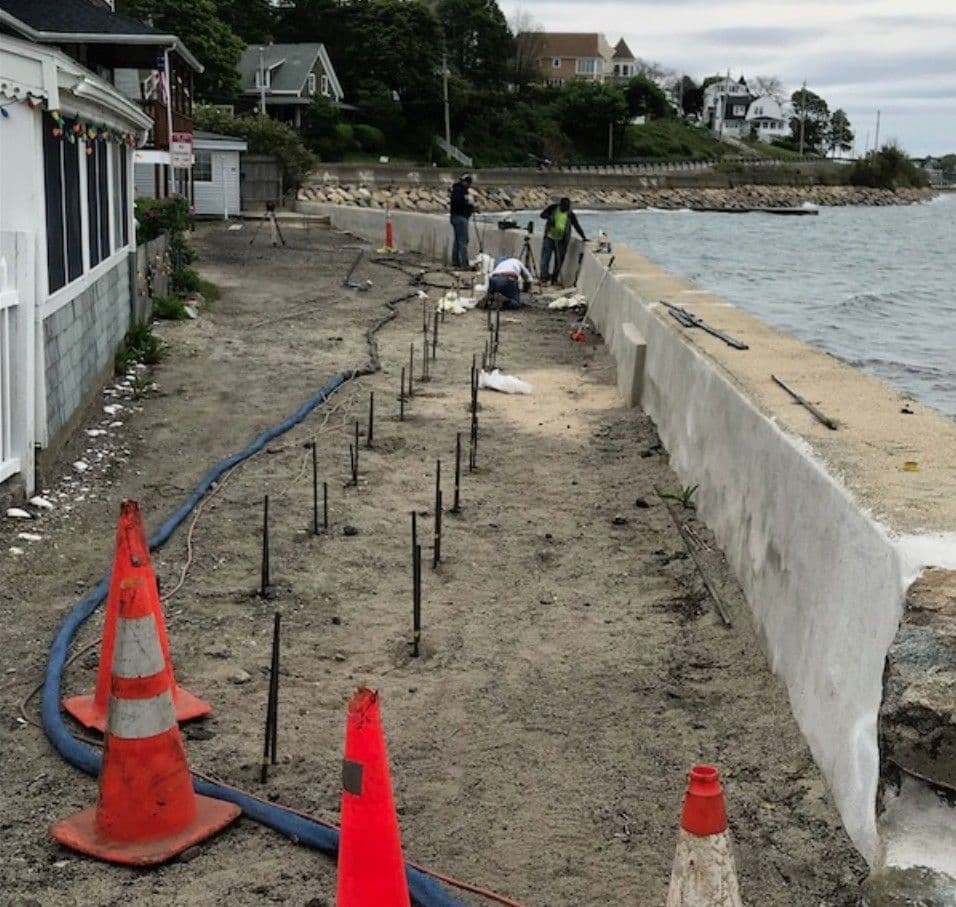
Injection tubes installed in the landside treatment grid adjacent to the seawall: the array of small- diameter tubes extends along the full treatment corridor, with traffic cones marking the active work zone; the entire program was executed with only brief lane restrictions rather than a full road closure
The entire injection program was completed over approximately one week. All work was performed from the existing pavement and shoulder: no trenches were dug, no demolition was performed, and no heavy equipment was staged on the roadway. The road remained open throughout with only brief lane restrictions during active injection work.
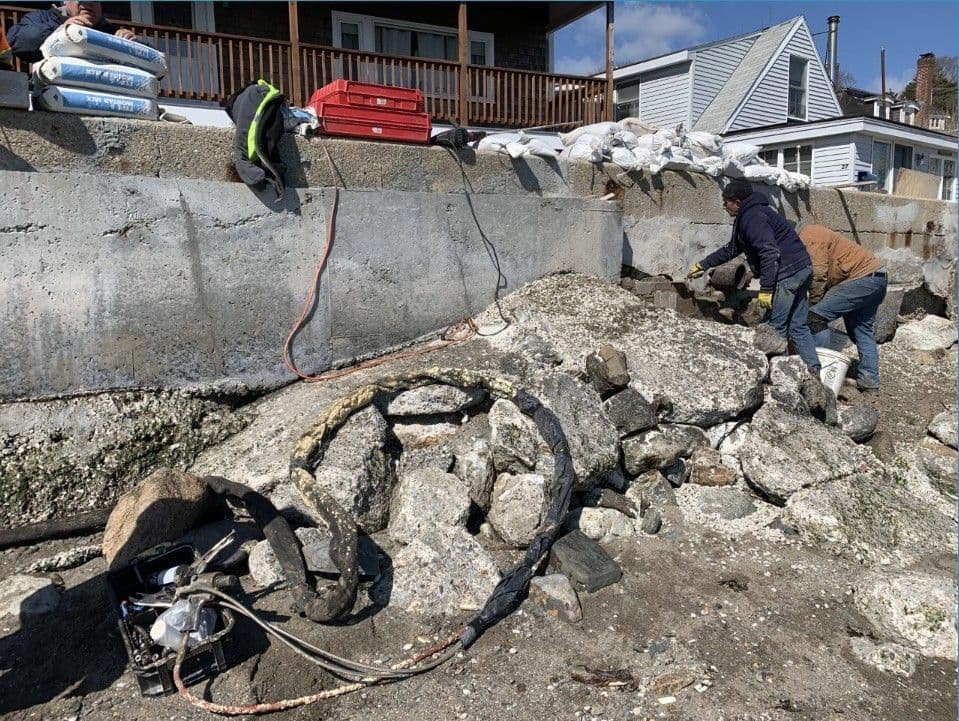
Close-up of injection equipment and lines at the seawall face: the precision of the port placement and the routing of injection lines along the wall illustrate the controlled, surgical nature of the repair methodology compared to conventional excavation-based approaches
One week versus one year. For a municipality managing a busy coastal roadway where closures create cascading impacts on traffic, emergency access, and community function, that operational profile is as important as the engineering outcome. A one- week repair with lane restrictions is a fundamentally different project than a months- long reconstruction with full road closure.
The stabilized section has remained sound since treatment, and the results speak to the durability of the repair in one of the most demanding tidal environments on the East Coast.

Sinkhole eliminated. The voids behind the wall that had produced the sinkhole were completely filled. No new sinkholes have appeared since treatment.
Backfill re-consolidated. The fine sand that had been loosened and transported by tidal scouring was pressed back into a dense, stable mass by the expanding resin. The ground behind the wall now carries its loads safely, and the pavement above it is level and solid.
Seepage pathways sealed. The resin bonded to both the soil and the concrete wall face, closing the joint-level pathways that water had been using to scour sediment. The mechanism that caused the problem has been interrupted at its source.
Stormwater outfall protected. The stabilized embankment now provides the support that the adjacent stormwater infrastructure depends on, eliminating the cascading failure risk that the original void condition had created.
Existing infrastructure preserved. The seawall and roadway were both preserved in place. No reconstruction was required. The municipality received a durable repair at a fraction of the cost and disruption of a full rebuild.
Long-term performance confirmed. The repair has held through continued tidal cycling: the same twice-daily, 12-foot tidal swings that caused the original damage have not compromised the treated section. The hydrophobic resin is performing exactly as designed in permanent tidal exposure.
Scouring is invisible until it produces a sinkhole. Tidal energy working beneath and behind a seawall removes soil gradually, over years, through pathways that are not visible from the surface. By the time a sinkhole appears, the subsurface damage is extensive. Proactive assessment of aging seawalls in high-tide environments, before surface symptoms develop, is the most cost-effective risk management strategy available.
The wall is not the problem. The ground behind it is. When the seawall structure itself is still sound, the repair should target what has actually failed: the eroded backfill and the seepage pathways through the joints. A targeted injection program addresses both without the cost and disruption of replacing a structure that does not need replacing.
High-tide environments demand hydrophobic materials. In a nearly 12-foot tidal range, the treatment zone is fully saturated twice daily for the life of the repair. The injection material must cure in wet conditions, resist hydraulic erosion forces, and maintain its structural properties in permanent tidal exposure. Hydrophobic polyurethane resin is designed for exactly this service condition.
One week versus one year. A polymer injection program that stabilizes the ground behind a seawall in approximately one week, with only lane restrictions, is not just faster than a full reconstruction. It is a fundamentally different class of project. For municipalities where road closures carry political, economic, and safety consequences, the timeline difference is often the deciding factor.
If you are managing a seawall, bulkhead, or coastal retaining structure where tidal action is scouring soil from behind or beneath the wall, especially if sinkholes, pavement settlement, or utility failures have already appeared as surface symptoms, URETEK can evaluate whether deep-injection polymer stabilization is the right solution for your site. We will assess the extent of void development and soil loss behind your wall, design an injection program that fills the voids, re-consolidates the backfill, and seals the scouring pathways, and execute the work around your tidal windows with minimal disruption to the roadway and community above.

 800-240-7868


