

Location
Oregon coast, riverfront marine facility
Structure Type
Working marine facility with concrete slab and supporting infrastructure on a tidal river
Core Challenge
Soft, saturated coastal soils had lost density and bearing capacity beneath the facility slab, with voids and erosion channels developing from groundwater movement and tidal action
Subsurface Conditions
Native fill and loose sands near continuous saturation, with significant hydrostatic pressure and active erosion undermining the slab and adjacent infrastructure
Regulatory Constraint
All work had to comply with marine permit windows and minimize environmental disturbance below the mudline
URETEK Scope
Deep polymer injection program using hydro-insensitive expanding resin to fill voids, consolidate loose sands, and restore bearing capacity beneath the facility, entirely trenchless, with no excavation or dewatering
Result
Post-injection testing confirmed substantially higher soil stiffness and bearing capacity, with treated soils exhibiting strength comparable to compacted rock. Facility operations including crane lifts and boat traffic continued uninterrupted throughout the work
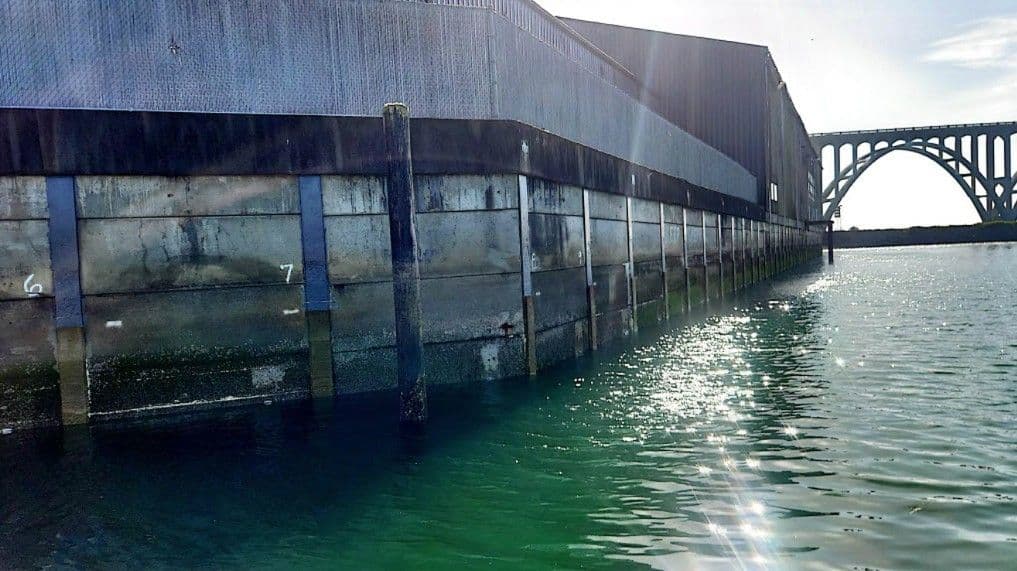
The marine facility structure on Oregon's coast: the concrete seawall and building extend along the tidal river, with a historic arch bridge framing the site; the scale of the infrastructure and the active tidal environment define every constraint that the stabilization program had to work within
A marine facility on Oregon's coast was built on the kind of ground that coastal engineers know well, and worry about constantly. Native fill and loose sands beneath the facility's concrete slab had lost density over time, and the soils were near continuous saturation from high groundwater and tidal influence on the adjacent river. The result was a foundation that was slowly failing.
Voids and erosion channels had formed beneath the slab, carved by groundwater moving through the loose, saturated soils. The combination of weak bearing capacity, active void development, and significant hydrostatic pressure in the ground created a condition that was getting worse with every tidal cycle, and threatening settlement of both the slab and the infrastructure that depended on it.
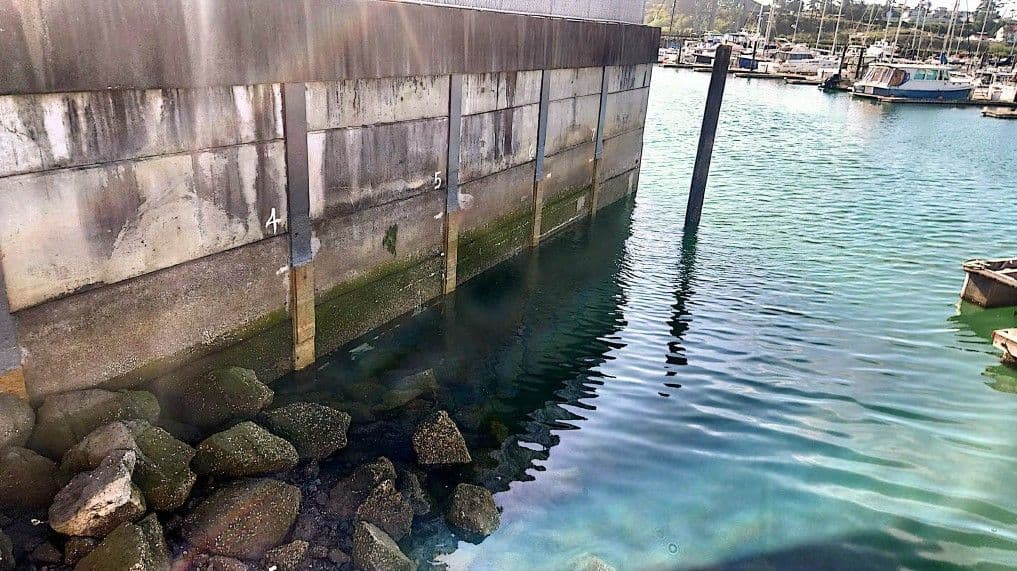
The facility seawall from the water: panel joints, tide-line staining, and the tidal zone visible at the base illustrate the conditions beneath which the stabilization program had to perform; the active marina in the background confirms that operations could not be interrupted during the work
For engineers evaluating this kind of coastal ground condition, the diagnosis is familiar but the solution is often not straightforward: the soils lack sufficient bearing capacity, voids are developing from erosion and groundwater movement, and the hydrostatic environment means conventional stabilization methods face saturated conditions they may not be designed to handle. This is not a site where you can dewater, excavate, and replace the soils. It is a site where the ground has to be improved in place, in the conditions it currently exists in, without disrupting the facility that sits on top of it.
Marine facilities present a unique combination of constraints that narrows the field of viable stabilization methods significantly.
The native soils were near saturation with significant hydrostatic pressure, meaning any stabilization material had to perform in wet conditions as a permanent reality, not a temporary inconvenience during installation. Materials that require dry conditions, that lose strength in the presence of water, or that cannot develop their design properties underwater were not candidates for this application.
The problem was not static. Groundwater movement and tidal action were actively creating new voids and erosion channels beneath the slab. A solution that only addressed existing voids without also densifying the surrounding loose sands would leave the facility vulnerable to continued erosion: the new voids would simply form around the treated zones.
The waterfront location meant all work had to comply with marine permit windows and avoid disturbance below the mudline. Deep excavation, large-scale dewatering, or any method that could release sediment or material into the river was not an option. The stabilization had to be performed from the surface with a minimal environmental footprint.
This was a working marine facility: crane lifts, boat traffic, and daily operations could not be shut down for an extended construction campaign. The stabilization method had to work around the facility's operations, not the other way around.
URETEK stabilized the loose subgrade soils using a trenchless deep injection program: small-diameter steel tubes pushed to design depths from the surface, through which a high-density, hydro-insensitive expanding polymer resin was injected in controlled, staged lifts. No excavation. No dewatering. No disturbance below the mudline.
Before any injection work began, URETEK performed a detailed site assessment and geotechnical review to map the subsurface conditions, identifying the extent of void development, the depth and density of the loose sand zones, and the locations where bearing capacity was most compromised. Based on that characterization, the engineering team designed a grid of injection points at precise depths and spacing tailored to the actual conditions beneath the facility.
This front-end engineering step is what separates a controlled stabilization program from guesswork. The injection grid, depth targets, and material volumes were all derived from the site data, not from a standard template applied regardless of conditions.
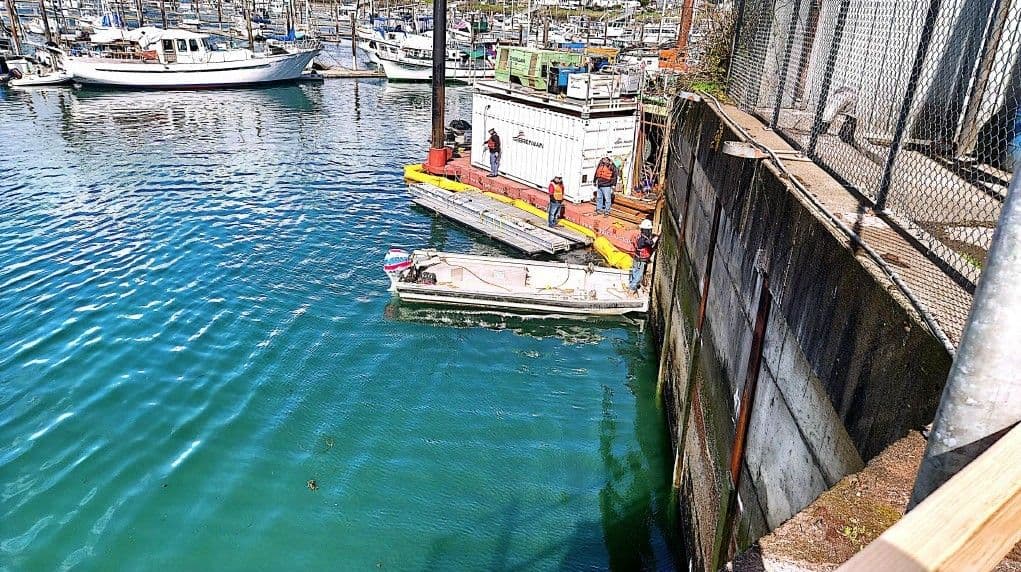
URETEK equipment staged on a work barge alongside the facility structure: marine-access operations allowed the crew to treat the wall and subsurface zones directly adjacent to the water without disturbing the facility above; the barge configuration kept the surface footprint minimal and the facility operational throughout
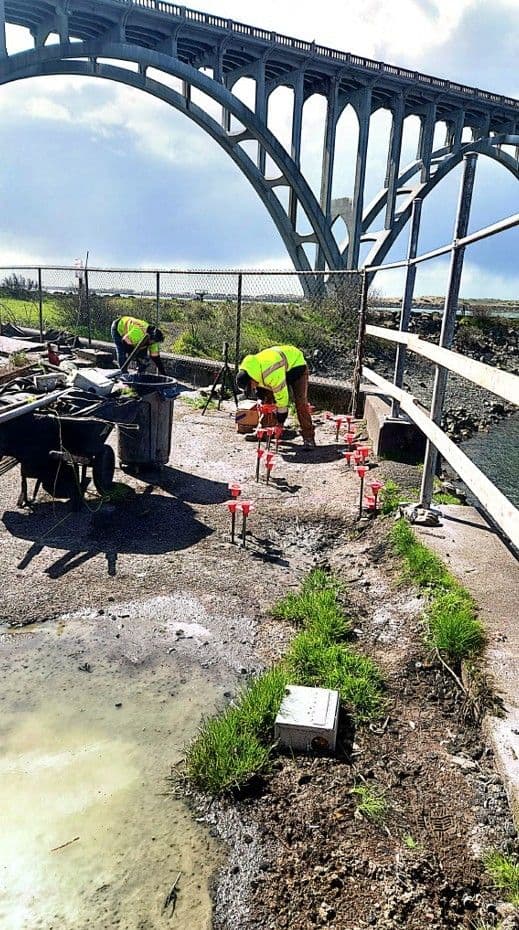
URETEK crew performing injection at the facility perimeter: working beneath the historic arch bridge, the team installs and sequences injection points across the treatment area; the red-capped ports mark completed locations as the crew advances systematically through the grid
Small-diameter steel tubes were pushed into the ground to design depth with minimal surface disturbance. Through each tube, the expanding polymer resin was injected in controlled, staged lifts, building the treatment from the bottom up through the full depth of the compromised soil zone.
As the resin entered the ground, it expanded to fill void space, permeated into the pore structure of the surrounding loose sand, and bound the soil particles into a dense, consolidated matrix. The material displaces pore water as it expands, which is what drives the densification effect: the water that was keeping the soil loose and weak is replaced by an expanding structural material that locks the soil grains into a tighter, stronger configuration.
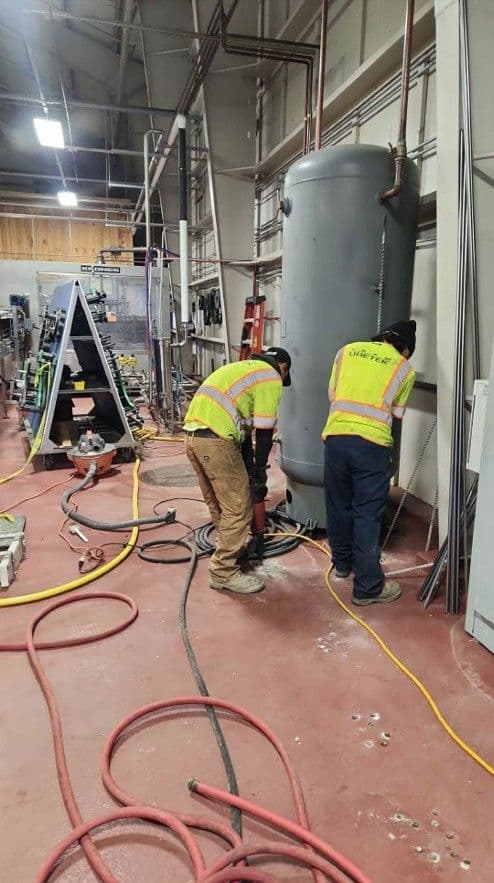
URETEK crew performing injection through the facility concrete slab: the interior treatment phase addressed bearing capacity loss beneath the slab directly; URETEK branding on crew vests, injection hoses, and drilling equipment are all visible in the active work zone inside the operating facility
Throughout injection, pressures and ground response were monitored in real time to ensure the material was reaching all target zones and that the treatment was producing the intended improvement at each location. This real-time feedback loop is one of the practical advantages of polymer injection: the crew can verify performance during installation rather than waiting for post-treatment testing to discover whether the program worked.
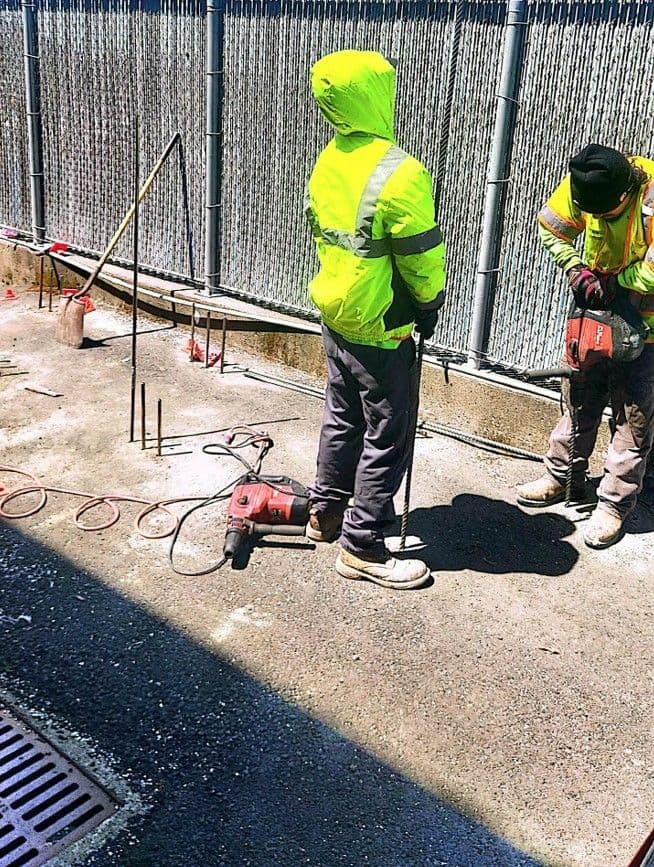
Close-up of injection tube installation at the slab perimeter: crew members drill and drive small-diameter steel tubes to design depth; the precision of the access point placement and the minimal surface disturbance are visible in the tight working conditions alongside the facility's perimeter drain
The single most important material selection criterion on this project was hydro- insensitivity. The soils were saturated, the groundwater was under hydrostatic pressure, and dewatering was not an option. The resin had to expand reliably underwater, cure to its design strength in saturated conditions, and maintain its structural properties indefinitely in an environment that would never be dry.
The hydro-insensitive resin system selected for this project is specifically designed for this condition: a material that expands and cures in the presence of water without losing density, strength, or durability. In a tidal riverfront environment where the treated soils will be permanently submerged or cyclically saturated, this is not a material preference. It is a structural requirement.
The injection program was executed exactly as planned, and the results were confirmed through post-treatment testing.

Bearing capacity restored. Post-injection testing confirmed substantially higher soil stiffness and load-bearing capacity throughout the treated zone. Concrete load tests and penetrometer readings showed the treated soil behaving like firm, compacted material: one engineer reported that the stabilized soils exhibited strength and consolidation comparable to rock.
Voids eliminated. The expanding resin filled all accessible void space and erosion channels beneath the slab, eliminating the cavities that had been developing from groundwater movement and tidal cycling.
Soils densified. The loose, saturated sands that had lost density were consolidated into a dense, reinforced matrix, bound by the cured polymer into a composite material with dramatically improved structural properties.
Environmental compliance maintained. All work was performed from the surface through small-diameter access points with no excavation, no dewatering, and no disturbance below the mudline. Marine permit requirements were fully satisfied.
Operations uninterrupted. Crane lifts, boat traffic, and daily facility operations continued throughout the injection program without delay or restriction.
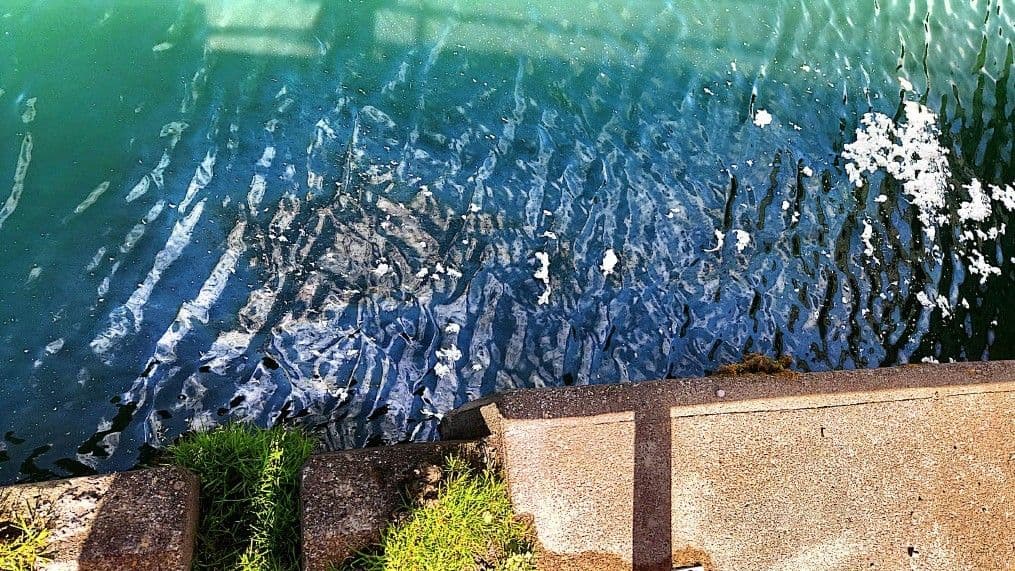
Cured polymer resin visible at the waterline at the base of the treated structure: the material that expanded into void spaces and soil pores during injection is visible as it contacts the water surface; this is direct visual confirmation that the treatment reached the critical zone at the soil-water interface
The facility's concrete slab and supporting infrastructure now sit on stabilized, densified soils that resist both settlement and continued erosion, a durable outcome that protects the asset for the long term in an environment that will continue to challenge it.
Coastal soil stabilization must work in the conditions that exist, not the conditions you wish existed. Saturated, pressurized, tidally influenced soils cannot be dewatered or excavated on most marine sites. The stabilization method and material must perform in wet conditions as a permanent operating state. Hydro- insensitive polymer injection is designed for exactly this reality.
Void filling and soil densification are both required. Filling existing voids without densifying the surrounding loose soil leaves the site vulnerable to new void formation. The expanding resin does both simultaneously: filling cavities while compacting and binding the adjacent soils into a stronger matrix.
Marine facilities cannot shut down for ground improvement. A trenchless injection program using small-diameter probes and portable equipment can be executed around active facility operations: crane lifts, vessel traffic, and daily production. The stabilization works around the facility, not the other way around.
Post-treatment verification confirms what real-time monitoring suggests. Monitoring pressures and ground response during injection provides immediate confidence that the treatment is working. Post-injection load testing and penetrometer readings confirm the improvement quantitatively, giving engineers the data they need to close out the project with confidence.
If you are managing a marine facility, port structure, dock, bulkhead, or any coastal asset where the subgrade soils are soft, saturated, and losing bearing capacity, especially in environments where marine permits restrict disturbance, operations cannot be interrupted, and conventional excavation is not feasible, URETEK can evaluate whether a deep polymer injection program is the right solution for your site. We will characterize your subsurface conditions, design an injection program tailored to your soil profile and operational constraints, and execute a trenchless stabilization that restores bearing capacity and controls void development, with little or no excavation where conditions permit, without dewatering, and without shutting down your facility.

 800-240-7868


