

Location
West coast of Florida
Structure Type
Aging concrete seawall along a high-traffic municipal waterfront promenade adjacent to an active marina and new waterfront development
Core Challenge
Frequent voids and soil loss behind the seawall caused by leaking joints and tidal action, creating a hazard to pedestrians and cyclists on the promenade and threatening the investment in adjacent new development
Public Safety Dimension
The undermined embankment sat directly beneath a high-volume pedestrian and bicycle corridor, making the void condition not just an infrastructure concern but an immediate public safety risk
URETEK Scope
Systematic expanding resin injection program on a 4-foot grid at three depth targets (4, 8, and 12 feet below grade) to seal leaking joints, fill voids, and consolidate soils beneath the wall footing
Environmental Controls
Containment booms deployed along the entire treatment length to capture any excess material and protect the adjacent marina waters
Result
All joints sealed, all identified voids completely filled, embankment stabilized without excavation or wall replacement, and the city reported being extremely pleased with the outcome
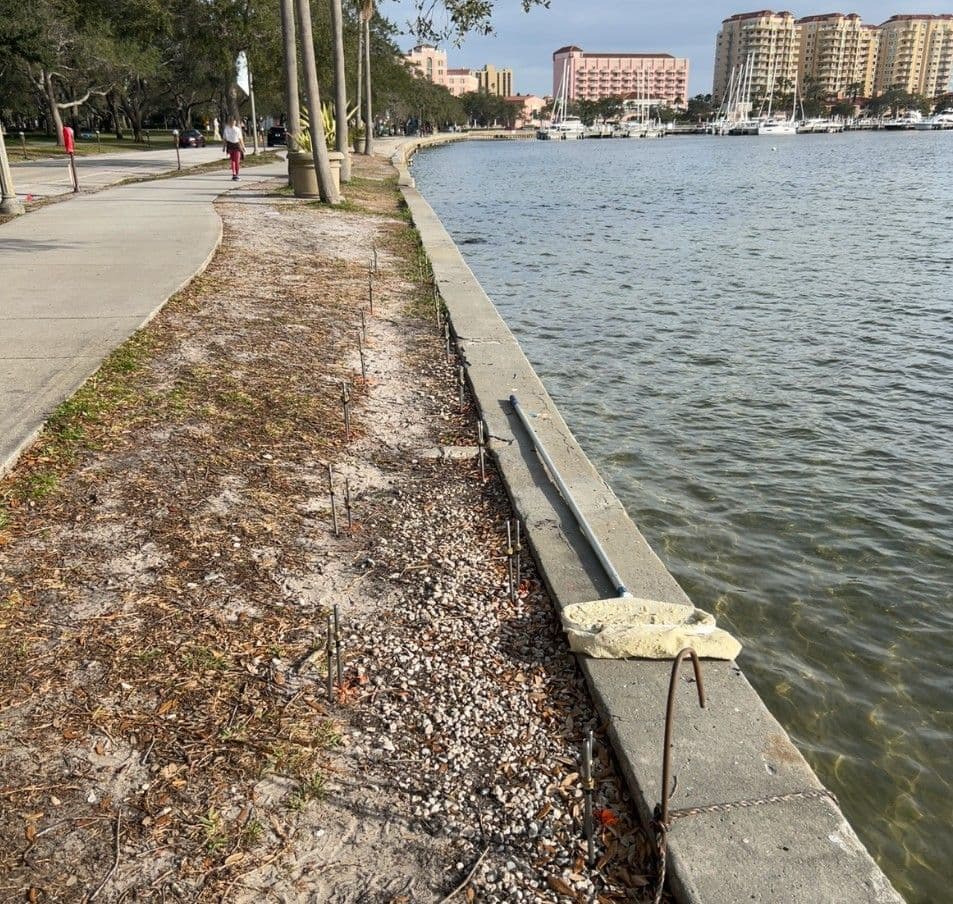
The municipal waterfront promenade: injection tubes mark the full treatment corridor along the aging concrete seawall, with the marina, hotels, and pedestrian walkway visible; a resident continues using the promenade during the repair, illustrating the minimal disruption the methodology delivered
A municipal marina on Florida's west coast features a concrete seawall that forms the boundary between open water and one of the city's most popular waterfront promenades. The walkway above the seawall carries heavy pedestrian and bicycle traffic daily, and directly behind it, a significant new waterfront development was either underway or recently completed. The seawall was not just infrastructure. It was the foundation that the city's waterfront investment depended on.
Recent inspections revealed what the city's engineering staff had suspected: frequent voids and soil loss had developed behind the west seawall, driven by leaking joints and tidal action. Water was moving through the aging wall's joints with every tidal cycle, carrying fine soil particles with it and progressively eroding the embankment that supported the promenade above.
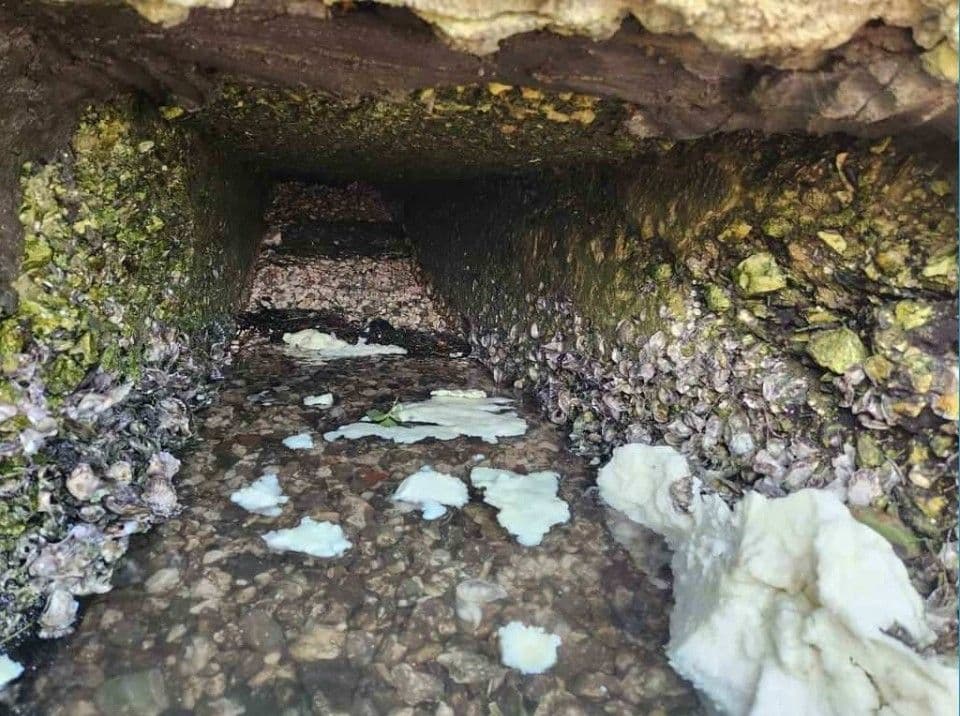
A void exposed at the base of the seawall cap: the hollow cavity lined with marine growth shows exactly how tidal cycling had scoured material from behind and beneath the wall, leaving the embankment that supports the promenade above with nothing beneath it
The situation presented a risk that went beyond infrastructure maintenance: the undermined soils sat directly beneath a high-volume pedestrian and bicycle environment. A void collapse under a crowded promenade is not a maintenance inconvenience. It is a public safety emergency. The city's engineering staff recognized that the condition required remediation, and that a polyurethane injection treatment could stabilize the soils and prevent further hazards.
At the same time, the wall itself showed no immediate danger of structural collapse. The problem was the ground behind it, not the wall itself. That distinction matters because it meant full wall replacement, with its enormous cost, duration, and disruption to the waterfront corridor, was not necessary. What was necessary was stabilizing the embankment, sealing the leak pathways, and restoring the soil support that had been eroded away, all without tearing apart the city's most prominent public waterfront space.
On a busy municipal waterfront promenade, the constraints on how repair work can be performed are as important as the repair itself.
Excavating behind the seawall would have meant closing a major section of the pedestrian corridor, disrupting an active marina operation, and potentially destabilizing the very soils the project was trying to protect, all in a highly visible public setting where construction disruption carries political and community-relations consequences. A full seawall rebuild would have been orders of magnitude more expensive and disruptive than the condition warranted, given that the wall structure itself was sound.
The city needed a targeted, low-disruption approach that could fill the voids, seal the leaking joints, and consolidate the weakened soils behind the wall, through small access points, without extended closures, and with environmental controls that protected the adjacent marina waters. The solution had to be surgical: fix what was broken without disturbing what was working.
URETEK designed a systematic injection program to address the full depth of the compromised embankment, from the shallow void zone immediately behind the wall down through the sand beneath the wall footing. The approach was deliberate, layered, and controlled at every stage.
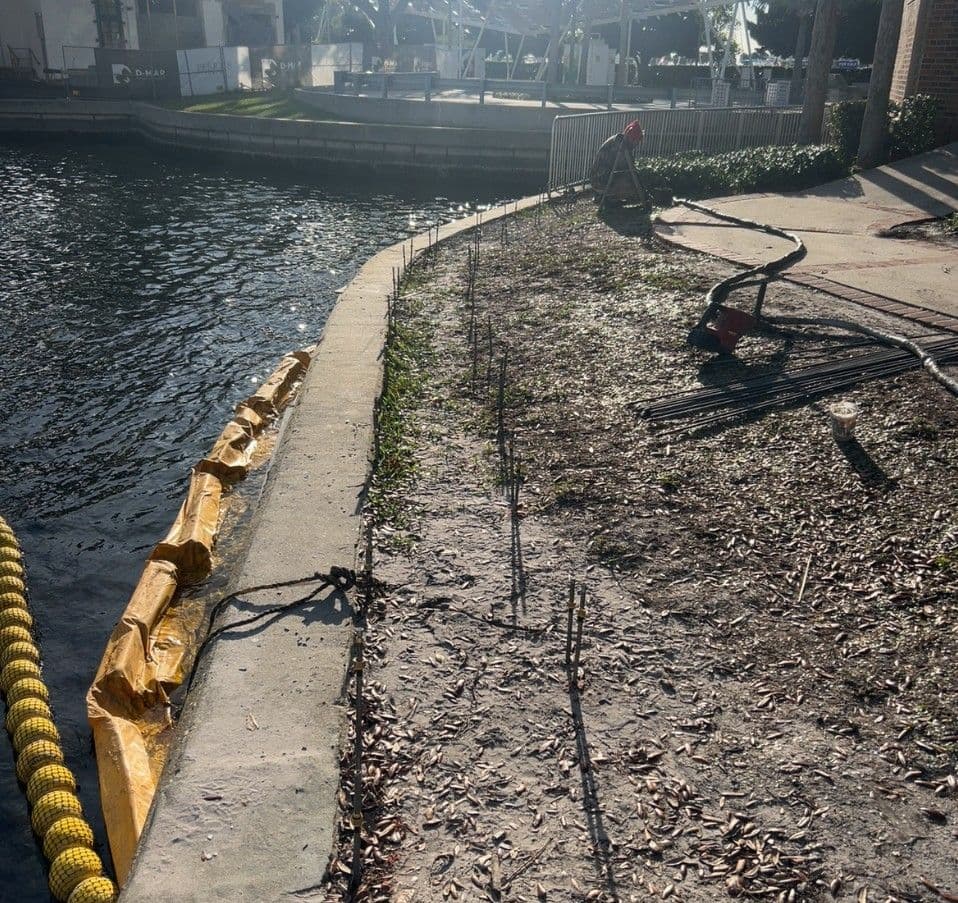
Injection tubes installed in the treatment grid with containment booms deployed along the full waterside length: the dual setup captures the two defining features of this project: the precision of the injection grid addressing every depth zone behind the wall, and the environmental protection ensuring nothing reaches the marina
Small-diameter drill holes were placed on a 4-foot grid just behind the seawall. Through each access point, resin was injected at three distinct depth targets: 4, 8, and 12 feet below grade, each serving a specific purpose in the overall stabilization.
Shallow injections at 4 and 8 feet targeted the void zone closest to the wall, where soil loss from leaking joints had been most aggressive. These injections filled the voids that had developed behind the wall and sealed the seepage pathways at the joint interfaces, stopping the mechanism that was pulling soil through the wall with every tide cycle.
Deep injections at 12 feet targeted the sand beneath the wall footing, consolidating the foundation soils and preventing further washout at the base of the structure. This deep treatment is what protects against long-term undermining: even if the shallow void filling stops the active soil loss, the footing-level soils must be competent to maintain the wall's structural stability over its remaining service life.
In all cases, injections were performed at low pressure to fill voids through permeation rather than forcing soil displacement, an important distinction when working behind an aging concrete structure where excessive pressure could do more harm than good.
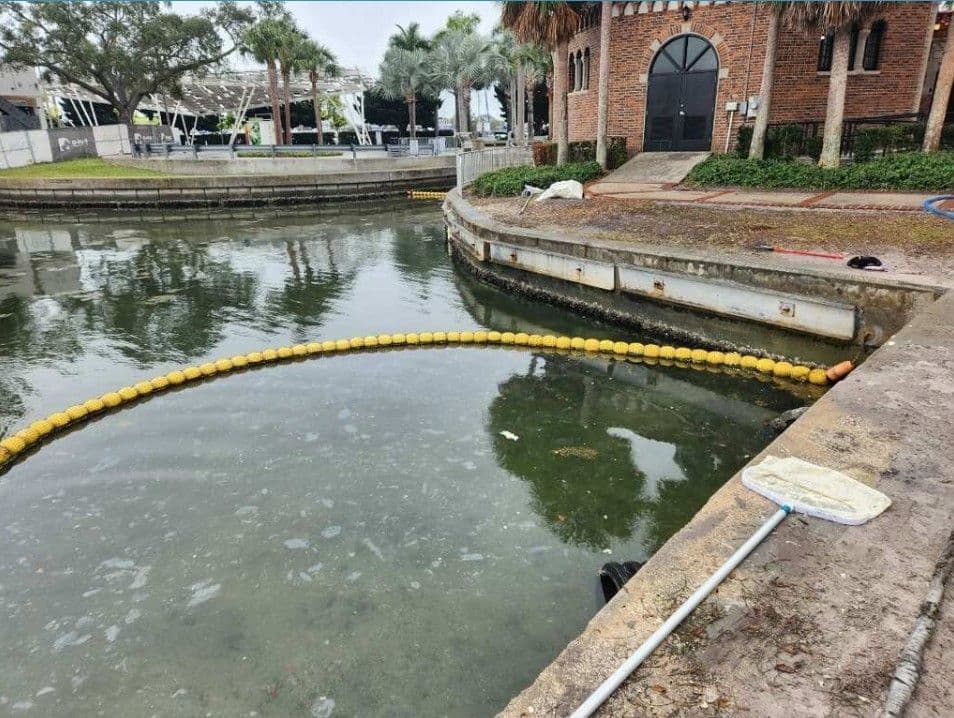
Containment boom deployed in a circular pattern at the marina water's edge: positioned to capture any resin material that might escape through the wall joints during injection; the historic brick building and marina development visible in the background illustrate the high-visibility public setting where environmental compliance was non-negotiable
Because the seawall directly borders marina waters, URETEK deployed containment booms along the full length of the treatment zone throughout the injection program. The booms were positioned to capture any cured resin that might escape through the wall joints before it could reach the water, providing a physical containment barrier between the work and the marine environment.
This is standard practice on URETEK's waterfront projects, but it is worth highlighting for engineers and municipal owners evaluating polymer injection for their own seawall assets. The environmental control is built into the methodology, not added as an afterthought. The injection approach itself generates minimal disturbance: no excavation, no spoils, no heavy equipment on the waterfront. The containment booms provide a second layer of protection for the adjacent waters.
The injection program delivered comprehensive results across every project objective.
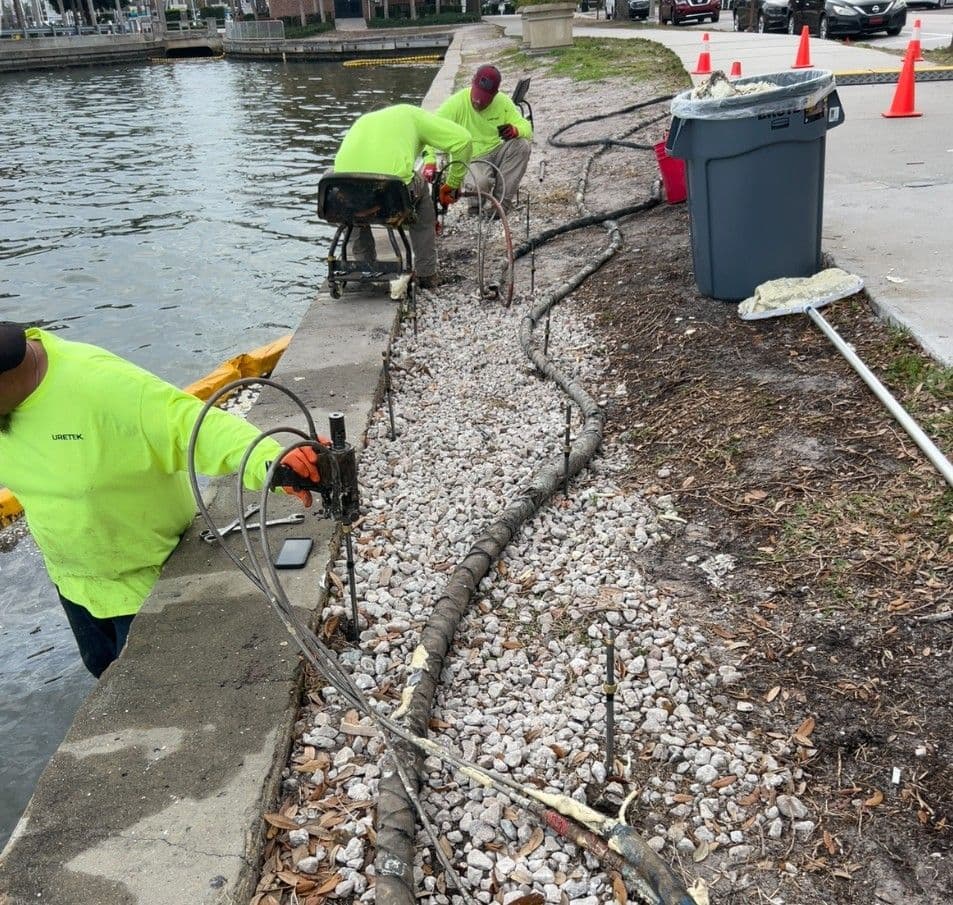
URETEK crew performing active injection at the seawall: two technicians manage injection equipment and lines simultaneously along the treatment corridor, with the containment boom visible at the wall face and the marina immediately behind; the entire scope was completed with no excavation, no closures, and no disruption to the promenade above

All joints sealed. Every joint in the work area was sealed by the expanding resin, interrupting the tidal seepage pathways that had been driving soil loss behind the wall.
All voids filled. Every identified void behind the seawall was completely filled. The embankment was re-established as a continuous, stable mass supporting the promenade above.
Footing soils consolidated. The deep injections at 12 feet strengthened and densified the sand beneath the wall footing, protecting against continued undermining and extending the effective service life of the existing seawall.
Environmental compliance maintained. Containment booms captured any escaped material throughout the program. The adjacent marina waters were protected for the duration of the work.
No disruption to the waterfront. The work was performed through small- diameter access holes with no large excavations, no extended closures, and no heavy equipment on the promenade. The city's most visible public waterfront space was preserved throughout the project. At completion, city representatives reported being extremely pleased with the outcome. The seawall embankment was stabilized, the public safety risk was eliminated, and the city's investment in its waterfront development was protected, all without the cost, duration, or disruption of a full wall rebuild.
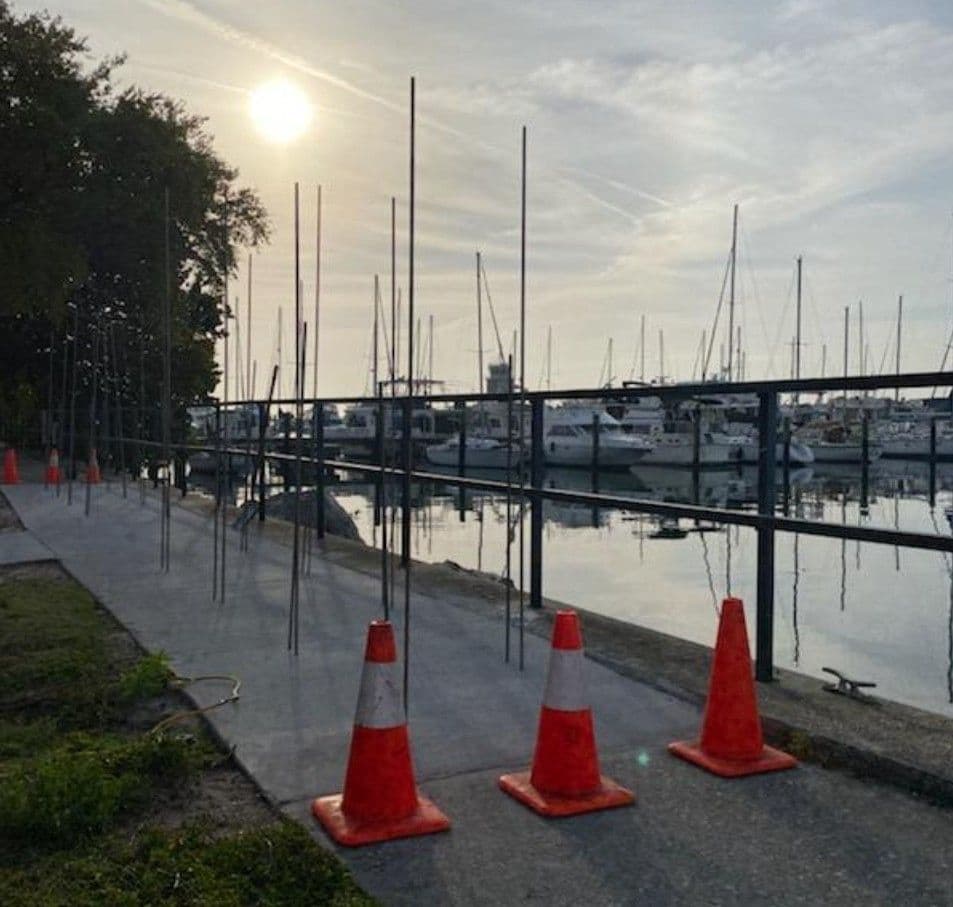
Injection tubes installed along the marina promenade at dawn: the grid of small-diameter tubes extends along the full treatment length, with sailboat masts reflected in the calm marina water; the scale of the work and the beauty of the setting together capture what was at stake and why a no-excavation, no- disruption approach was the only viable path forward
Not every seawall problem requires a new seawall. When the wall structure itself is sound but the ground behind it has been eroded by leaking joints and tidal action, targeted injection stabilization can restore the embankment at a fraction of the cost and disruption of full replacement. The critical assessment is whether the wall needs to be rebuilt or whether the soil behind it needs to be fixed. They are very different problems with very different solutions.
Layer-by-layer depth targeting treats the full failure zone. Shallow injections seal the leak pathways and fill the voids closest to the wall. Deep injections consolidate the foundation soils beneath the footing. Both are necessary for a durable repair: treating only the shallow zone leaves the footing vulnerable, and treating only the deep zone does not stop the active soil loss.
Public waterfront assets demand invisible repairs. On a municipal promenade with heavy foot traffic and high community visibility, the repair method must be as unobtrusive as the problem is urgent. Small-diameter access holes, little or no excavation where conditions permit, no heavy equipment, and no extended closures: polymer injection is inherently compatible with the operational and political realities of public waterfront infrastructure.
Environmental containment is standard practice, not an extra. Containment booms along the treatment length protect adjacent waters as a matter of course. For municipal owners operating in regulatory environments where environmental compliance is non-negotiable, this built-in protection is a significant risk reducer compared to methods that generate excavation spoils, turbid runoff, or heavy equipment operations at the water's edge.
If you are managing a municipal seawall, marina bulkhead, or waterfront retaining structure where inspections have identified voids, soil loss, or undermined embankments, especially along public promenades, parks, or development corridors where disruption must be minimized and public safety is paramount, URETEK can evaluate whether a targeted injection stabilization program is the right solution for your asset. We will assess the void and soil-loss conditions behind your wall, design a depth- targeted injection plan that addresses both the leak pathways and the foundation soils, and execute the work with the environmental controls and minimal footprint that waterfront assets require.

 800-240-7868


