

Location
Coastal United States
Structure Type
Coastal seawall serving a developed waterfront corridor with adjacent hardscape, planters, and public walkways
Treatment Scope
Approximately 215 linear feet of seawall leak cutoff and backfill stabilization, plus a secondary 30 ft × 20 ft area of concrete walkway exhibiting subsidence and cracking
Core Challenge
Active heavy leak pathways through the seawall driving fines migration, void development, and growing settlement risk behind the wall, with the full extent of voiding unknown at the start of work
Site Constraints
Tidal flooding, strict no-dewatering requirement, mandatory turbidity monitoring with stop-work authority, public access maintenance, and a developed waterfront corridor that could not accommodate excavation
URETEK Scope
Landside polymer injection using a hydro-insensitive, high- density structural polyurethane to create a continuous waterproof barrier behind the seawall, fill voids, and densify supporting soils, through penny-sized access holes on a 3-foot grid with a two- row interwoven-depth injection layout
Result
Leak pathways sealed, fines migration interrupted, backfill support restored, secondary subsidence area stabilized, and the treated corridor returned to public use approximately 15 minutes after the final injection, with no dewatering, no excavation, and full environmental compliance maintained throughout
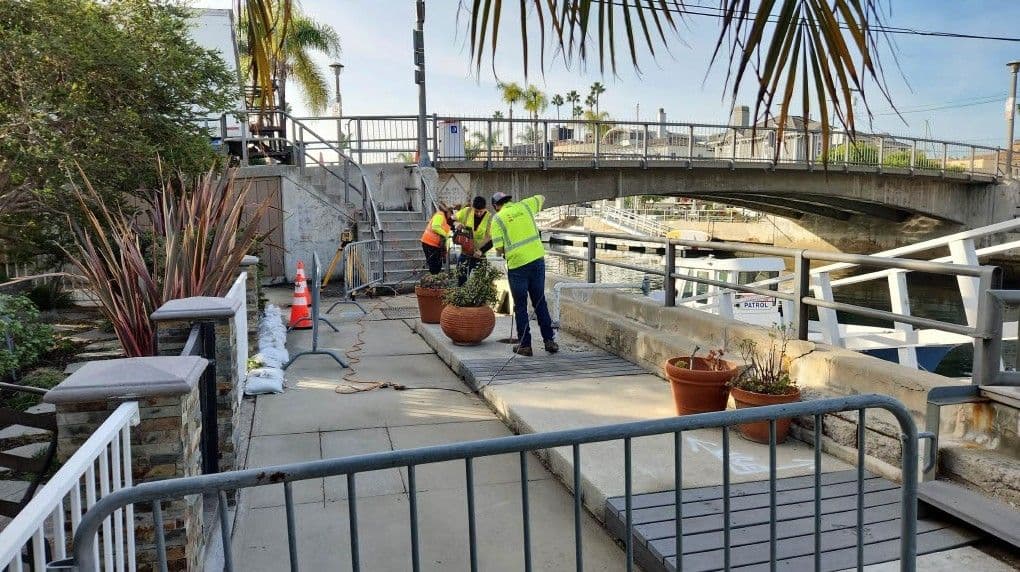
URETEK crew drilling access points along the waterfront walkway beside the canal bridge: the narrow developed corridor, ornamental planters, and active canal-side setting illustrate the access and environmental constraints that defined the entire project; the public promenade required continuous function throughout the repair
A coastal seawall along a developed waterfront corridor was experiencing active, heavy leakage through and behind the wall. This was not nuisance seepage. Water was moving through the wall system with enough force and volume to carry fine backfill material with it, a process that, left unchecked, leads to void development, loss of structural support, and eventually surface settlement or sinkhole conditions behind the wall.
The scope document identified the core concern directly: fines migration was already occurring, and the extent of void space behind the wall was unknown. That uncertainty is one of the most dangerous aspects of this failure mode. By the time surface symptoms appear (depressions, cracked hardscape, visible sinkholes) the subsurface damage is often far more extensive than what is visible from above.
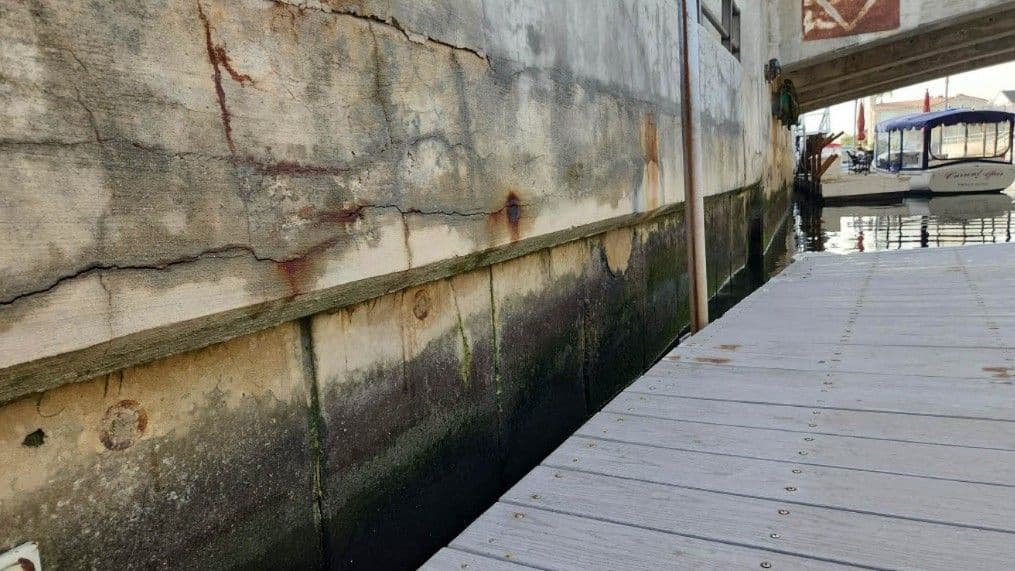
The seawall face viewed from the adjacent dock: cracking, staining, rust bleed from corroding tie-back hardware, and biological growth at the tidal interface are visible across the full panel length; these surface indicators confirmed what the condition assessment suspected: active water movement through aging joints was driving fines migration behind the wall
The damage had already progressed to a secondary location. A roughly 30-by-20-foot section of concrete walkway near the seawall was exhibiting subsidence and extensive cracking, the kind of surface distress consistent with loss of support in the underlying soils. For the owner, the connection was clear: the seawall leaks were not just a water problem. They were actively undermining the ground that supported the adjacent infrastructure.
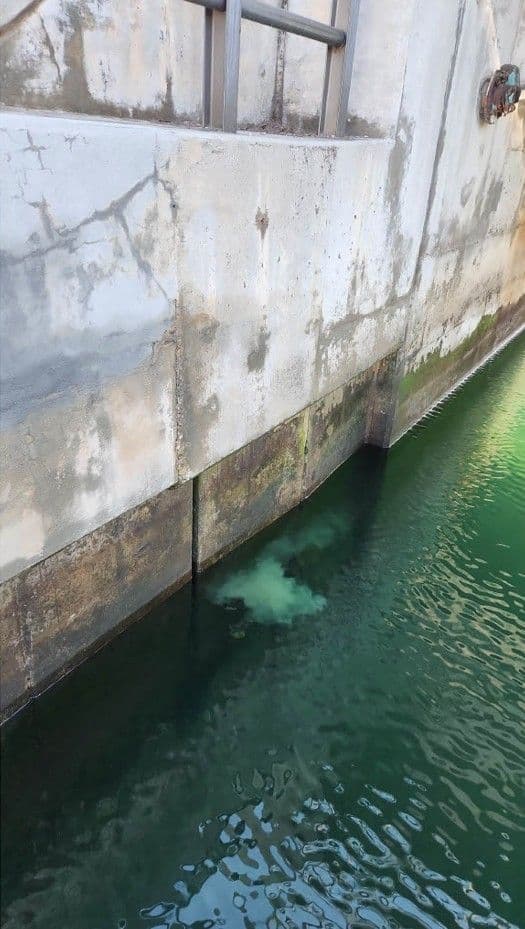
Cured polymer resin visible at the seawall joint interface at the waterline: the material has traveled through the leaking joint during injection and emerged at the seawall face, providing direct visual confirmation that the treatment reached the primary leak pathway; this in-progress observation served as real-time quality control that the barrier was forming exactly where it was needed
This project was governed by a set of contract-specified constraints that did not leave room for traditional approaches.

No dewatering permitted. The bid documents prohibited dewatering outright. In a tidal coastal environment, this eliminates any repair approach that requires drawdown, dry excavation behind the wall, or stable water levels during installation. The solution had to perform in wet, saturated conditions with no ability to control the water table.
Tidal flooding conditions. The site was subject to tidal flooding, with a directive to avoid high-tide nuisance water. Production planning had to work around conditions that change twice a day and cannot be engineered away. The methodology had to tolerate variable water levels without compromising material performance or installation quality.
Turbidity monitoring with stop-work authority. The contract required monitoring the ocean side of the seawall for turbidity, with a stop-work trigger if turbidity became visible in the immediate area. Any method that generated significant soil disturbance, excavation spoils, or sediment release to the water column was not just risky. It was operationally incompatible with the environmental requirements.
Public access and corridor constraints. The waterfront corridor included planters, sidewalks, and residential access that had to remain functional throughout. The repair method needed a small surface footprint, minimal closure duration, and quick return to use.
Unknown void extent. The scope acknowledged a reality common in seawall fines-migration cases: the full extent of void space behind the wall is unknown until remediation begins. The injection program was intentionally designed with conservative coverage to reduce the risk of ongoing settlement or developing sinkhole conditions.
URETEK designed and executed a non-excavation injection program to install a continuous waterproof barrier directly behind the seawall while simultaneously filling voids and densifying the supporting soils weakened by years of fines migration. The entire scope was performed from the landside through 5/8-inch access holes, approximately the size of a penny.
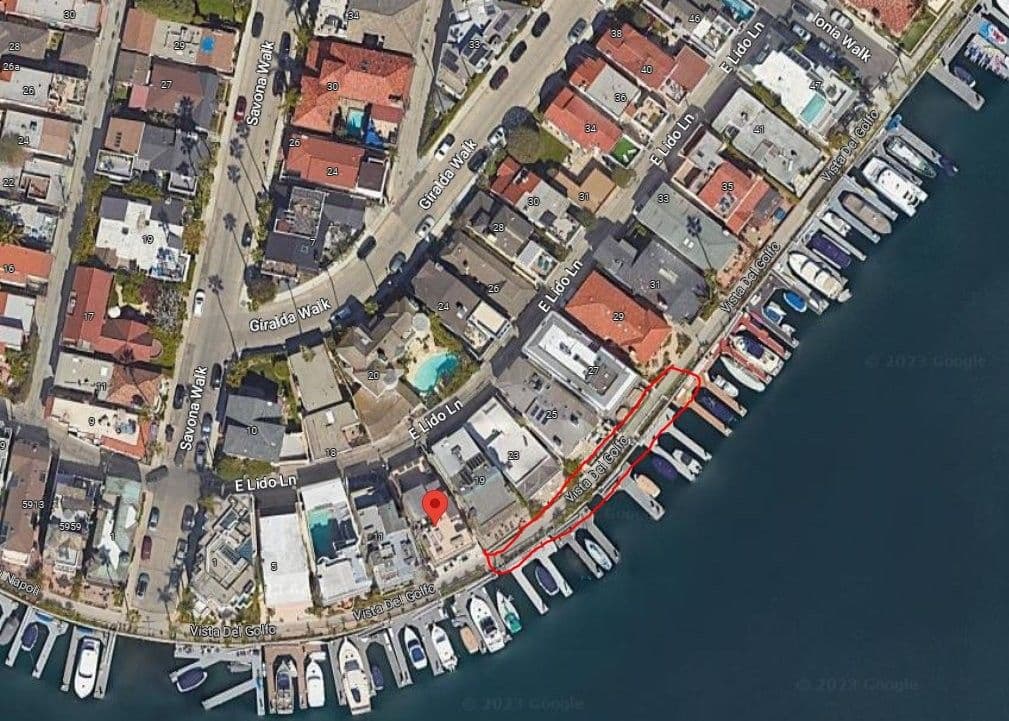
Aerial view of the treatment site with the scope corridor outlined in red: the 215-linear-foot primary treatment zone follows the seawall along the developed waterfront, with the marina and residential properties immediately adjacent; the aerial view illustrates why excavation was never a viable option in this constrained urban waterfront setting
The primary 215-linear-foot seawall treatment used a 3-foot grid of small-diameter access holes drilled from the landside. The injection layout used two rows through existing planters in a staggered 'zipper' configuration with interwoven depths: Row 1 targeted 3, 6, and 9 feet. Row 2, offset from the first, targeted 4.5, 7.5, and 10.5 feet. This geometry is specifically designed to build a continuous treated zone behind the wall rather than isolated injection points: by staggering both horizontal position and vertical depth between rows, the resulting barrier has significantly fewer untreated gaps than a single-row or uniform-depth approach would produce.
For the secondary subsidence area, the 30-by-20-foot section of cracked and settled concrete, the same injection approach was applied on a gridded pattern to restore support by filling voids, displacing water, and densifying surrounding soils.
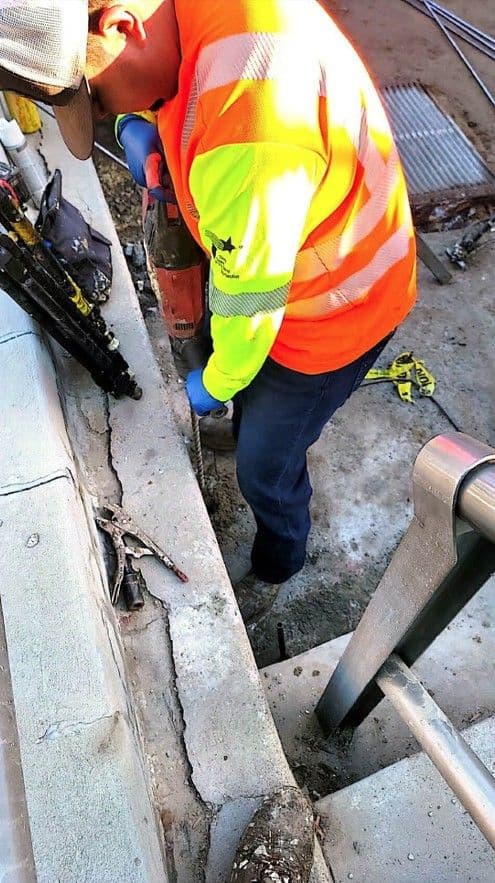
Close-up of drilling operations at the seawall joint interface: the technician drills a small-diameter access hole directly at the crack and joint face; the 5/8-inch access point is barely visible against the concrete surface, illustrating how the entire repair program operated through openings no larger than a penny with no surface demolition or excavation
Thin-walled hollow steel tubes were driven pneumatically to target depths after pre- drilling. The resin was injected at low pressure through the tubes, entering the ground as a low-viscosity liquid that spread into porous spaces and voids in the soil behind the wall. The material then underwent a controlled exothermic reaction, expanding to fill void space, creating contact and confinement against the back face of the seawall, and densifying surrounding soil as it pushed outward into available pore volume.
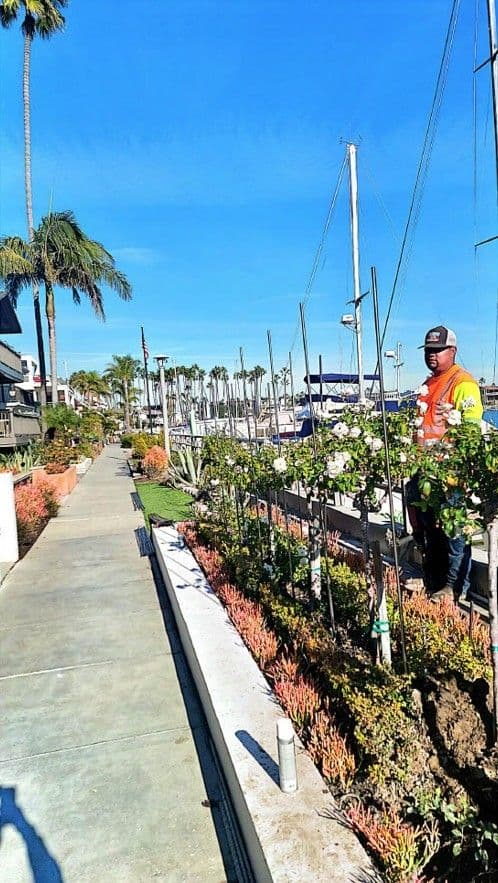
TEAM URETEK crew managing the injection grid along the seawall: the grid of small-diameter tubes extends along the treatment corridor with injection hoses running to the pump unit; the marina and resident boats are visible immediately over the wall, confirming the tidal and environmental exposure that made material selection and containment critical throughout the program
On a tidal site with no dewatering allowed, the injection resin does not get favorable conditions. It must perform in saturated soil, in direct contact with groundwater, and deliver its structural properties as if the water were not there. The material used is a hydro-insensitive, high-density structural polyurethane, inherently hydrophobic, injectable directly into water-saturated conditions, and retaining its density and strength performance in wet environments. It is also characterized as non-hazardous, non-toxic, and environmentally inert.
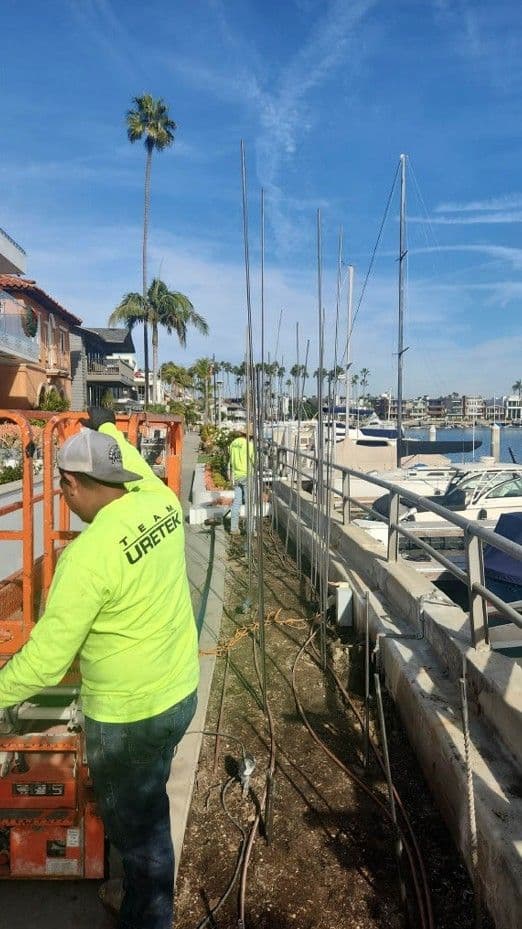
Crew member managing injection tubes installed through the planter bed landward of the seawall: the tubes are placed among established plantings with minimal surface disturbance; returning this corridor to public use approximately 15 minutes after the final injection required that the planters remain intact and undisturbed, a constraint the small-hole injection methodology satisfied completely
Injection tubes were countersunk into the planter areas when the work zone was unattended, eliminating trip and impalement hazards in a public-access corridor. At closeout, all access holes were filled with concrete, cementitious grout, or waterproof epoxy, and excess material was removed from site, leaving the waterfront corridor clean and fully restored.
URETEK's execution treated quality control and environmental protection as integrated requirements, not separate workstreams.
Leak observation as real-time QC. The scope specifically positioned observing active leaks sealing during injection as a practical quality-control indicator. When seepage slows or stops at a joint during treatment, the crew has direct, real-time evidence that the barrier is forming where it needs to. This is one of the most powerful advantages of injection-based seawall repair: the performance feedback is immediate and observable.
Subgrade verification. Dynamic Cone Penetrometer testing was used to confirm subgrade conditions, locate voids, and finalize injection depths, ensuring the treatment targeted actual problem zones.
Surface monitoring. Before-and-after pavement profiling and continuous monitoring during injection using laser levels and dial indicators ensured controlled response during stabilization.
Quantity tracking. Calibrated flow meters recorded injected component quantities at each location, providing a quantitative production record for documentation and review.
Environmental compliance. The small-hole, contained injection approach minimized soil disturbance throughout. Turbidity monitoring was maintained on the waterside, and the stop-work threshold was never triggered.
The injection program delivered on every project objective while maintaining full environmental compliance in a sensitive coastal setting.
Leak pathways sealed. The continuous hydrophobic barrier installed behind the seawall targeted and sealed the heavy leak pathways that had been driving fines migration, interrupting the erosion mechanism at its source.
Backfill support restored. Void space was filled and surrounding soils were densified, reducing the conditions that lead to progressive settlement and sinkhole development behind the wall.
Secondary subsidence addressed. The 30-by-20-foot area of settled and cracked walkway received the same grid-based treatment, restoring support beneath the distressed panels.
Environmental compliance maintained. No turbidity events were triggered. No dewatering was performed. No excavation was required.
Rapid return to use. The treated corridor was returned to public access approximately 15 minutes after the final injection, a critical advantage in a waterfront setting where extended closures create public-interface and scheduling problems that can be as consequential as the repair itself.
Seawall leaks with fines migration are a countdown to failure. Every tidal cycle that moves water through a leaking joint carries more soil with it. The damage is cumulative, often invisible until it manifests as settlement or sinkholes, and the cost of repair increases the longer it is deferred. Early intervention with a targeted injection program is significantly less disruptive and less expensive than the excavation-and- rebuild approach that delayed repairs eventually require.
Unknown void extent demands conservative design. When the subsurface damage behind a seawall cannot be fully characterized before work begins, the injection program should be designed with sufficient coverage to address both confirmed and suspected void zones. An interwoven two-row, staggered-depth layout provides the continuity needed to treat a problem whose boundaries are not precisely known.
Real-time leak observation is the best QC tool available. On a seawall leak- sealing project, watching the leaks stop during injection provides immediate, direct confirmation that the barrier is forming in the right place. No laboratory test or post-treatment report can match the confidence of watching the problem disappear in real time.
15-minute return to use changes the project equation. For waterfront owners managing public corridors, the ability to reopen the treatment area about 15 minutes after the last injection eliminates the extended-closure problem that makes conventional repair approaches operationally and politically difficult. The repair does not just fix the wall. It respects the corridor.
If you are managing a seawall, bulkhead, or coastal retaining structure that is exhibiting active leakage, fines migration, void development, or settlement behind the wall, especially in a tidal environment where dewatering is restricted, environmental compliance is mandatory, and public access must be maintained, URETEK can evaluate whether landside polymer injection is the right solution for your site. We will assess your leakage and soil-loss conditions, develop an injection plan tailored to your tidal constraints and access limitations, and execute a controlled program designed to seal the water pathways and restore the ground support, with little or no excavation where conditions permit, without dewatering, and with rapid-reacting materials that put many repairs back in service the same shift.

 800-240-7868


