

Location
Southwest Florida
Structure Type
Precast concrete seawall panels and associated box-culvert infrastructure along a municipal canal corridor
Core Challenge
Active water intrusion at vertical joints between precast seawall panels, requiring a continuous seal along the panel-to-panel seam line
Defining Constraint
Property restrictions prevented any exterior access: all work had to be performed from inside the box culvert
Schedule
Substantial completion required within 60 days, final completion within 90 days
URETEK Scope
Interior-access polymer injection to create a continuous hydrophobic foam barrier on the backside of the seawall seams, sealing the vertical joints between panels
Result
Water intrusion controlled at treated panel-to-panel seams, seepage pathways sealed, and the work completed from inside the culvert with no exterior excavation, no property disturbance, and no disruption to the surrounding canal corridor
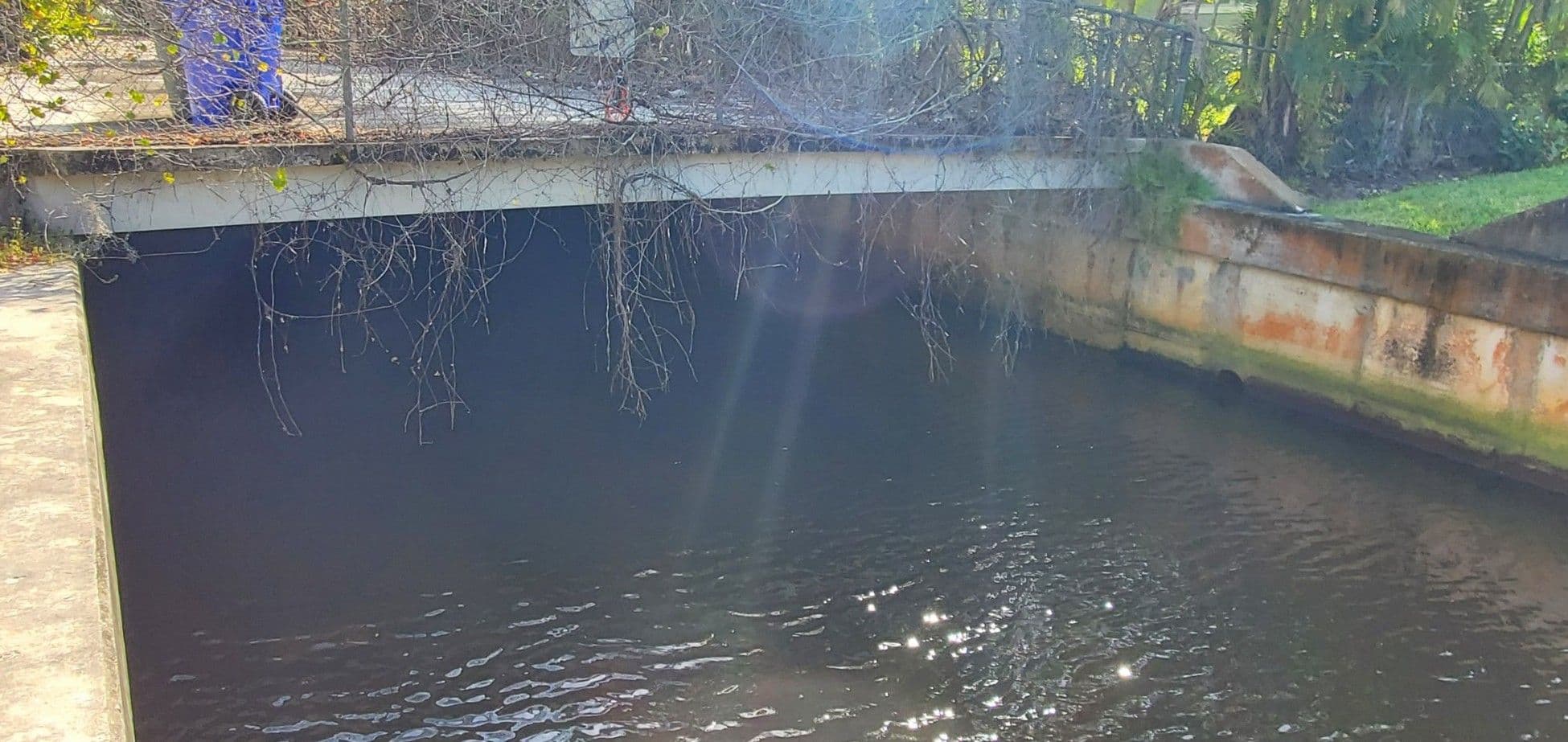
The canal corridor: the precast concrete seawall panels form the boundary between the water and the adjacent properties; active leaking at the vertical panel joints was driving water and fines into the backfill, with all exterior access blocked by property restrictions
A municipal public-works owner in Southwest Florida had a straightforward problem with a complicated constraint. Vertical joints between precast concrete seawall panels along a canal corridor were leaking. Water was migrating through the panel-to-panel seams, and left uncorrected, that seepage would continue to erode supporting soils behind the wall, accelerate deterioration of the joint interfaces, and progressively undermine the structural integrity of the seawall system.
The complication was access. Property restrictions made exterior access impossible. The repair could not be performed from the canal side, from behind the wall, or from adjacent parcels. There would be no exterior excavation, no waterside staging, and no large-scale dewatering operation. Every aspect of the joint sealing, from port installation to injection to verification, had to be executed from inside the box culvert.
For owners and engineers who manage canal infrastructure, seawalls, bulkheads, and waterfront assets, this constraint is not unusual. In fact, it is one of the most common reasons conventional repair methods get ruled out on these structures. The joints need sealing, but the only feasible access is from the interior, and most repair approaches were designed for the other side.
When seawall joints leak, the conventional response typically involves some form of exterior access: excavating behind the wall to expose the joint line, installing or replacing waterstops from the waterside, or reconstructing the joint from the outside. Every one of these approaches requires working from the exterior face of the structure.
On this project, that was explicitly off the table. The contract documents recognized the property restrictions and required the joints to be sealed from inside the box culvert. This single constraint eliminated the most common repair methods and demanded a solution that could reach the intrusion pathway, deliver sealing material to the backside of the joint, and create a durable barrier, all from the interior.
The schedule added urgency. Substantial completion was required within 60 days, with final completion at 90 days. That timeline rewards solutions that are repeatable, predictable, and minimally disruptive, not approaches that require extensive setup, exterior coordination, or multi-phase staging around an active public canal corridor.
URETEK designed and executed an interior-access injection program to create a continuous hydrophobic foam barrier on the backside of the seawall seams. The concept is straightforward: rather than accessing the joint from the outside, URETEK reached the seepage pathway from inside the culvert using strategically placed injection ports that intersected the joint line at depth.
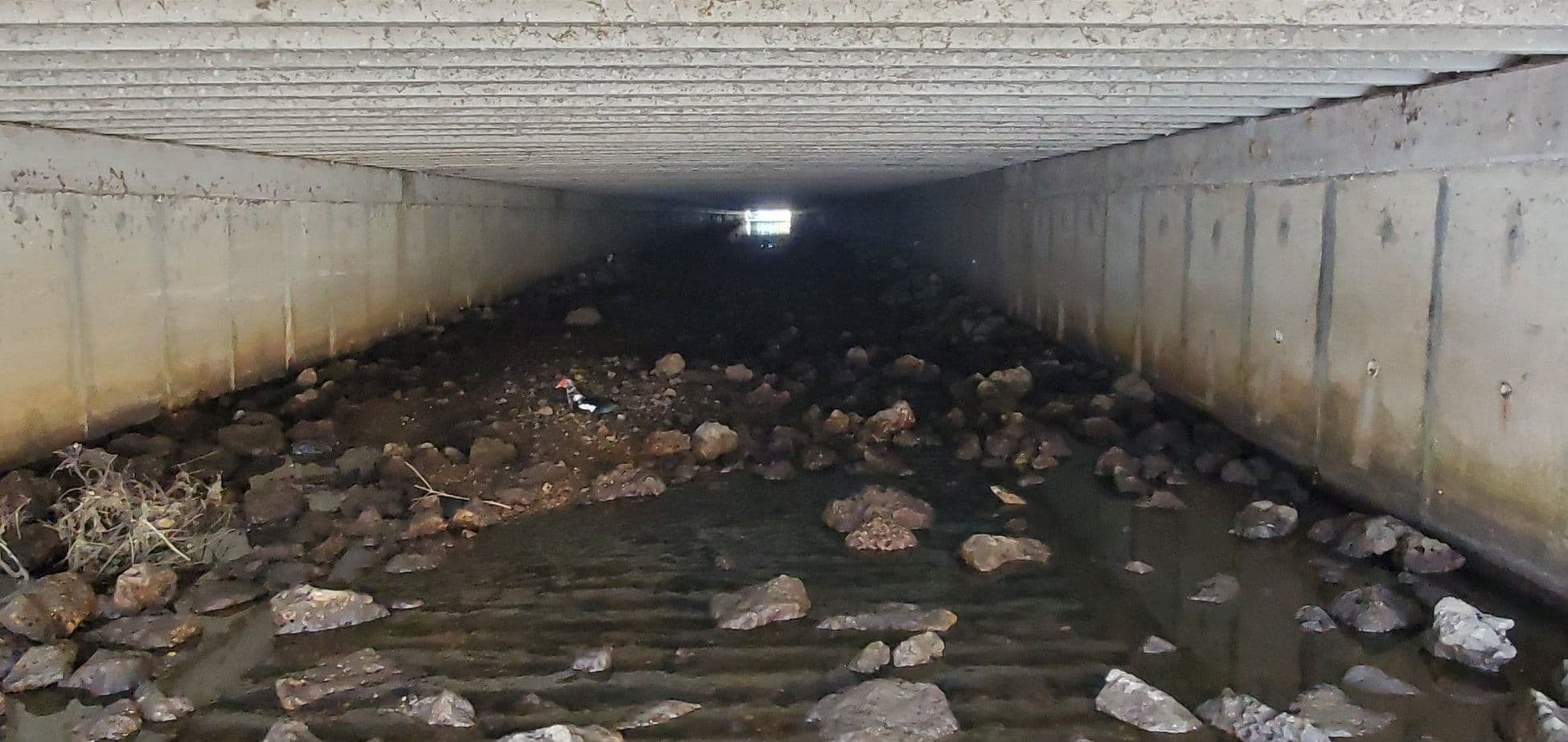
The interior of the box culvert: this is the working environment from which the entire repair was executed; injection ports were installed through the culvert walls and floor to intersect the vertical joint pathways at depth, reaching the seepage source without any exterior access
The installation sequence followed a controlled, repeatable process at each joint location. First, the crew accessed the seam line from inside the culvert and installed injection ports at positions designed to intersect the joint pathway between panels. Then, a low-viscosity, single-component, hydrophobic polyurethane resin was injected through the ports under controlled pressure. The material permeated through the seam and void network behind the joint, traveling into the pathways that water had been using to enter the structure. Once in contact with moisture, the resin reacted and expanded to form a dense, closed-cell foam barrier that sealed the seepage pathways and filled accessible void space along the joint line.
The result is a continuous foam seal on the backside of the seawall seam, installed entirely from the interior, with no disturbance to the exterior face of the wall, the canal corridor, or the adjacent properties.
Material selection on this type of project is driven by the conditions the material has to perform in. At a canal seawall joint, those conditions include active water presence, tight seam geometries, and the need for a seal that holds against hydrostatic pressure from the water side.

Low viscosity for tight pathways. The resin's low viscosity allows it to flow into the narrow seam geometries and fine void networks between precast panels, reaching pathways that thicker materials cannot enter. This is essential because the joint line is not a wide-open void; it is a network of narrow gaps, irregularities, and connected pathways that require a fluid material to fully permeate.
Hydrophobic behavior for water resistance. Unlike hydrophilic grouts that absorb and swell with water, a hydrophobic resin pushes water back and cures into a rigid, water-resistant foam. This distinction matters at a seawall interface where the seal will be permanently exposed to hydrostatic pressure from the canal side. A hydrophobic barrier does not soften, swell, or lose integrity in sustained wet conditions.
Field-adjustable reaction time. The resin's reaction profile can be tuned using a catalyst system, allowing crews to adjust set speed based on actual conditions: temperature, seepage intensity, and joint behavior at each location. In a canal environment where conditions can vary from joint to joint, this field adjustability is what keeps the installation controlled and predictable.
Expansion to fill irregular geometries. Once activated, the material expands to fill void space and compress into the joint geometry, creating a foam barrier that conforms to the actual shape of the seam, not to an idealized joint profile that may not exist in a decades-old precast structure.
All work on this project was performed from inside the box culvert, a confined-space environment that added safety and logistical requirements to every aspect of the operation.
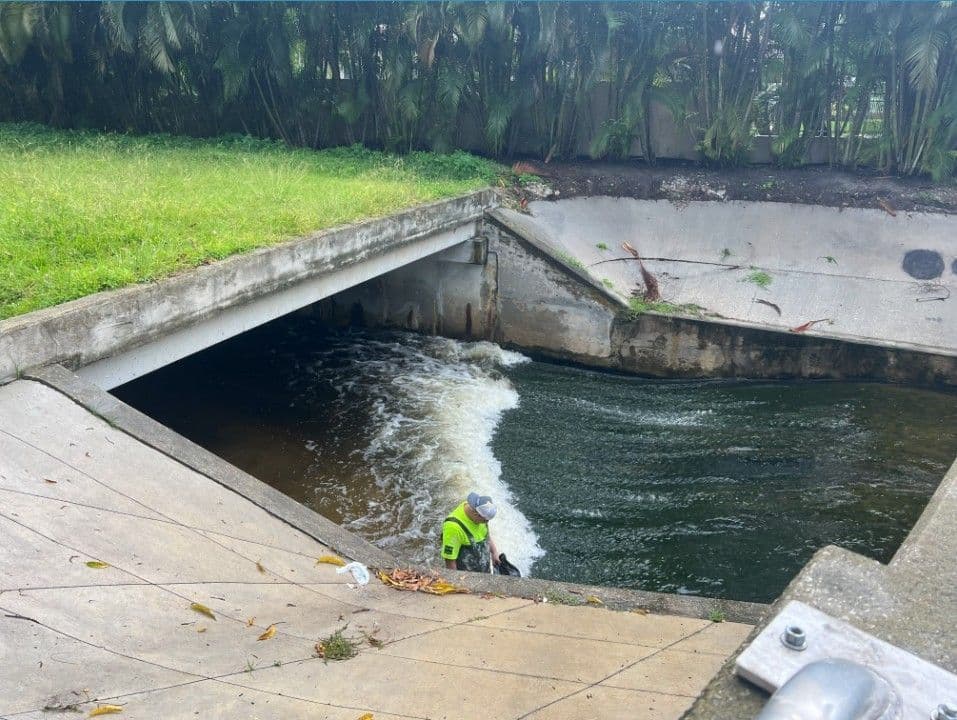
URETEK technician entering the box culvert at the canal inlet: the confined geometry of the structure is immediately visible, as is the active water present throughout the work zone; all injection operations were conducted from this interior access point
The project team treated the culvert as a confined space under OSHA's framework, with entry planning and hazard awareness built into the production sequence from the start. This is not a paperwork exercise. In a box culvert where reactive chemical materials are being injected, conditions can change as work progresses. The safety protocol included continuous monitoring, ventilation management, and material- handling controls designed for the realities of working in enclosed, below-grade spaces.
On the material-handling side, the polyurethane resin requires attention to storage temperature, moisture avoidance during handling, and lift thickness control during injection, because excessive foam mass buildup can generate high internal temperatures during the exothermic reaction. Managing these variables is standard practice for URETEK's crews, but it is worth noting for owners and engineers evaluating polymer injection for their confined-space assets: the safety planning is integral to the methodology, not separate from it.
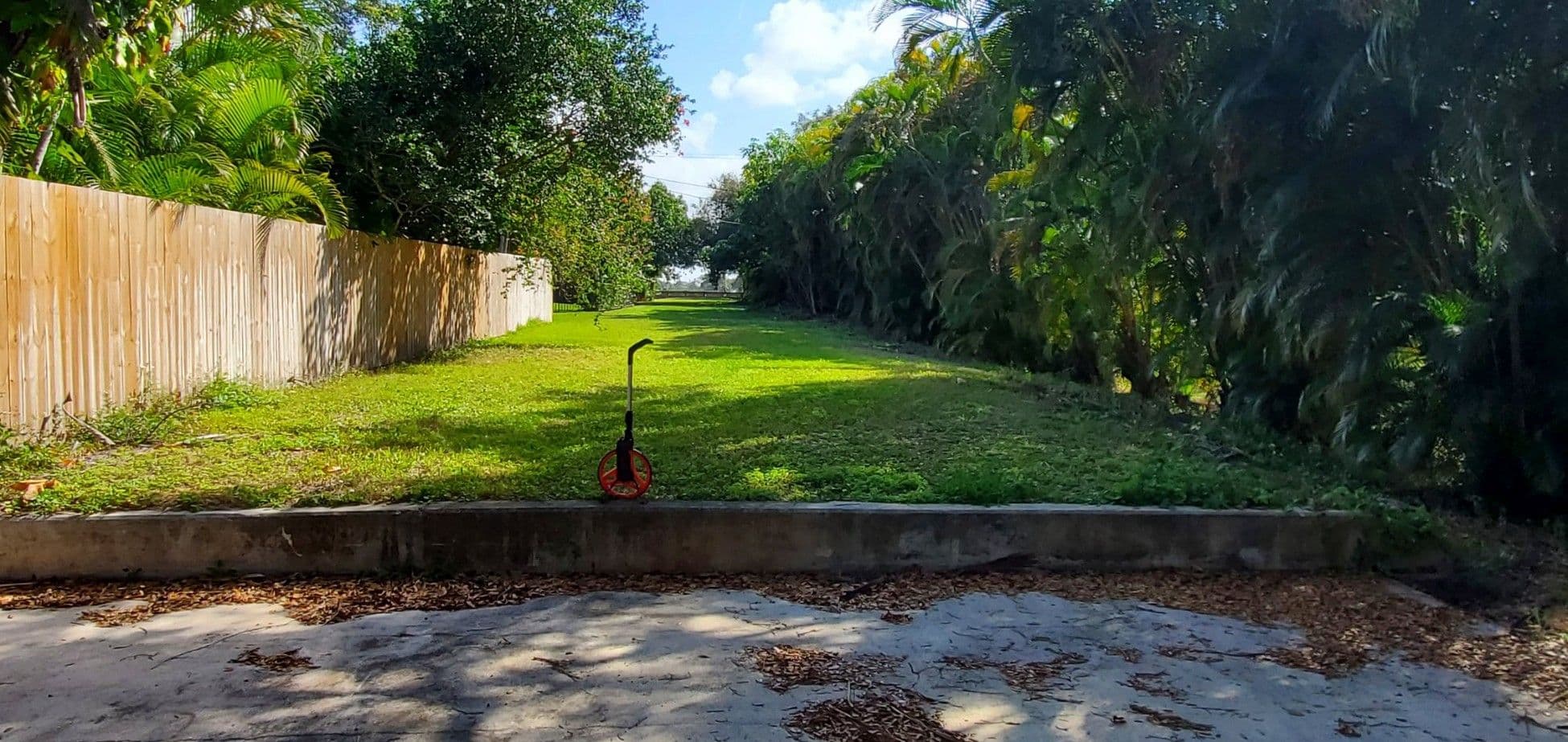
The landside surface above the box culvert treatment zone: a measuring wheel documents the treatment corridor extent; the unobstructed grass surface above the culvert confirms that no excavation was performed at any point during the project
One of the practical advantages of polymer injection, and a key reason it performs reliably in constrained environments, is that the installation is inherently measurable. Crews track injection location, sequence, pressure, flow behavior, and material response at every port. When something changes, the crew adjusts in real time within defined parameters.
This is not a "pump until it stops taking" operation. URETEK's field execution follows a controlled protocol with trackable inputs and defined limits, the kind of disciplined installation that engineers and inspectors can review, verify, and reference for future maintenance planning.
The injection program achieved its intended outcome: water intrusion was controlled at the treated panel-to-panel seams, seepage pathways were sealed with a continuous hydrophobic foam barrier, and the interface between panels was stabilized against continued water migration and soil erosion.
Water intrusion controlled. A continuous hydrophobic foam barrier was created on the backside of the seawall seams, stopping water migration through the panel-to-panel joints.
No exterior access required. All work was executed entirely from inside the box culvert. No excavation was performed behind the wall, no adjacent property was disturbed, and no large-scale dewatering or exterior staging was required.
Schedule met. The project was completed within the contract-specified 60-day substantial completion and 90-day final completion timeline.
Targeted repair, not excavation. For the municipal owner, a leaking seawall joint system was sealed using a method that fit the access constraints, met the schedule, and delivered a verifiable repair, without turning a targeted joint- sealing scope into an excavation project.
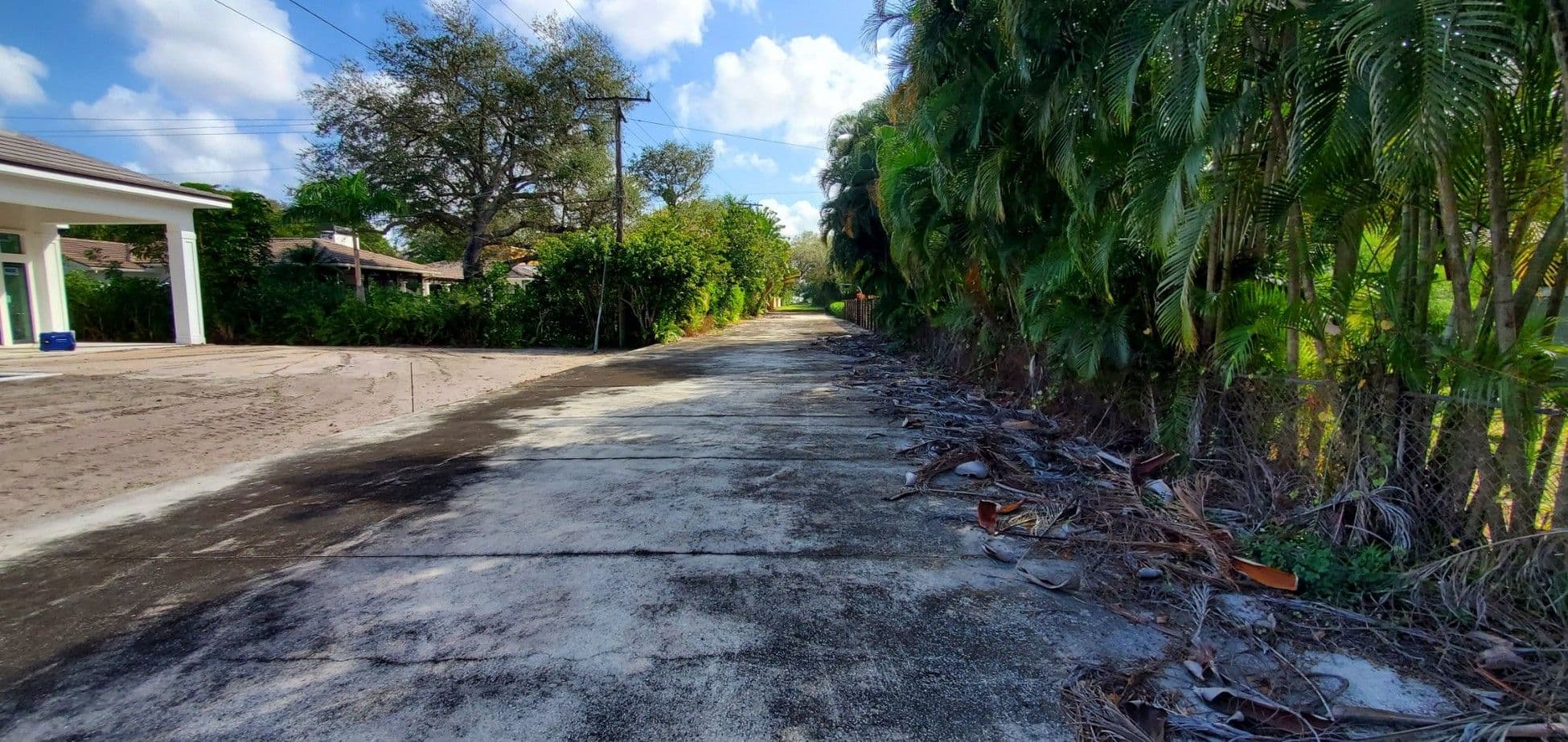
The surface corridor above the completed repair: the roadway and landscaping show no evidence of construction activity; the entire joint sealing program was executed from inside the culvert below, leaving the surface completely undisturbed
Interior access does not mean limited results. When property restrictions, canal geometry, or adjacent structures prevent exterior access, polymer injection can deliver a continuous seal from the inside, reaching the seepage pathways through strategically placed ports rather than through excavation. This project proves that "we can't get to the outside" is not the same as "we can't fix it."
Hydrophobic materials are designed for permanent water exposure. At a seawall or canal interface where the sealed joint will face sustained hydrostatic pressure, a hydrophobic polyurethane foam creates a barrier that resists water rather than absorbing it, maintaining its integrity in the exact conditions it was installed to withstand.
Confined-space discipline is part of the solution, not a complication. Working inside a box culvert requires safety planning that is integrated into production, not bolted on afterward. URETEK's teams are experienced in confined-space injection environments and treat entry planning, ventilation, and material-handling controls as standard operating procedure.
Schedule-friendly execution protects public infrastructure timelines. A repeatable, port-by-port injection methodology that can be executed from the interior, without exterior staging, property coordination, or large-scale dewatering, keeps the scope predictable and the timeline on track. For public-works owners managing canal corridors and roadway-adjacent assets, that predictability is often as valuable as the seal itself.
If you are managing a seawall, bulkhead, box culvert, or any precast concrete waterfront structure with water intrusion at panel joints or construction seams, especially where exterior access is restricted by property lines, adjacent structures, canal geometry, or staging limitations, URETEK can evaluate whether interior-access polymer injection is the right fit. The key question is straightforward: can we reach the intrusion pathway from available access points and treat it in a controlled, verifiable way without turning your project into an excavation problem? When the answer is yes, polymer injection joint sealing is a practical, schedule-friendly solution that aligns with both engineering intent and real- world constructability.

 800-240-7868


