

Location
San Francisco, California
Structure Type
A heavily used asphalt runway (and an intersecting runway segment) at a major international airport, over a cement-treated base and a weak, saturated subgrade
Core Challenge
A pavement-life analysis flagged portions of the runway as near the end of their functional life; DCP testing found a very weak, saturated soil layer about eight feet down and voids at the cement-treated-base interface, so a surface mill-and-overlay alone would not have restored the support
Verification
Independent heavy-weight deflectometer (HWD) testing before and after treatment against a 25 percent center-deflection-reduction target in seven lots, with layered back-calculation, a FAARFIELD pavement-life analysis, and pre- and post-injection DCP testing
URETEK Scope
URETEK Deep Injection (UDI) of structural polymer at a nominal 10-foot depth (and wherever testing found voids) to stabilize the subgrade and fill voids beneath the cement-treated base, performed at night, followed by milling and a minimum three-inch overlay
Result
Back-calculated subgrade modulus rose in five of six analyzed lots and cement-treated-base modulus in four; FAARFIELD indicated more than 20 years of remaining structural life for every lot tested; one of seven lots met the deflection target after seasonal correction; the treated sections were restored without full-depth reconstruction
Under the constant loading of a major international airport, portions of a heavily used asphalt runway had reached the end of their functional pavement life. A remaining-life pavement analysis confirmed that a surface fix alone would not be enough, because the problem was not only in the asphalt. It was in the layers below.
Subsurface testing found the weakness. Dynamic Cone Penetrometer (DCP) profiles, taken to about 14 feet, revealed a very weak, saturated layer of soil roughly eight feet below the surface, with single-digit blow counts, plus voids at the interface between the cement-treated base and the subbase. Placing a new asphalt surface over that condition would have left the underlying loss of support in place, and the new pavement would have gone on failing from the bottom up.
The runway also could not close for long. Full-depth removal and replacement of the affected sections would have taken the runway out of service for an extended period at a high-volume airport, and the work had to fit inside tightly controlled overnight airside windows. The team needed to strengthen the support layers in place, through the pavement, before resurfacing.
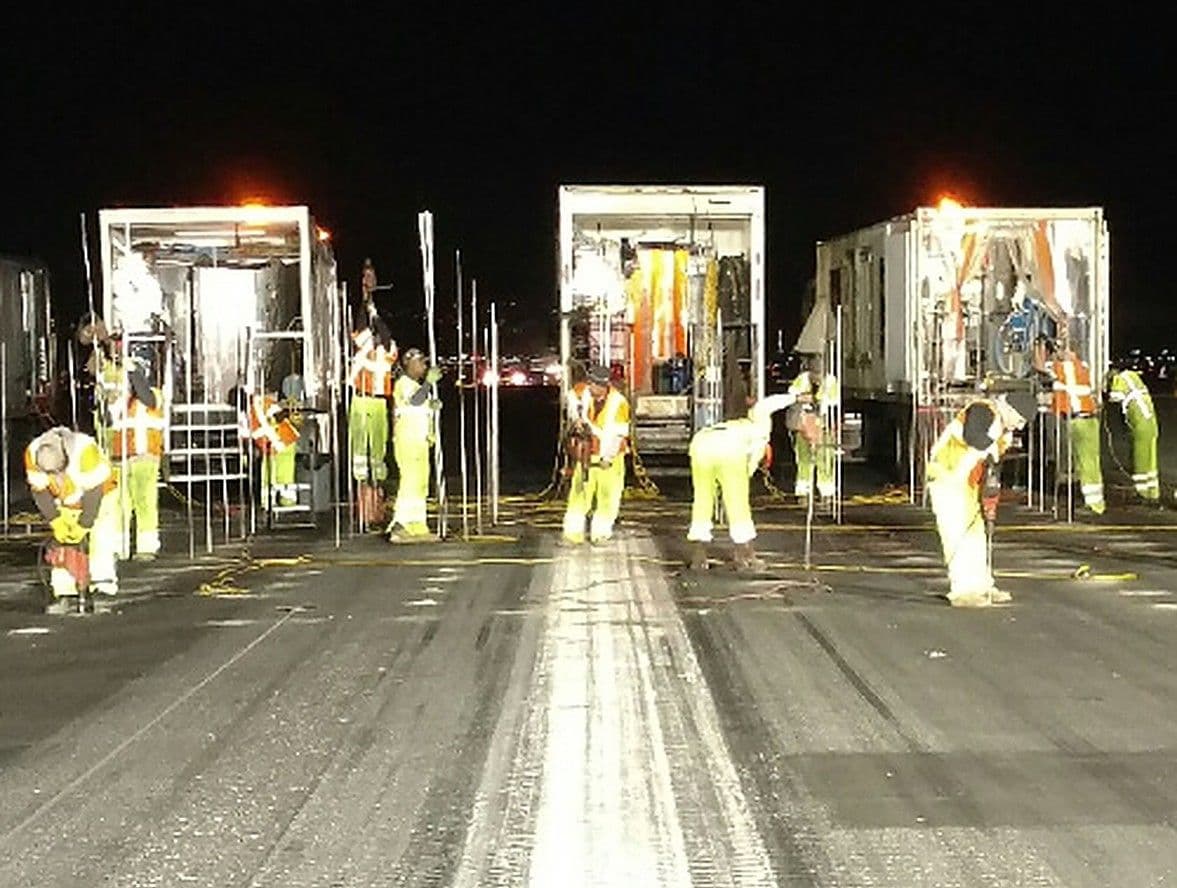
URETEK performed the deep injection at night, within tightly controlled airside windows, to return the runway to service as quickly as possible
The conventional response to a spent runway pavement is full-depth reconstruction: remove the asphalt and base, rebuild the subgrade, and repave. On an active runway at a major airport, that path means taking the pavement out of service for an extended closure that a high-volume airfield can rarely absorb, at a cost to match.
A simple mill-and-overlay had the opposite problem. It would refresh the surface but do nothing about the weak saturated soil eight feet down or the voids under the cement-treated base, so the new overlay would sit on the same failing foundation and lose life prematurely, just as the original pavement had.
What the runway needed was a way to strengthen the support layers in place, through small holes in the existing pavement, and verify the improvement, so a routine surface rehabilitation could then restore the runway for the long term. That is what URETEK Deep Injection was designed to deliver.
Guided by the DCP results and the pavement analysis, URETEK crews drilled small holes through the pavement and injected a structural polymer to stabilize the subgrade and fill the voids beneath the cement-treated base, reaching the weak layers without removing the pavement to get to them.
Injection was placed at a nominal depth of about 10 feet and wherever else DCP testing had detected voids or weak material, so treatment concentrated on the specific zones driving the loss of support rather than being applied uniformly. Surface elevations were monitored continuously during injection to control pavement movement, and the entire program was sequenced into overnight airside windows so the runway could return to service between shifts.
As it cured, the expanding polymer compacted and confined the surrounding soil and filled the voids beneath the cement-treated base, applying controlled pressure to the pavement above and increasing the load-bearing capacity of the support layers as a water-resistant composite.
Once the support layers were strengthened, the deteriorated asphalt was milled off and the treated pavement received a new asphalt overlay, a minimum of three inches to finished grade in the stabilization areas. The runway was, in effect, rebuilt from the subgrade up through the wearing surface, achieved through drilled access and resurfacing rather than full-depth reconstruction.
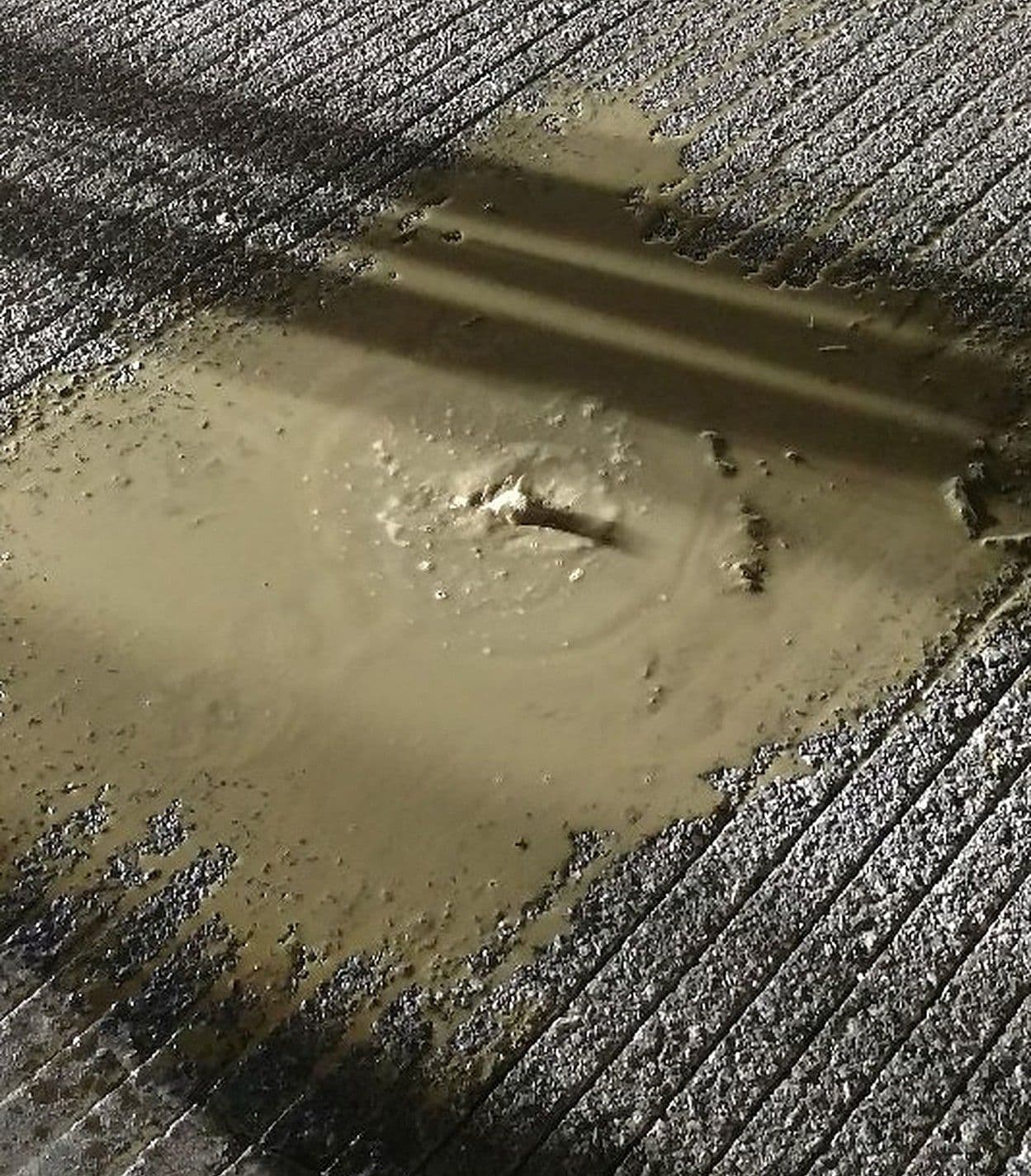
Water and saturated fines forced up through an injection point: direct evidence of the weak, waterlogged soil the injection was there to stabilize
Acceptance was set by a performance-based specification: heavy-weight deflectometer (HWD) testing by an independent pavement-testing consultant before and after injection, with a target of a 25 percent average reduction in center deflection within each of seven test lots. Four lots, each roughly 400 feet long, ran down about 1,600 feet of the primary runway, and three shorter lots covered the intersecting segment.
The deflection target proved a poor fit for the work. Between the winter and spring test rounds the area recorded more rain in four months than in the whole previous year, softening the subgrade and the weathered pavement, and the temperature change between rounds shifted the asphalt's response. HWD readings are also governed largely by the upper layers, while the treatment reached 10 feet. After seasonal correction, one of the seven lots met the 25 percent target, and the schedule did not allow re-injection.
Deeper analysis of the same HWD data told a clearer story. Layered back-calculation showed the subgrade modulus rising in five of the six lots analyzed (by 15 to 34 percent) and the cement-treated-base modulus rising in four (by 5 to 51 percent), while the old asphalt surface, due to be milled off, weakened over the same period. A re-run FAARFIELD pavement-life analysis indicated more than 20 years of remaining structural life for every lot tested, both after injection and after the new overlay, and post-injection DCP testing showed the single-digit blow counts at depth improved substantially.
Taken together, the testing showed the support layers stronger and the pavement's projected life restored. It also showed the limits of accepting deep subgrade work on a single surface-deflection target.
URETEK restored a spent runway from the subgrade up, verified by independent testing, without the closure and cost of full-depth reconstruction.
 Support layers measurably stronger. Back-calculated HWD data showed the subgrade modulus up in five of six analyzed lots (15 to 34 percent) and the cement-treated-base modulus up in four (5 to 51 percent).Pavement life restored. A re-run FAARFIELD analysis indicated more than 20 years of remaining structural life across the injected pavement, after the analysis had flagged the sections as near the end of their functional life.No full-depth reconstruction. Treating the support layers through small holes, then milling and overlaying, restored the runway without removing and rebuilding the full pavement section, and without the extended closure that would have required.Confirmed by more than one tool. HWD back-calculation, a FAARFIELD remaining-life analysis, and pre- and post-injection DCP all pointed the same way, although only one of seven lots met the 25 percent deflection-reduction target after seasonal correction.Backed by URETEK's two-year warranty against settlement. URETEK stands behind the completed ground-improvement work with its two-year warranty against settlement.
Test below the surface before you resurface. The pavement analysis and DCP testing traced the failure to a weak saturated layer about eight feet down as well as the asphalt, which is why a surface-only fix would not have held.
Strengthen the support, then restore the surface. Deep injection rebuilt the load-bearing capacity of the subgrade and cement-treated base in place, so the mill-and-overlay that followed could restore the runway for the long term rather than sit on a failing foundation.
Write the acceptance criterion around the test's limits. A fixed percentage drop in surface deflection, measured in different seasons and dominated by the upper layers, is a weak test of injection at 10 feet. Match verification to the treatment depth, record GPS positions on every HWD drop so before and after compare like for like, test in similar conditions, and back the deflection data with DCP and layered analysis.
Work with the airfield's clock. Sequencing the injection into overnight airside windows let a high-volume runway keep operating while its foundation was strengthened, avoiding the long closure a full reconstruction would demand.
If a pavement analysis shows a runway, taxiway, or roadway nearing the end of its life because the support layers below have weakened, URETEK can help. We stabilize the subgrade and fill voids through small holes, then verify the improvement, so a surface rehabilitation can restore the pavement without full-depth reconstruction. We will review your pavement and geotechnical testing, design a targeted injection program, and confirm the result with testing matched to the treatment depth, all sequenced around your operations.

 800-240-7868


