

Location
Baltimore, Maryland
Structure Type
A 32-inch concrete railway substructure carrying heavy daily traffic, with drainage water collecting beneath the ballast substructure.
Core Challenge
Erosion from a constant flow of drainage water had opened voids beneath the railbed, estimated by the operator at up to 12 inches deep across several hundred feet. Elevation differential was visible, and trains displaced large volumes of water as they passed. Extended downtime was not an option, and access and track geometry were both live concerns.
Verification
Laser-level monitoring on the railbed throughout injection to detect and control vertical movement, plus final inspection inside each service outage before the track went back into service.
URETEK Scope
URETEK Deep Injection (UDI) through the existing concrete railbed on a predetermined grid, starting with a 100 foot by 12.5 foot section and continuing across roughly 300 additional feet on later outages, to fill voids, stop further erosion, restore water flow, and stabilize the railbed.
Result
Between 100 and 150 linear feet treated per outage, roughly 400 linear feet in total. Each outage was completed in under 20 hours including setup, breakdown, cleanup, and final inspection, and co-scheduling with other planned maintenance meant the operator never had to add a track outage.
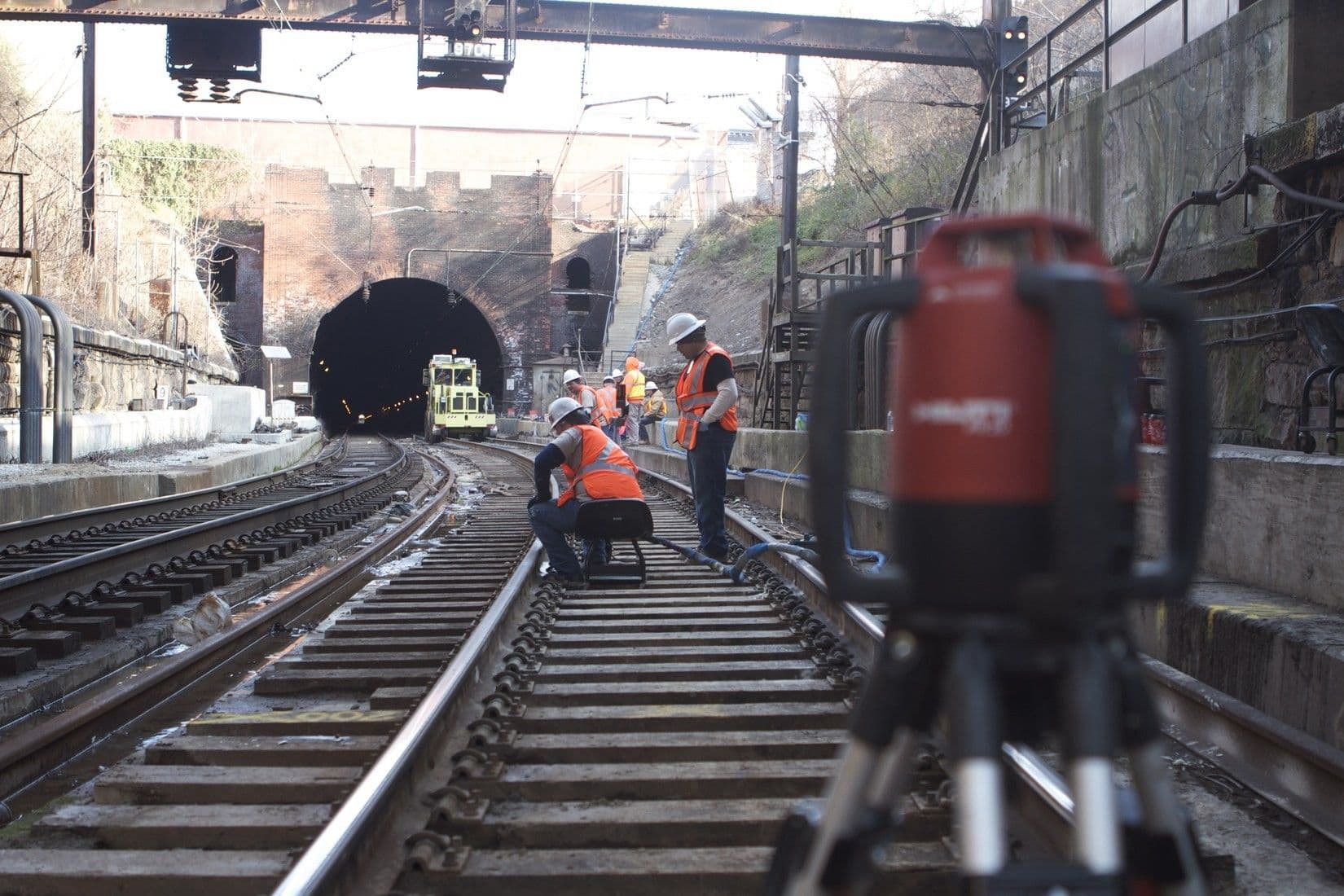
Rotating laser level set on the railbed while crews inject. Every injection point was watched for vertical movement, on live track, inside a fixed outage window.
A rail service operator called URETEK about a suspected erosion problem. Surface observations pointed to voids under a 32-inch concrete railway substructure, most likely opened by a constant flow of drainage water collecting beneath the ballast substructure and carrying material away with it.
The evidence was visible from the ballast line. Elevation differed noticeably along the affected stretch, and every train that passed over the problem areas displaced large quantities of water. The operator's own estimate put some voids as deep as 12 inches, running several hundred feet.
This was heavy daily traffic on an important corridor, so extended downtime was off the table from the start. Access was constrained, and track geometry was a standing concern for the operator. Whatever fixed the ground under the railbed had to fit inside the outages already on the calendar.
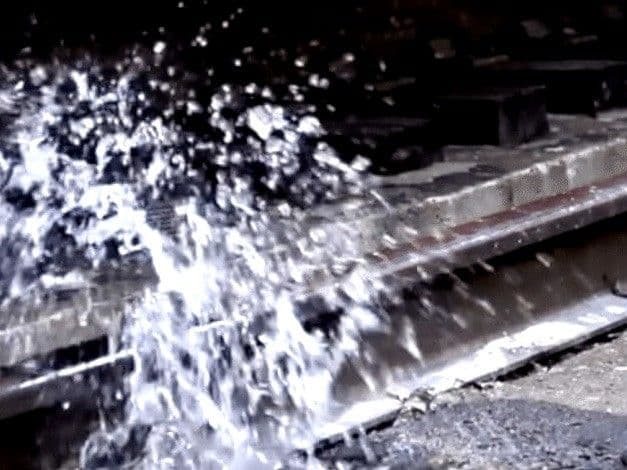
Drainage water forced up through the railbed as a train passes overhead. Water moving like this under load is what carries supporting material out and opens voids beneath the slab.
The conventional answer to voids under a rail structure is to get at them: pull track panels, dig out the failed material, rebuild the support, and put the track back. That work is well understood, and on a corridor with light traffic it is often the right call.
This corridor did not have light traffic. Reconstruction would have meant a work zone in a constrained location, spoil handling and haul-off, and an outage measured in days rather than hours. It would also have put the track's geometry back together from scratch, which is exactly the thing the operator was already watching closely.
The repair had to work from the top, through the structure that was already there, inside outage windows the operator had already scheduled for other maintenance. URETEK Deep Injection (UDI) does that: it reaches the voids and the weak zones beneath a slab through small holes drilled directly through it.
URETEK was brought in to do three things at once: fill the subsurface voids, stop further erosion from water infiltration, and stabilize the railbed. Crews started on the first identified section, a concrete railbed measuring 100 feet by 12.5 feet, and worked to a predetermined grid pattern across the whole section.
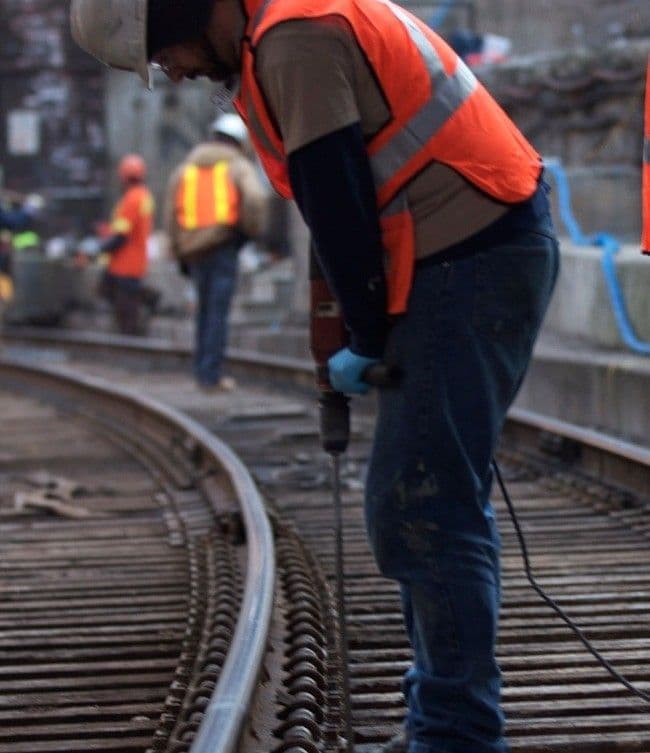
Drilling injection access directly through the concrete railbed. Small holes through the existing slab are what let the work happen without pulling track panels.
Technicians drilled through the railbed on the predetermined grid and injected expanding structural polymer directly through the slab into the voids and weak zones below. Filling on a grid across the whole treated length is what produced continuous support along it, at the soft spots and at the ground between them.
The work also had to move the water. Redirecting the subsurface flow away from the treated areas was part of the scope from the beginning, because filling voids while leaving the drainage path intact would have left the erosion mechanism running underneath the repair. On subsequent scheduled service outages, crews came back and treated roughly 300 additional feet of track suffering the same erosion, bringing the total to about 400 linear feet.
Laser-level monitoring equipment was set on the railbed and used throughout injection to detect vertical movement. On a rail structure that is the control that matters most, because the goal here was support without disturbing the geometry the operator had to hand back at the end of the outage.
Each outage also closed with a final inspection before the track returned to service, and that inspection was inside the same 20 hour window as the production work.
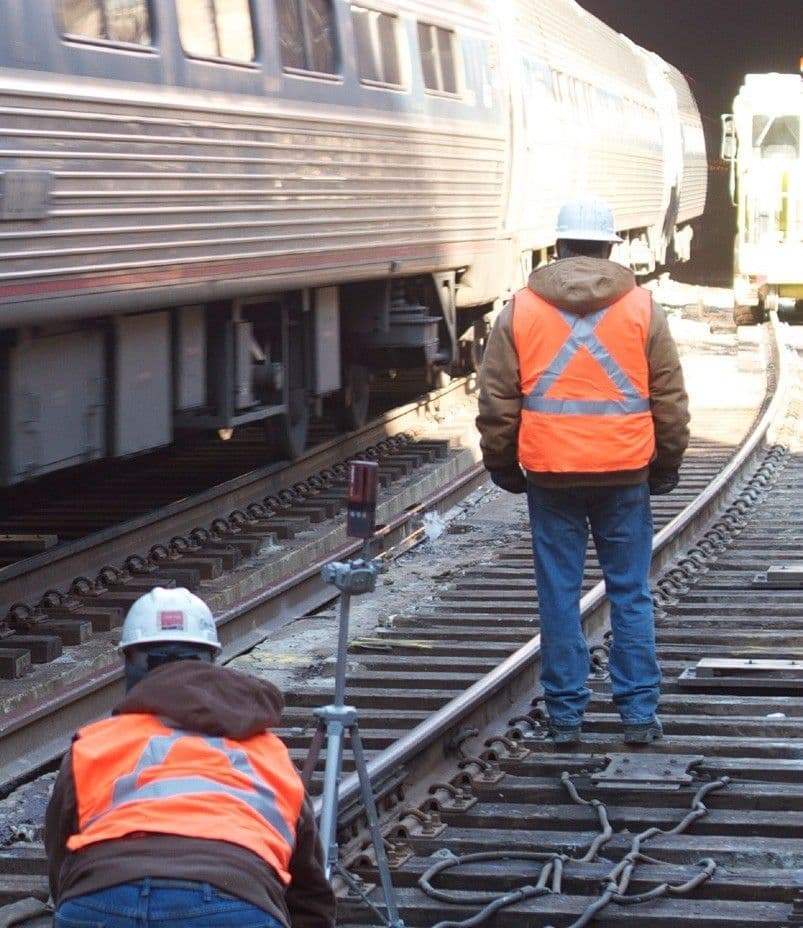
Monitoring the railbed with traffic running on the adjacent track. Injection hose stays on the structure, the lookout stays on the crew, and the corridor keeps moving.
This project's record is a production and schedule record rather than an instrumented performance study, and it is worth being straight about that. There is no long-term settlement monitoring here and no post-treatment load testing. What the record documents well is dimension, rate, and the control exercised during the work.
On dimension: a 32-inch concrete substructure, a first section of 100 feet by 12.5 feet, roughly 300 additional feet on later outages, and voids the operator estimated at up to 12 inches deep.
On rate: between 100 and 150 linear feet of railbed treated per outage, with every outage completed in under 20 hours including setup, breakdown, cleanup, and final inspection. For a corridor where downtime is the binding constraint, that rate is the number the operator was buying.
On control: laser-level monitoring ran through the injection at every point, and the treated track went back into service at the end of each window after inspection.
URETEK filled the voids, stabilized the railbed, and redirected the water that had been eroding it, roughly 400 linear feet of it, without pulling a single track panel and without adding one outage to the operator's schedule.
 Voids filled and support restored. Expanding structural polymer was injected through the existing concrete railbed on a predetermined grid, filling accessible voids beneath the slab and restoring contact with the supporting material.Subsurface water redirected. Redirecting the subsurface water and restoring proper water flow away from the treated areas addressed the erosion mechanism itself.100 to 150 linear feet per outage. Production held between 100 and 150 linear feet of railbed for each scheduled service outage, across roughly 400 feet in total.Under 20 hours per window, inspection included. Setup, injection, breakdown, cleanup, and final inspection all fit inside a sub-20 hour outage, which is what kept the work inside windows the operator had already planned.No additional outages required. Co-scheduling the injection with other maintenance already booked for the corridor eliminated the need to schedule any additional track outage.Backed by URETEK's two-year warranty against settlement. URETEK stands behind ground stabilization work with its two-year warranty against settlement.
Water displacing under a passing train is a diagnosis. Visible water movement under load, paired with an elevation differential, points at voids and active erosion beneath the structure well before anyone opens it up. Act on it before anyone opens the structure.
Fill to a grid across the whole treated length. A predetermined injection pattern across the treated length gives continuous support. Chasing individual voids leaves the untested ground between them carrying the same load with none of the treatment.
Move the water or the repair is temporary. Voids beneath a railbed are the symptom of a drainage path running where it should not. Filling them while leaving that path in place puts new material in front of the same erosion.
Let the outage window size the method. On a corridor in daily service, the binding constraint is hours on the calendar. A method that works through the existing slab and fits inside an outage already on the calendar can beat a better repair that needs the track for a week.
If water is displacing under load, elevation is drifting along a stretch of track, or you suspect voids beneath a concrete railbed, URETEK Deep Injection reaches them through the existing structure. No track panels pulled, no spoil to handle, and production measured in hundreds of feet per outage. We will design the injection grid for your structure and your subsurface conditions, monitor the railbed with laser level equipment through every point, and hand the track back inside the outage window you give us.

 800-240-7868


