

Location
Maryland
Structure Type
Jointed concrete runway pavement at a secure military airfield, the primary runway for presidential aircraft operations, settled where soil was being carried out of the pavement system through a leaking culvert beneath it
Core Challenge
A two-inch deep dip had developed in the runway surface. Full-depth reconstruction would have closed the runway for weeks at a facility where security holds already limited access, and the water pathway causing the soil loss was still active
Verification
Slab elevations were monitored at the surface through staged lifting, and injection continued only until the panels were back at the intended grade. The owner and its consultants re-evaluated the repair in 2000, 2004, 2006, and 2007, and an injected sample excavated in December 2010 was found intact after more than 11 years in service
URETEK Scope
URETEK Deep Injection (UDI) organized as five coordinated tasks: initial slab lifting, soil stabilization to 14 feet, oversight of the leaking culvert repair, final slab alignment, and sealing of pavement joints and cracks
Result
15 concrete slabs realigned and soft soils stabilized to 14 feet within a 60-foot by 88-foot work area. Measured against the reconstruction proposal, the project record shows approximately $125,000 and about 20 days of runway closure time avoided, a 60 percent reduction in work time and a 50 percent reduction in repair cost
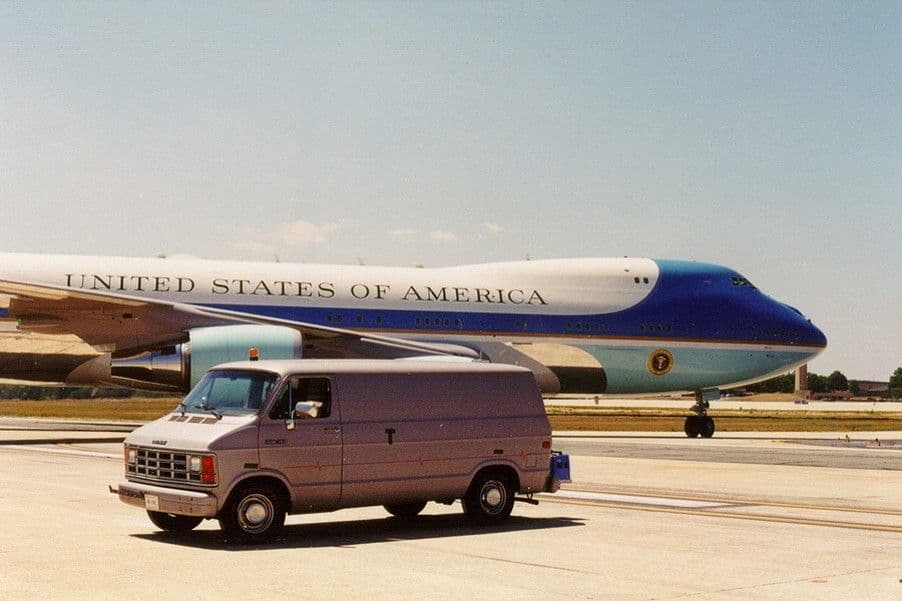
URETEK on the airfield in 1999. The runway under repair was the primary runway for presidential aircraft operations, which is why an extended closure for reconstruction was ruled out before the work ever started.
In 1999, a two-inch deep dip developed in the primary runway at a secure military airfield in Maryland, the runway used for presidential aircraft operations. An engineering investigation traced the cause to water. Water was infiltrating the pavement system and carrying soil particles out through a leaking culvert that ran beneath the runway. The concrete above had lost the uniform support it was built on, and it settled into the space the lost soil left behind.
Two inches is a large number on a runway. Airfield pavement is held to far tighter surface tolerances than a highway, and a depression of that depth is both a ride-quality problem for a heavy aircraft at rotation speed and the start of a maintenance problem: water ponds in the low spot, joint stresses rise at the panel edges, and the deterioration accelerates from there. The settled slabs had to come back to grade, the weakened soils beneath them had to be stabilized, and the water pathway had to be closed, or the same settlement would return.
What set this repair apart was the schedule around it. Access to the runway was limited by aircraft operations and, at this facility, by security holds that shut down all movements unrelated to the presidential mission. Work windows were short and not fully predictable, and the runway itself carried an operational priority that made closure time the most expensive line in any repair option. The engineering question was not only how to restore the grade, but how to do it inside the time the airfield could actually give up.
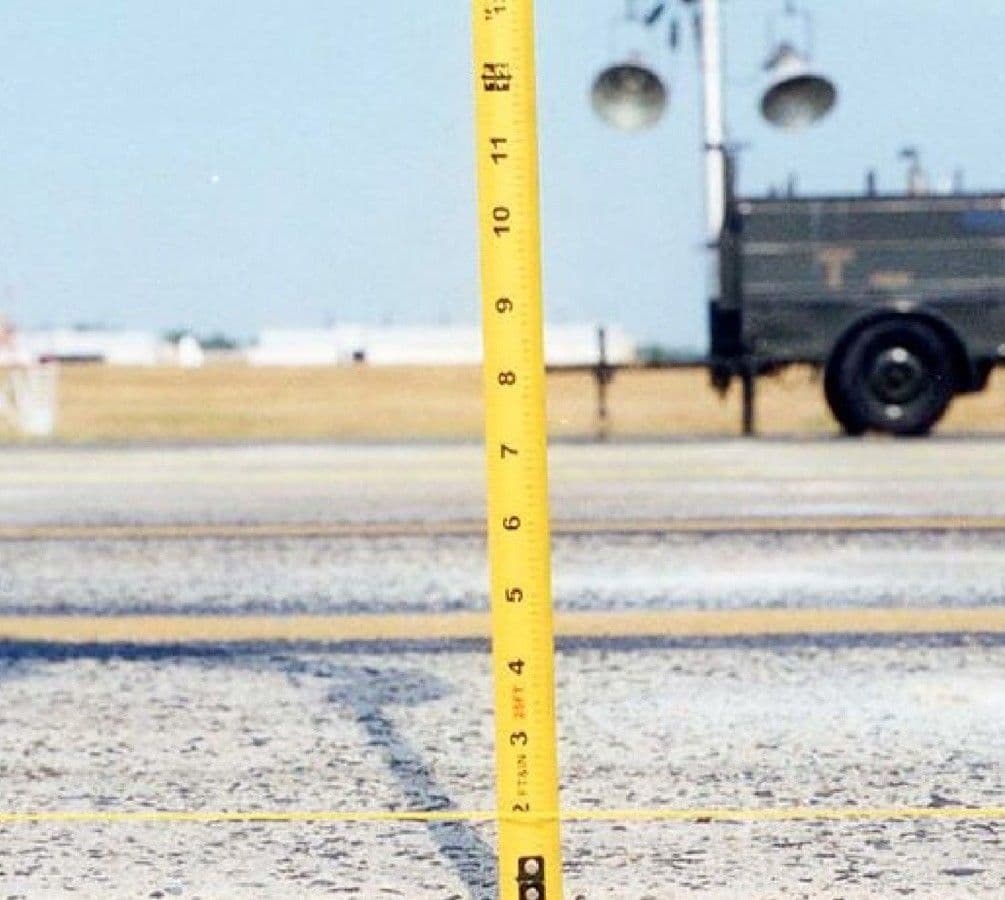
The two-inch dip that started the project. A string line and rod across the settled panels show the depth of the depression that developed as soil was carried out of the pavement system through a leaking culvert beneath the runway.
The conventional answer to a settled concrete panel is to take it out and put a new one in. Full-depth reconstruction of this area would have meant sawing and demolishing the slabs, excavating and recompacting the failed subgrade, forming and placing new concrete, and then waiting on that concrete to gain strength before an aircraft could touch it. The airfield engineers reviewed that option and ruled it out. The closure it required was measured in weeks, and this runway could not give up weeks.
The disruption also reached well past the work area. Demolition and reconstruction on an active airfield brings heavy equipment, haul traffic, and a large construction footprint onto a surface where every vehicle movement has to be cleared and escorted, and where a security hold can stop the work with no notice. On an asset like this one, each day the runway stayed open was worth more than any difference in the unit cost of the repair.
What the project needed was a method that could reach the weakened soils from the surface, bring the settled slabs back to grade in controlled increments, and be cleaned up and off the pavement when the window closed. It also needed to be paired with a fix for the culvert, because stabilizing soil above an active water path postpones the next settlement instead of preventing it.
URETEK used its URETEK Deep Injection (UDI) process to realign the runway and stabilize the soils supporting it, and organized the work as five coordinated tasks: initial slab lifting, deep soil stabilization, repair of the leaking culvert, final slab alignment, and sealing of the pavement joints and cracks. The sequence carried the engineering logic. Initial lifting restored enough support to work from, stabilization treated the weakened soil mass at depth, the culvert repair removed the mechanism that had caused the loss, and the final alignment and sealing set the surface back to grade and kept water out of it.
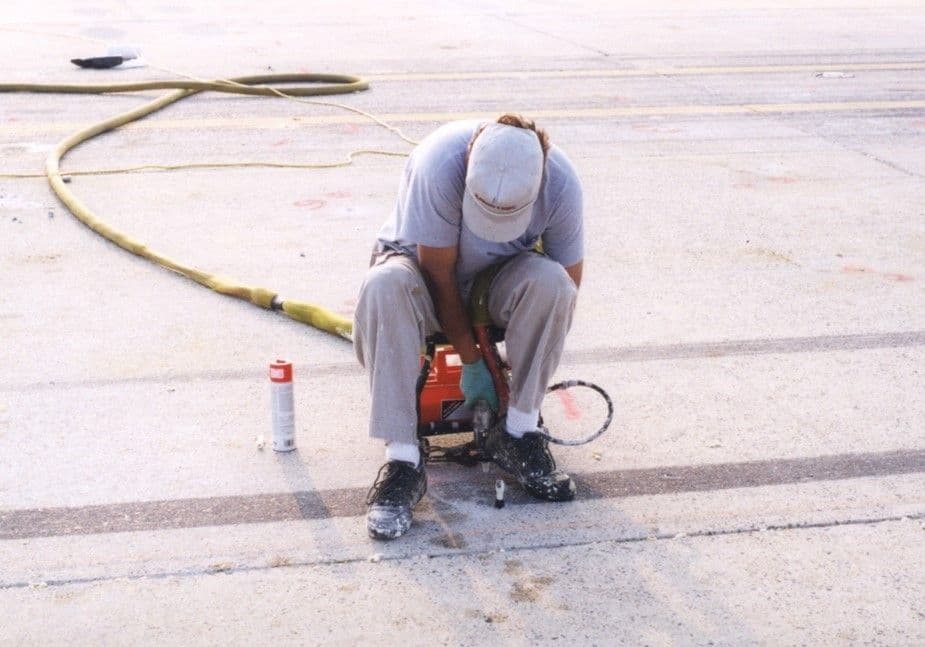
Injection through a small hole drilled directly through the runway pavement. Structural polymer was placed in stages at depths set by the site analysis, reaching soft soils 14 feet below the surface.
Crews drilled small holes directly through the concrete and injected high-density expanding structural polymer into the base and subgrade soils. The material flows into voids and weak zones within the soil mass, and as it reacts it compacts and confines the soil around it and applies controlled pressure on the pavement above. Injection depths came from the site-specific analysis rather than from a standard pattern, and the treatment went down in stages, reaching soft soils 14 feet below the pavement surface, well beneath the layer where the failure was visible at the top.
Lifting was done in increments rather than in one pass. A multi-injection plan let crews bring the slabs up gradually while watching how the surface responded, which is what protects jointed pavement from being over-lifted or cracked at the panel edges. Because the polymer reaches about 90% of its strength within 15 minutes of injection, each treated area could be released back to the airfield at the end of its window instead of waiting on a cure.
Verification on this project was tied to what the owner actually needed to know, which was whether the runway profile had come back. Slab elevations were monitored at the surface as injection progressed, and lifting continued only until the panels were at the intended grade. The proof was the measured recovery of the surface itself, together with the condition of the pavement once the work was finished.
The longer verification came from the owner. The airfield engineers and their consultants evaluated the repair in 2000, 2004, 2006, and 2007, and each evaluation determined it was performing well. In December 2010, during a separate runway keel replacement project, a sample of the injected material was excavated and examined. After more than 11 years in service, the material was still intact.
The figures on this project come from the project record and from the comparison the owner was weighing at the time, which was this repair against the full-depth reconstruction proposal already on the table.
The work area was 60 feet by 88 feet. Inside it, 15 concrete slabs were realigned and soft soils were stabilized to a depth of 14 feet, measured from the pavement surface. The movement being corrected was the two-inch dip that started the project.
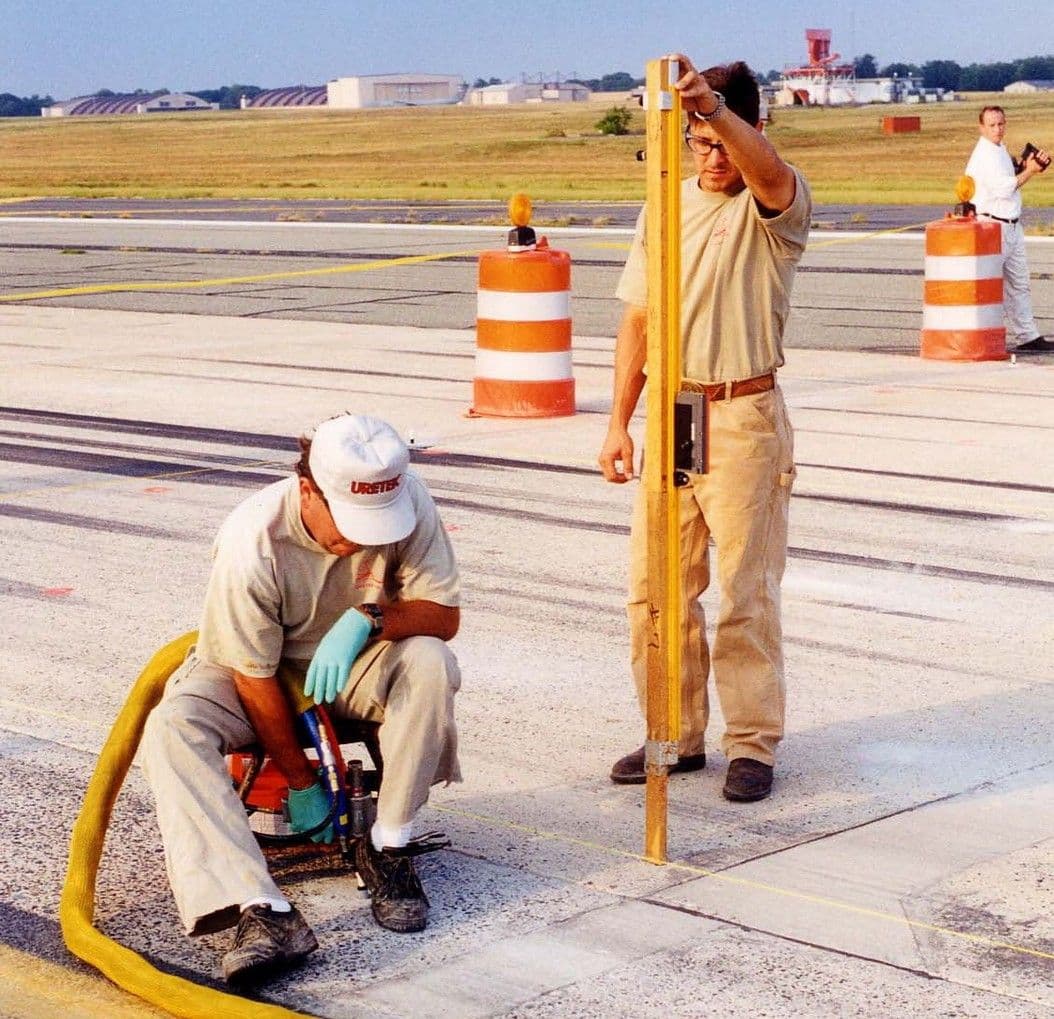
Grade control at the surface. Slab elevation was read against a rod as injection progressed, and lifting continued only until the panels were back at the intended grade.
Measured against the reconstruction proposal, the project record puts the result at approximately $125,000 and about 20 days of runway closure time avoided, which the project team expressed as a 60 percent reduction in work time and a 50 percent reduction in repair cost. Those are comparisons against the owner's own reconstruction estimate, not an independent cost study.
The durability record is the figure that takes longest to earn. Four owner evaluations across eight years found the repair performing well, and the sample excavated in December 2010 was intact after more than 11 years of service beneath an operating runway.
URETEK brought a settled runway back to grade and stabilized the soils under it without the extended closure that reconstruction required, and the repair was still intact when it was physically examined more than a decade later.
 Runway profile restored. Fifteen concrete slabs were realigned within a 60-foot by 88-foot work area, bringing the two-inch depression back to the intended grade through staged injection rather than removal and replacement.Weak soils stabilized at depth. Structural polymer was injected to depths of 14 feet below the pavement surface, treating the soil mass that had lost material rather than only the void immediately under the slab.Water pathway closed at the source. The leaking culvert carrying soil out of the pavement system was repaired and the pavement joints and cracks were sealed, under URETEK's oversight, removing the water pathway that had caused the settlement.Closure time and cost cut against reconstruction. The project record shows approximately $125,000 and about 20 days of runway closure avoided compared with the reconstruction proposal, a 60 percent reduction in work time and a 50 percent reduction in repair cost.Performance confirmed over more than a decade. Owner evaluations in 2000, 2004, 2006, and 2007 found the repair performing well, and a sample excavated in December 2010 was intact after more than 11 years in service.Backed by URETEK's two-year warranty against settlement. URETEK stands behind ground stabilization and pavement lifting work with its two-year warranty against settlement.
Fix the water before you fix the grade. The settlement here was the symptom; the leaking culvert was the cause. Lift slabs above an active water path and the settlement comes back. Sequence the work so the pathway is closed and the joints are sealed before the project is called complete.
Treat the soil mass, not just the void. The failure was visible at the surface, but the material loss extended to 14 feet. Injection depths set by site-specific analysis, rather than by a standard pattern, are what let a repair worked from the surface reach the zone actually governing settlement.
On an operational asset, closure time is the real budget. The reconstruction proposal was rejected on schedule, not on price. A method that hands the pavement back at the end of each window can be worth more than any difference in unit cost, and on this project it also came in at roughly half the repair cost.
Staged lifting protects jointed pavement. Bringing panels up in increments while watching the surface respond is what keeps a lift from becoming a crack. On pavement held to tight surface tolerances, control of the lift matters as much as the capacity of the material.
If settlement is developing on pavement you cannot take out of service, and water is moving soil out from under it, URETEK can help. We lift and stabilize from the surface through small holes, inside the windows your operations can actually give up. We will investigate what is moving beneath your pavement, design an injection program to the depths your site conditions call for, stage the lift under surface monitoring, and coordinate the drainage repair that keeps the settlement from coming back.

 800-240-7868


