

Location
Dallas-Fort Worth, Texas
Structure Type
Jointed concrete municipal arterials, bridge approaches, and localized street repairs
Core Challenge
Faulted or mismatched panel joints and localized weak or unsupported zones beneath slabs the owner was weighing for replacement
Verification
14 preconstruction DCP soundings on the initial corridor, pre- and final roadway profiling, real-time surface-movement monitoring, and daily panel and location logs with inspector signoff
URETEK Scope
Targeted soil stabilization, void filling, controlled pavement lifting, and joint matching, delivered panel by panel across a multi-year program
Result
3,965 completed panels documented across two corridor trackers and 797,282 pounds of structural polymer recorded across three program trackers, from a pilot through a later term contract
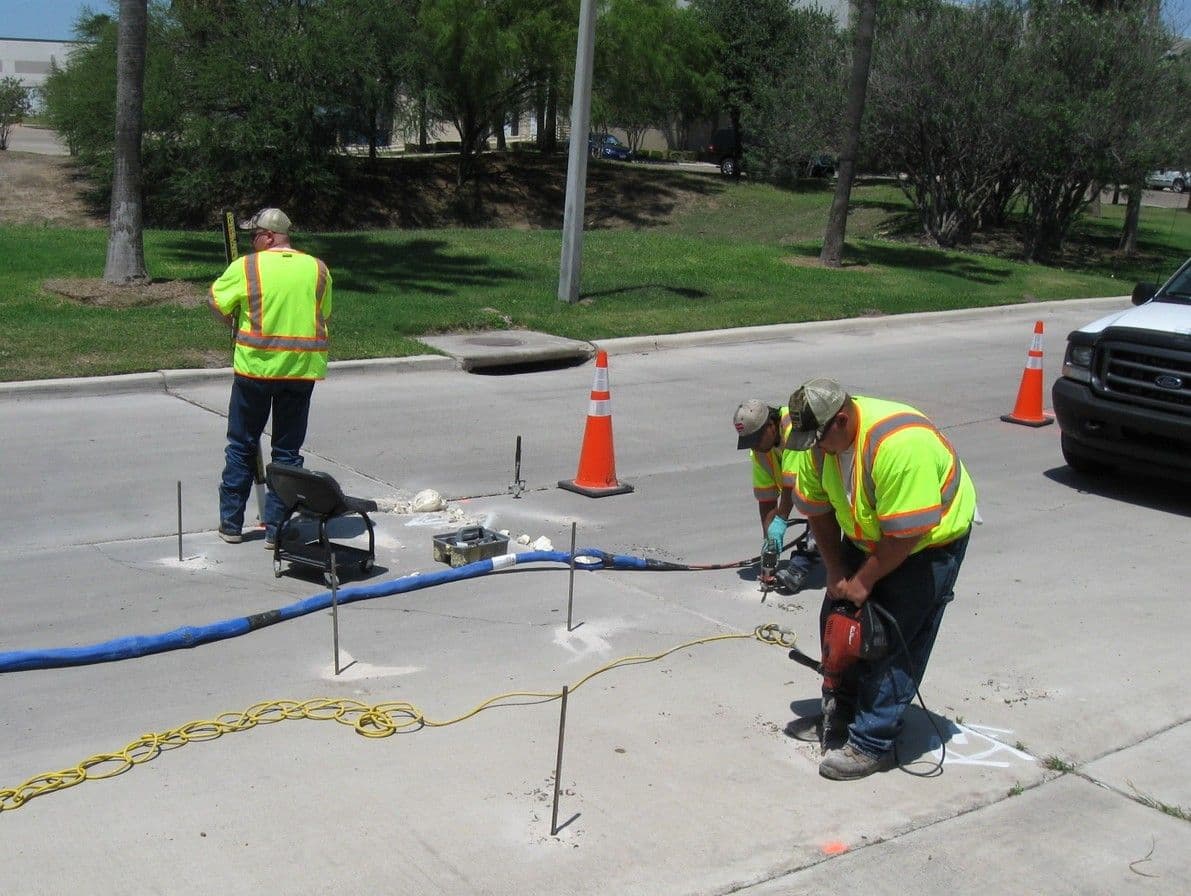
A URETEK crew injecting structural polymer through small access holes under live traffic control. Panels were treated one at a time, with the pavement surface watched throughout for movement.
A North Texas municipality was maintaining long stretches of jointed concrete arterial where adjacent panels had drifted out of alignment. At joint after joint, one slab sat slightly higher than its neighbor, and the ride showed it. In places the concrete still looked sound on top but was losing support underneath, and the city was already weighing some of those panels for full replacement.
The owner needed a way to sort the corridor panel by panel, and to separate two problems that often sit side by side: a slab that has settled or lost support, and a slab that is simply worn out. Fourteen preconstruction Dynamic Cone Penetrometer soundings documented the subsurface along the initial corridor. Roadway profiling and a field pilot then helped the team identify candidate panels, confirm access, and set production assumptions before the larger program began.
What the testing showed was that conditions changed from one location to the next. Some panels needed support beneath the slab while staying at their existing grade.
Others needed both support and a measured lift to bring the joint back up to its neighbor. Panels with deeper structural damage stayed in the replacement program, where they belonged.
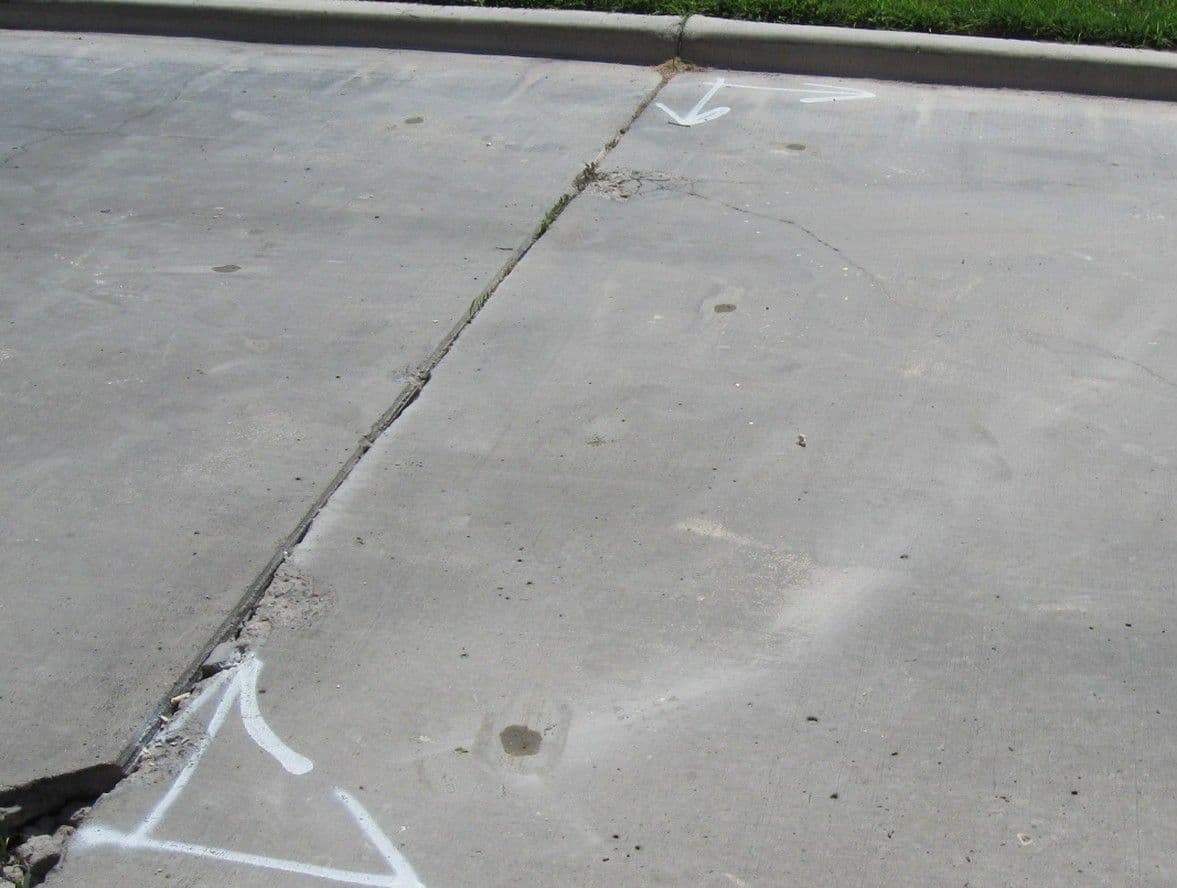
A candidate joint marked by hand during selection. Adjacent panels had moved out of alignment, and locations were profiled and logged before any injection.
When a concrete panel fails, the default answer is to take it out and pour a new one. For badly deteriorated slabs, that is still the right call. But full-depth replacement is slow, it closes lanes for days, and on a busy arterial it often moves the traffic problem around instead of fixing what caused it: the soil under the slab.
Many of the panels on this corridor were not broken. They had settled, faulted, or lost support because the material beneath them had moved or left voids, and replacing that concrete without treating the soil invites the same failure back. Digging to reach and recompact the soil, meanwhile, means excavation, extended closures, and disturbance to lanes that were otherwise carrying traffic fine. The owner needed a targeted option that could treat the ground in place, on the panels that qualified, without tearing up the ones that did not.
That is where targeted injection fit. It reaches the soils that are actually causing the movement, improves their support from within, and does it through small access holes with the lane open again 15 minutes after the last injection. It does not replace a city's paving program. It gives that program a precise tool for the panels that need support rather than demolition.
URETEK started where the risk was highest, with testing and a pilot, then grew the work into a repeatable corridor program. The method stayed the same at every location: inject structural polymer into the weak zones and voids beneath the slab to fill them, compact and confine the surrounding soil, and form a stabilized support zone under the panel. Where the scope called for it, injection continued past stabilization to lift the slab and match the joint.
Injection points were laid out at roughly four-foot centers across the treatment area. Tubes were advanced about two to three feet beneath the pavement, with deeper injection at the joints where the plan required it, so material was placed where support was missing rather than only at the surface.
Material was introduced in controlled stages. At stabilization-only locations, the crew injected until about one millimeter of movement was detected at the surface, the signal that the soil beneath had been adequately supported, then stopped. Where the scope included elevation correction, injection continued in measured increments to raise the slab and close the gap with the adjoining panel, which served as the reference grade.
Verification was built into the daily routine rather than added at the end. Preconstruction DCP soundings established subsurface conditions and shaped the injection plan. The crew watched the pavement surface during every injection and stopped at the specified response. Stabilization-only locations were logged separately from areas that received lift. Roadway profiles were recorded before and after treatment for warranty purposes, and daily production and location records were signed off by the inspector and sent to the project engineer.
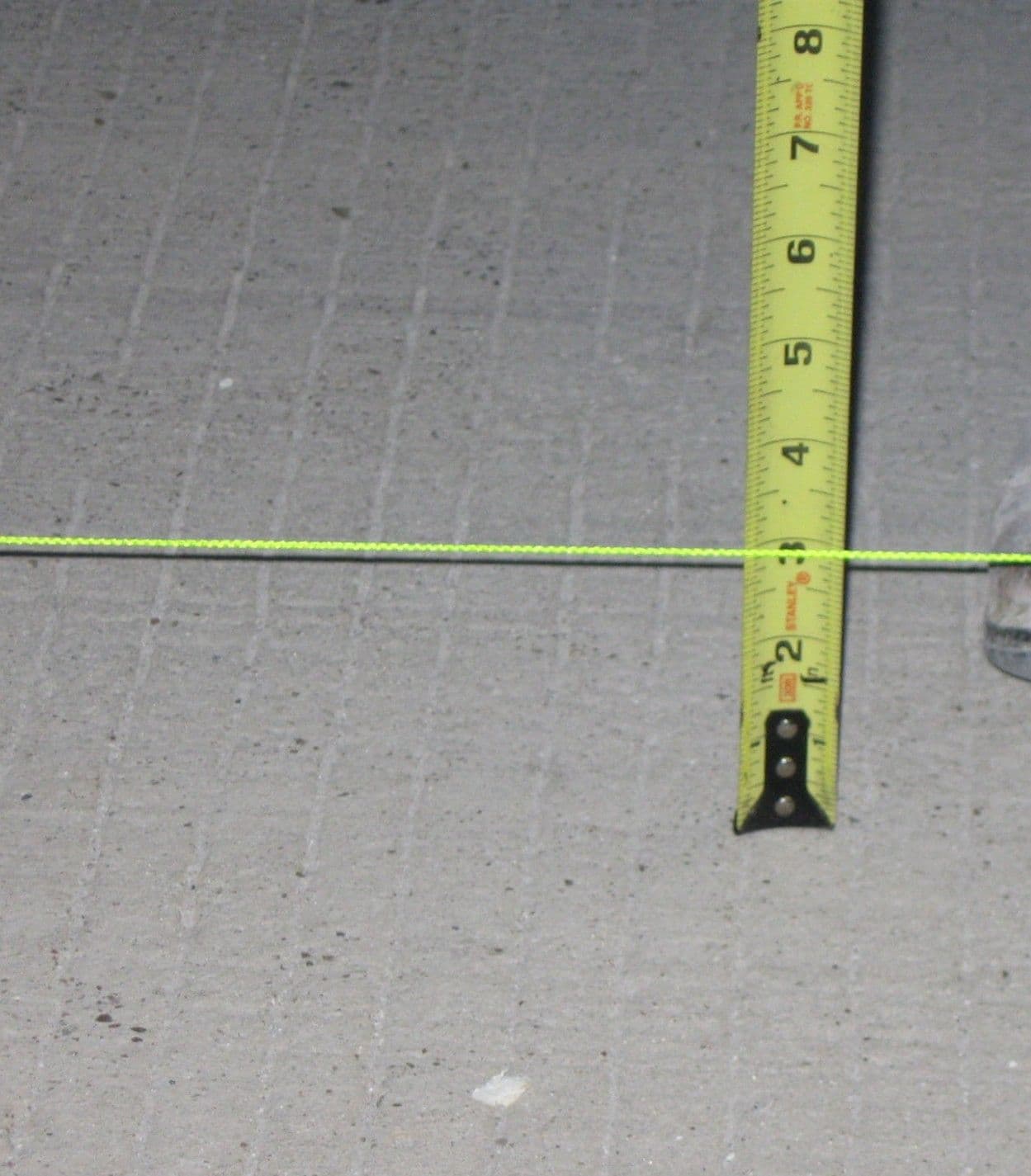
Field measurement at a treated joint. Roadway profiles were recorded before and after treatment for warranty verification, and every location was logged by hand.
The project files document a multi-year program, not a single repair event. Activity in the program trackers runs from 2016 into early 2020, across several corridors, multiple purchasing methods, and changing traffic plans.
The initial corridor tracker records 1,201 completed panels. A later combined tracker records 2,764 completed panels across five additional roadway groups. Together, the two corridor trackers document 3,965 panel completions. Three non-overlapping program trackers record 797,282 pounds of structural polymer placed.
The files also show how the program scaled. It began with a pilot and an initial corridor, expanded into follow-on corridor packages, and continued under a later term contract. That term contract alone spans 39 project days across multiple street locations, with recorded lifts up to 4.25 inches where elevation correction was specified. A program does not get renewed and extended like that unless it is producing a record the owner can stand behind.
One honest note on the evidence. These files document what was tested, injected, lifted, and logged. They do not include a post-project pavement condition survey or a before-and-after structural test program, so this case study rests on documented quantities, the field controls the contracts required, and the fact that the owner kept coming back for the same work.
Across roughly three and a half years, the program built a documented, repeatable way to address localized support loss and joint mismatch on active municipal concrete, one panel at a time.

Program scale documented. The corridor trackers record 3,965 completed panels across the initial and follow-on work, with 797,282 pounds of structural polymer placed across three program trackers.
The program earned its own renewal. Work progressed from a pilot and an initial corridor to additional corridors and a later 39-day term contract, the clearest sign that the process held up across changing conditions and purchasing methods.
Treatment matched the actual condition. Every location was logged as stabilization, lift, or both, so support-only panels were treated without unnecessary lifting and replacement candidates stayed in the replacement program.
Lanes stayed in service. Small access holes, staged injection, and surface monitoring kept the work inside defined traffic-control areas, with treated lanes reopening 15 minutes after the final injection at a location.
Backed by warranty. The contracts carried URETEK's two-year warranty against settlement of more than one-quarter inch in treated areas, with a documented exclusion for deeper untreated conditions the owner chose not to address.
Let testing pick the candidates. Subsurface soundings and roadway profiling separate a support problem from a slab that is simply worn out. That selection step keeps targeted treatment from being wasted on panels that need replacement, and keeps sound-but-settled panels out of the demolition budget.
Separate stabilization from lift. A panel can need support without needing to move. Logging each location as stabilization, lift, or both gives the owner an honest record of what was required and what was actually done.
Track the work by location. Panel counts, material quantities, profiles, and inspector signoff give a municipal team a defensible, corridor-by-corridor record, the kind procurement and engineering both want before a program grows.
Start with a pilot, then standardize. A defined pilot sets spacing, production rates, traffic sequencing, and reporting before the scope expands. On this program, that discipline is what turned a single corridor into a multi-year, multi-contract relationship.
If you manage concrete arterials with recurring joint faulting, isolated settlement, or support loss beneath otherwise serviceable panels, URETEK can help you build a targeted program around it. We evaluate a candidate corridor, define candidate selection and field controls, and scope a measurable pilot before any large commitment. We will also tell you plainly where targeted injection fits and where full-depth replacement is the better answer, so your engineering and procurement teams have the record they need to move. Contact URETEK today: www.uretekusa.com

 800-240-7868


