

Location
Georgetown, Kentucky
Structure Type
Multi-lane asphalt connector roadway carrying an interstate exit ramp over a large precast box structure, settling at the flexible- pavement-to-rigid-structure transition
Core Challenge
A transverse dip had formed at the eastern edge of the box across multiple lanes; a prior asphalt patch had not held, and the agency needed the settlement arrested and the dip reduced, without full-depth reconstruction and without closing the corridor
Verification
DCP testing to compare subsurface strength and set injection depths, with continuous string-line and before/after profile monitoring at 10-foot stations, and injection held to a per-hole quantity or a set surface movement
URETEK Scope
URETEK Deep Injection (UDI) through 3/4-inch holes, injection tubes at roughly 4, 6, and 8 feet, structural polymer placed incrementally to stabilize the soils and lift the pavement across all westbound lanes and the eastbound right lane, one lane closed at a time
Result
The pronounced dip was removed from the treated westbound lanes and the soils stabilized; completion profiles recorded up to 2.5 inches of upward movement westbound and 1.75 inches in the eastbound right lane, all through small drilled holes with no full-depth reconstruction
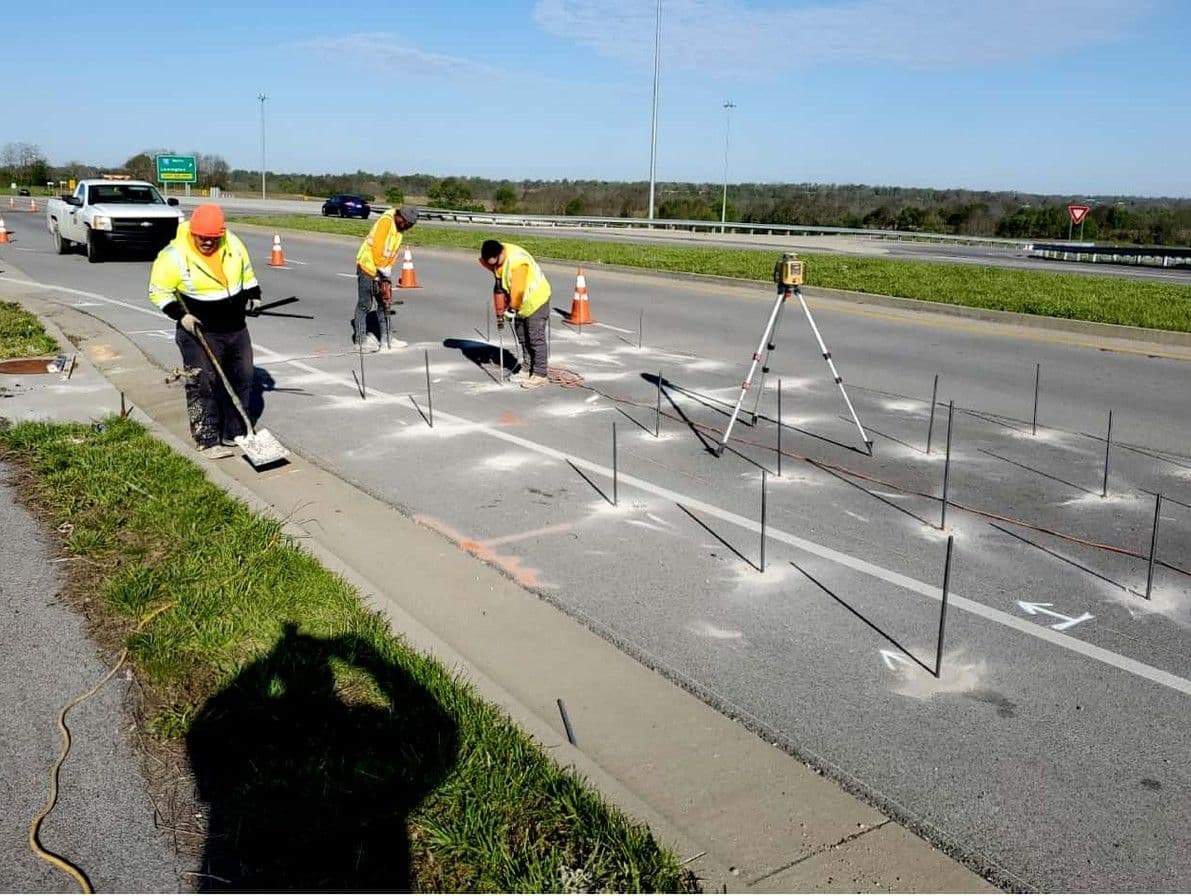
Laying out the injection grid across the multi-lane ramp: crews set string lines and tubes at each point, then injected structural polymer to stabilize the soils and lift the pavement while one lane stayed open to traffic
On a multi-lane asphalt connector near Interstate 75 in Georgetown, Kentucky, a transverse dip had formed across several lanes at the eastern edge of a large precast box structure that carries the roadway over an exit ramp. The dip sat right at the transition between the flexible asphalt pavement and the far more rigid box, the spot where roadways commonly develop the abrupt bump drivers feel at a bridge or culvert.
The movement kept coming back. A previous asphalt patch had been placed in the most affected westbound turn lane, but the depression underneath remained. The state transportation agency had a specific, practical priority: reduce the abrupt grade change and, above all, stop the area from settling further, without removing and rebuilding the full pavement section. A final asphalt overlay was anticipated later to provide the finished riding surface.
The exact cause was not established. Project records associate the dip with the edge of the box and point to the adjacent over-excavation and backfill zone as a likely contributor, but no complete geotechnical investigation was on hand, so the backfill condition is best treated as a working hypothesis. What was clear was the need: stabilize the supporting soils and take the dip out, on a corridor that had to keep carrying traffic.
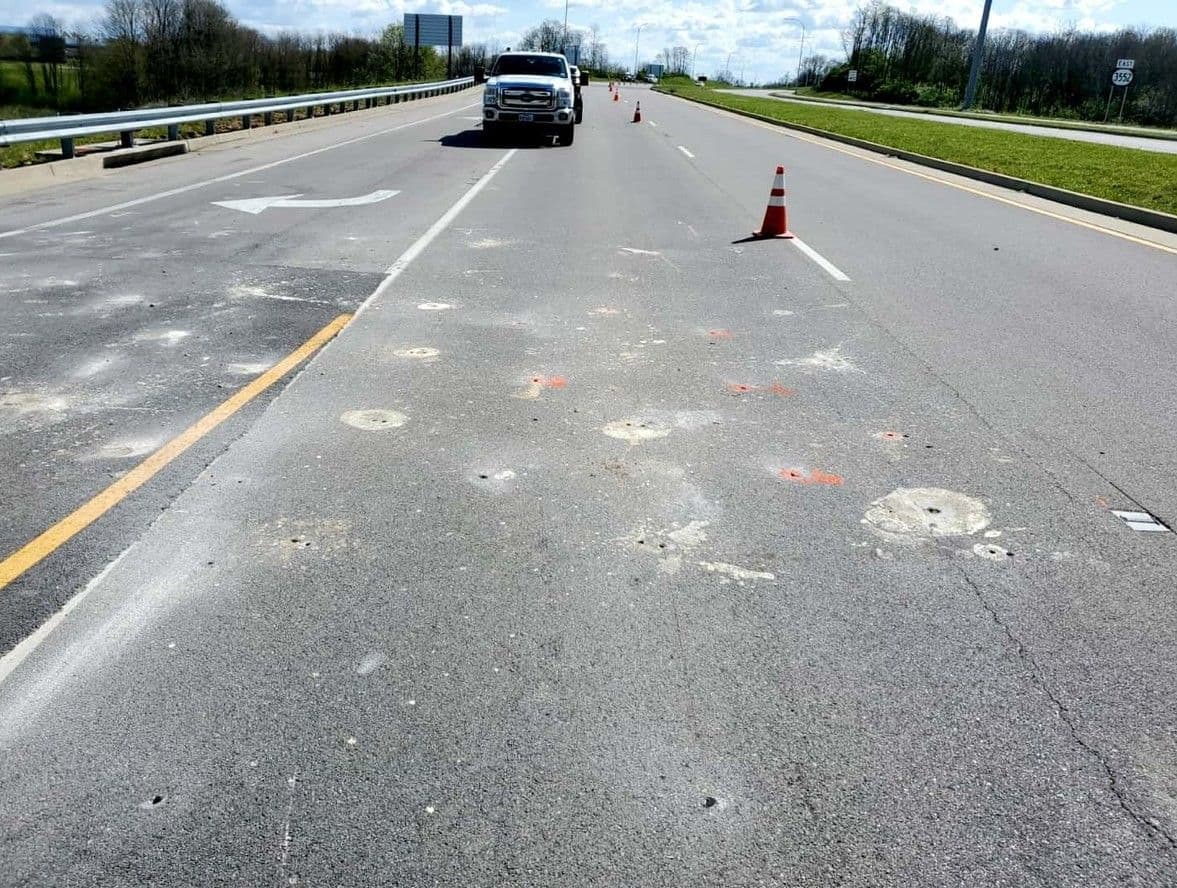
One lane closed at a time: traffic kept moving on the connector while crews worked each section; the light patches mark completed injection points down the lane
The conventional fix for a failing pavement-to-structure transition is to remove and rebuild it: mill or excavate the section, rework the backfill and subbase, and repave. On a multi-lane connector that feeds an interstate, that path means extended lane closures, significant cost, and days of disruption, more than the agency's immediate goal of arresting the settlement and pulling out the dip required.
Repeated patch-and-overlay had already shown its limit here. The earlier asphalt patch restored the surface briefly, but because it did not address the weak soils below, the depression returned. Treating the symptom at the surface was never going to stop the settlement.
What the corridor needed was a way to reach and strengthen the supporting soils in place, take out the dip through the existing pavement, and keep the road open while doing it. That is what URETEK Deep Injection was designed to deliver.
Because the subsurface was uncertain, the work was driven by testing and by the pavement’s own response, not by a fixed recipe. URETEK Deep Injection (UDI) places an expanding structural polymer into the weak soils through small holes drilled directly through the asphalt; as it reacts, it fills voids and weak zones, compacts and confines the surrounding soil, and applies controlled upward pressure to bring the pavement back toward grade.
Crews ran Dynamic Cone Penetrometer (DCP) testing in the roadway to compare soil strength and set treatment depths, and the results varied sharply between adjacent locations. In the previously patched turn lane, the probe met firm resistance (125 blows) at about 5 feet; in the neighboring travel lane, that same resistance was not reached until roughly 14 feet. The plan’s original 4- and 8-foot levels were refined in the field to add an intermediate depth near 6 feet where the soils and the pavement response called for it.
Injection was staged and closely controlled. Crews drilled 3/4-inch access holes, set tubes to the selected depths, and placed polymer incrementally, using string lines and before-and-after profiles to find the deepest part of the dip and watch the pavement move. When the patched area and the high points beside the low spot began to lift together, crews shortened each injection to about six seconds and paused between placements to avoid raising the wrong ground.
Field conditions kept reshaping the plan, and the crew adjusted rather than forced it. Several tubes set for the 8-foot treatment came up bent or crushed and would not take material, so those locations were redrilled or treated near 6 feet instead. Deep stabilization was held to about 30 pounds of polymer per hole or until the surface began to move, whichever came first. In the eastbound right lane, crews injected at about 4 feet and left the deeper tubes unused once material consumption approached the contracted quantity. Work shifted lane by lane and direction by direction as each section was finished, holes were cleaned and grouted, and final profiles were recorded.
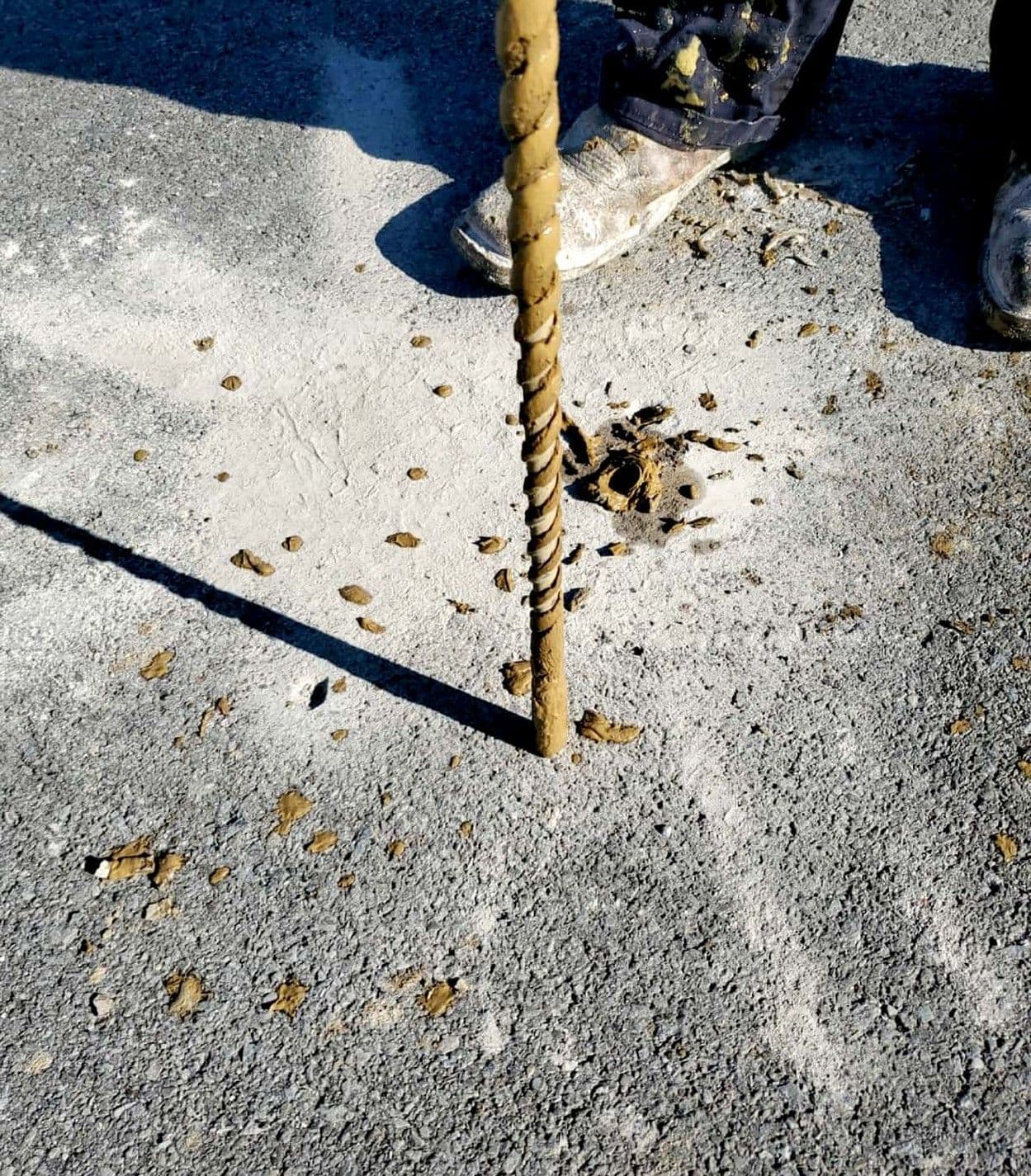
Weak, saturated soil pulled up on the drill during boring: DCP testing and the drilling itself confirmed the soft zones the injection was designed to stabilize
The figures for this repair come from the injection plan, the DCP logs, the daily field reports, and the completion profiles: the record of what was tested, injected, and measured on the road.
The preliminary plan laid out two treatment areas of roughly 44 by 24 feet and 30 by 24 feet at the box transition. DCP testing set the depths, and the contrast was telling: firm resistance at about 5 feet in the patched lane versus about 14 feet one lane over. Treatment depths ended up at roughly 4, 6, and 8 feet, placed through 3/4-inch holes, with deep stabilization held to about 30 pounds per hole or the onset of surface movement.
Movement was measured, not assumed. Completion profiles were taken at 10-foot stations across each treated lane. The westbound profile recorded upward movement concentrated between stations 30 and 60, with the greatest single reading about 2.5 inches along the right shoulder. The eastbound right-lane profile recorded a maximum of about 1.75 inches between stations 30 and 40.
The work ran across four documented field shifts, the first cut short by rain, and was completed entirely through drilled access points with no full-depth removal of the existing roadway. Crews noted that a slight drop remained right at the box itself, which the agency’s planned asphalt overlay would smooth out.
URETEK arrested the settlement and pulled the dip out of the treated lanes, through small holes, without closing the corridor or reconstructing the pavement.

Dip removed from the westbound lanes. The pronounced depression was taken out of the treated westbound turn and travel lanes, with completion profiles showing up to about 2.5 inches of upward movement between stations 30 and 60.
Soils stabilized at depth. Guided by DCP testing, structural polymer was placed at roughly 4, 6, and 8 feet to compact and confine the weak supporting soils, targeting the cause of the settlement rather than only the surface dip.
Corridor stayed open. With only one lane closed at a time and all work done through 3/4-inch holes, traffic kept moving on the connector throughout the four field shifts, with no full-depth reconstruction.
Profile correction measured, not assumed. Before-and-after profiles at 10- foot stations documented the movement lane by lane, including about 1.75 inches of lift in the eastbound right lane between stations 30 and 40.
Backed by URETEK’s two-year warranty against settlement. URETEK stands behind the completed work with its two-year warranty against settlement.
Test before you lift, and expect variation. DCP results here differed sharply from one lane to the next, firm ground at about 5 feet in one lane and 14 feet in the next. Testing each location, rather than assuming a uniform profile, is what set the right depths.
Stabilize the soil, not just the surface. An earlier patch had already shown that resurfacing alone would not hold. Reaching the weak soils at depth and confining them is what addresses why a transition keeps settling.
Let the pavement’s response govern the injection. When high points began lifting with the low spot, crews shortened injections to about six seconds and paused between them. Watching the surface and adjusting in real time protects the areas that should not move.
Adapt to field conditions instead of forcing them. Crushed tubes, hard drilling, and a material budget all reshaped the plan on site. Shifting depths, redrilling, and knowing when to stop delivered the correction without damaging the pavement or overrunning the scope.
If a dip keeps returning where your pavement meets a bridge, box, or culvert, especially where patching has not held and the road has to stay open, URETEK can help. We test the soils, stabilize them at depth, and lift the pavement through small holes, one lane at a time. We will evaluate your subsurface with in-situ testing, design a staged injection program, and correct the profile under continuous monitoring, giving your team a faster, lower-disruption repair than full-depth reconstruction.

 800-240-7868


