

Location
Indiana
Structure Type
Seven precast manholes on a gravity sewer in a municipal wastewater collection system, set in a low-lying area that stayed saturated after rainfall, alongside an interstate highway and adjacent commercial drainage.
Core Challenge
Inflow and infiltration through manhole joints and pipe connections drove flow at some pump stations up as much as 500 percent during major rain events, and flow at the treatment plant up as much as 300 percent. The excess water was consuming the capacity the city needed to approve new commercial development.
Verification
Flow monitoring from the downstream pump station upstream through the collection system to locate the source, CCTV inspection of the sewer, direct observation that active high-pressure leaks stopped during injection, and the city's own pump-runtime comparison across matched weeks before and after the work.
URETEK Scope
URETEK Deep Injection (UDI) at seven manholes, worked from inside each structure through small injection ports. Three received targeted injection at active leakage points; four received radial injection to encapsulate the structure. No excavation around the manholes and no bypass pumping.
Result
All seven manholes treated in about 1.5 working days. High-pressure leaks stopped at the point of injection, flow dropped at both the treated and the downstream pump station, and the city reported an average of 26.91 fewer pump-runtime hours per week.
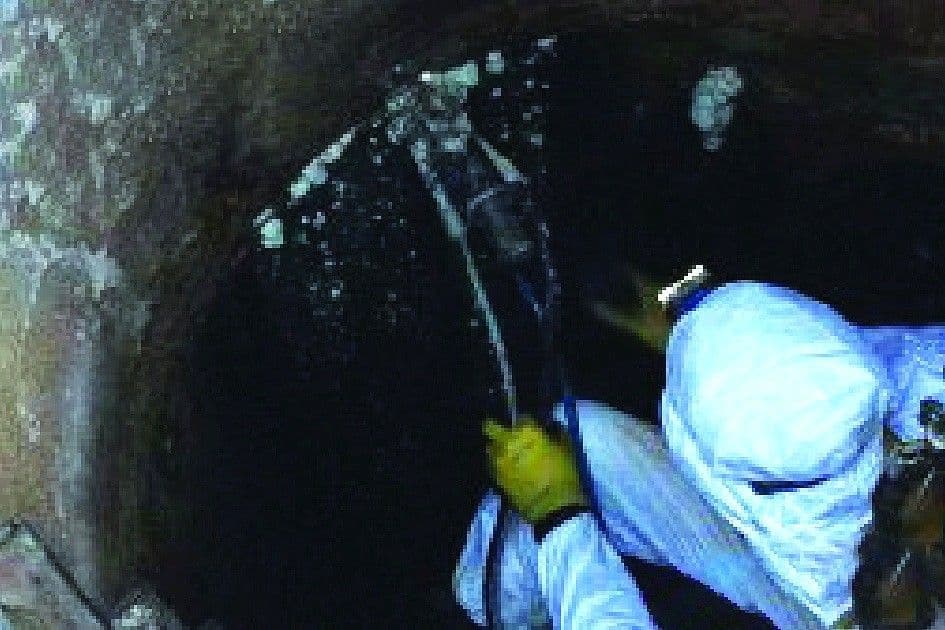
A URETEK technician injecting at an active leak inside one of the manholes. Crews worked entirely through the existing access opening, in the wet, with the sewer in service.
Commercial development was picking up, and the city's wastewater system was quietly running out of room. Operators noticed unusually high water at one pump station, and the strain carried downstream to the treatment plant. During major rain events, flow at some pump stations climbed as much as 500 percent, and flow arriving at the plant as much as 300 percent.
That extra water was groundwater and stormwater getting into a sewer built to carry neither, and the city was paying to pump and treat every gallon of it.
Budget pressure had kept the repair near the bottom of the list for years. What moved it to the top was a permitting problem. The wet-weather flow threatened the city's ability to sign capacity letters for new commercial developments, at which point a leaking manhole stopped being a maintenance item and became an economic development one.
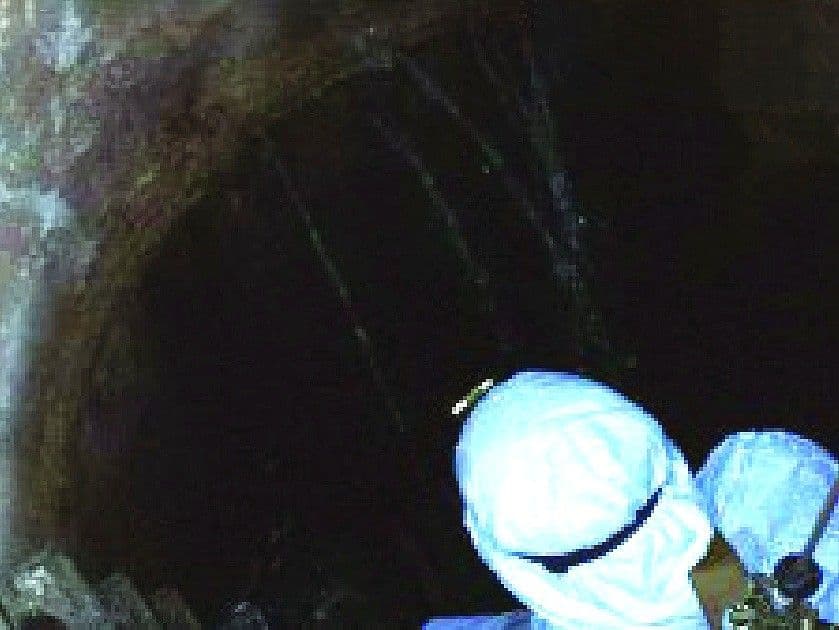
Two technicians working a structure from the inside. Several of these manholes sat behind developed properties with almost no room to set up, which is the constraint that decided the method.
The investigation ruled out the obvious culprit first. Flow monitoring started at the downstream pump station and worked upstream through the collection system until it landed on the gravity outlet serving an upstream station. CCTV inspection of that sewer found the pipe generally sound. The water was coming in at the joints, the manholes, and the pipe connections.
That finding narrowed the options. The city priced sewer lining, cured-in-place pipe, and relocating the line. All three rebuild the pipe, which the CCTV inspection had just cleared. Two of them also meant getting equipment and a work zone to structures sitting in a chronically saturated low spot, several of them behind developed properties with almost no working room.
URETEK Deep Injection (UDI) got the work on grounds the city documented: it cost less than the alternatives and it sidestepped the access problems.
Seven manholes went into the rehabilitation program, sorted into two treatment types. Three had general I&I entering at identifiable points. Four were far enough gone to need full encapsulation. Sorting them that way put the material and the crew hours where the water actually was.
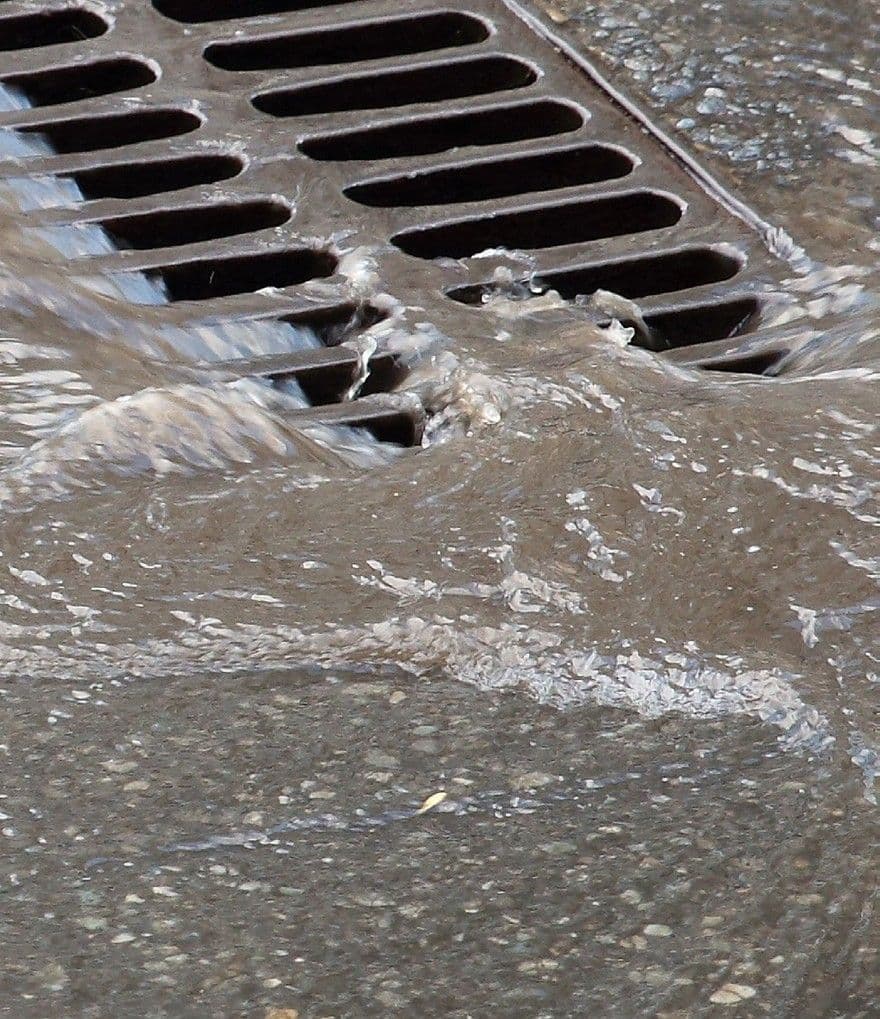
Highway and commercial runoff feeding the drainage system above the work. Saturated ground around these structures is what put the groundwater under head and drove it through every open joint.
Crews worked from inside each manhole. They drilled small injection ports through the wall and injected a two-component expanding hydrophobic polyurethane grout, which reacted outside the structure and moved into the accessible voids and water pathways around it. On the three manholes with localized leaks, injection went in at the leak points and expanded through the surrounding voids. On the four encapsulation manholes, injection was run radially around the structure to get continuous coverage.
Injection at each port continued until resistance indicated the targeted pathways were filled and the observed leakage was under control. Nothing was excavated around the manholes, and the project record notes that no bypass pumping was required. All seven structures took about 1.5 working days.
The immediate verification was visual, and on this project it was unambiguous. Several of these manholes had groundwater entering under real head, jetting clear across the structure. Those high-pressure leaks stopped during the work, at the point of injection, with the crew standing there watching.
The longer verification came off the pump stations. The city compared flow before and after the repair and recorded reductions at both the treated station and the station downstream of it. On a water-cutoff scope, pump runtime is the measurement that counts, because it tracks the volume the system no longer has to move.
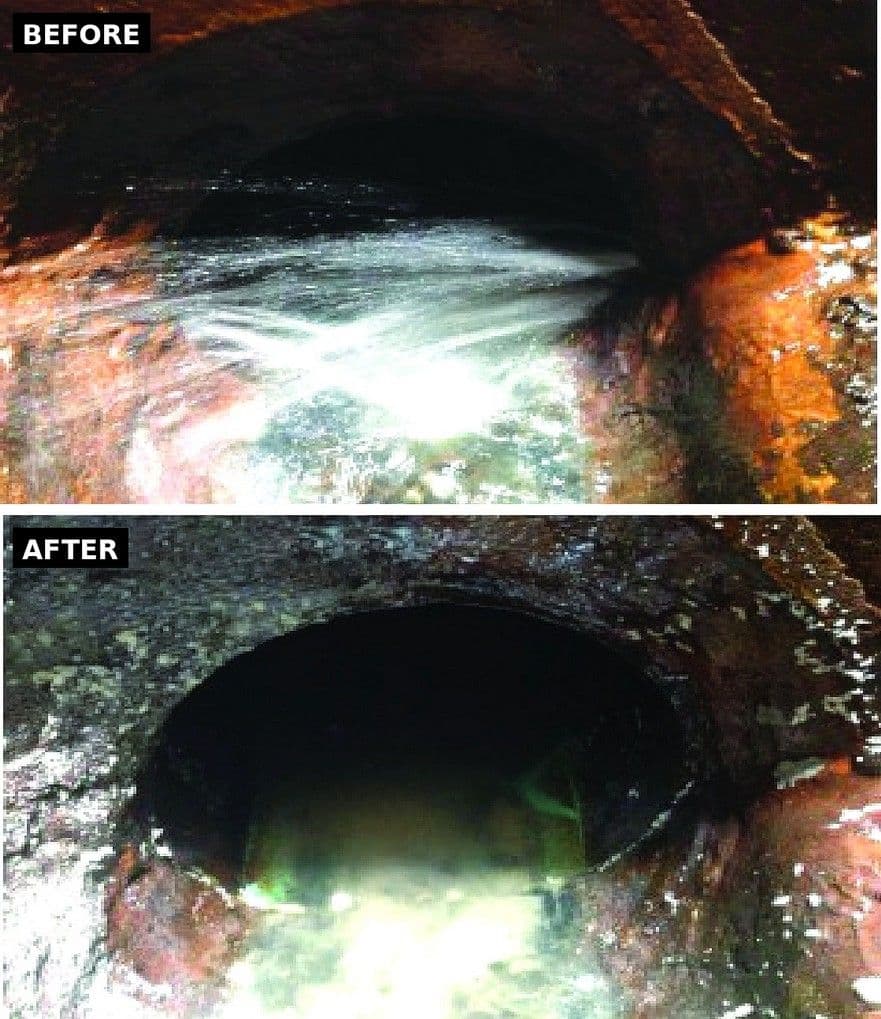
The same pipe connection before and after injection. Groundwater under head on the way in, then the void behind the wall filled and the leak stopped.
The city ran the before-and-after comparison itself, on its own flow and runtime data. The figures below are the city's analysis rather than a URETEK measurement, and they are worth reading with that attribution in mind.
The comparison covered weeks 31 through 45 in consecutive years and found an average reduction of 26.91 pump-runtime hours per week after the rehabilitation. It is a reported pre- and post-project comparison over matched weeks, and the available records do not document normalization for rainfall differences between the two years. A real operational result, read with that caveat.
From those runtime hours the city calculated roughly 2.34 million gallons per week of flow it no longer had to pump and treat, and an annual operating saving of about $1.1 million. The city also credited the repair with removing the need for a new pump station it had been considering, an avoided capital cost of about $750,000.
Seven manholes in about 1.5 working days produced those figures. That ratio is the argument for finding and sealing the I&I source before buying more pumping and treatment capacity.
URETEK sealed seven leaking manholes from the inside in about 1.5 working days, with no excavation, no bypass pumping, and the sewer in service the whole time.
 Leaks stopped at the point of injection. Active high-pressure groundwater leaks were observed to stop during the work, where the grout went in, with the crew present to confirm it.Seven structures, about 1.5 working days. Three manholes received targeted injection at leakage points; four received radial injection to encapsulate the structure. All seven were back in full operation at the end of the work.Flow dropped at two pump stations. The city recorded lower flow at the treated pump station and at the station downstream of it after the rehabilitation.26.91 fewer pump-runtime hours per week. From the city's own comparison of matched weeks before and after the work. The city calculated that as roughly 2.34 million gallons per week and about $1.1 million a year in operating cost.A new pump station avoided. The city credited the repair with removing the need for a pump station it had been considering, an avoided capital cost of about $750,000.
Find the source before you buy capacity. This city was pricing a new pump station to move water it did not need to be moving. Flow monitoring from the downstream station upstream cost a fraction of that and pointed at seven structures.
A sound pipe is a finding worth acting on. CCTV that clears the pipe while the joints, manholes, and connections leak takes lining and cured-in-place pipe off the table and points at the structures. Read the inspection for where the water enters.
Access constraints belong in the method comparison. Structures in a saturated low spot behind developed properties change what equipment can reach them at all. A method that works through the existing manhole opening prices differently than one that needs a work zone, and that difference decided this job.
On water-cutoff work, measure the pumps. Runtime and flow at the stations up and down the line are the honest measure of an I&I repair. State the comparison period and whether rainfall was normalized, and the number will hold up to the questions an engineer should ask about it.
If wet-weather flow is consuming treatment capacity, driving pump runtime, or standing between you and the next capacity letter, the water is getting in somewhere specific. URETEK Deep Injection seals leaking manholes, joints, and pipe connections from inside the structure, with little or no excavation where conditions permit and the line in service. We will help trace the source, design a targeted or full-encapsulation injection program for each structure, and stop the leakage where it enters.

 800-240-7868


