

Location
Cranston, Rhode Island
Structure Type
Heavily traveled interstate highway pavement (asphalt over concrete) directly above a 108-inch reinforced concrete storm drain, four to five feet below grade, flanked by two 12-inch underdrains
Core Challenge
Up to two inches of recurring settlement across all northbound lanes over roughly 170 linear feet, with subgrade support loss suspected from fines migrating into a deteriorated, non-functioning underdrain system
Verification
Dynamic Cone Penetrometer (DCP) testing to establish soil conditions and injection depths, plus continuous laser-level and dial-indicator monitoring with pavement profiles recorded every 10 feet before and after injection
URETEK Scope
Multi-level URETEK Deep Injection (UDI) soil stabilization on a 4 by 3 foot grid to depths of 15 feet, performed overnight under live traffic with no excavation
Result
Roughly 170 linear feet by 24 feet of pavement stabilized across five injection elevations; completed in 10 days, five days ahead of schedule, and about $125,000 under budget
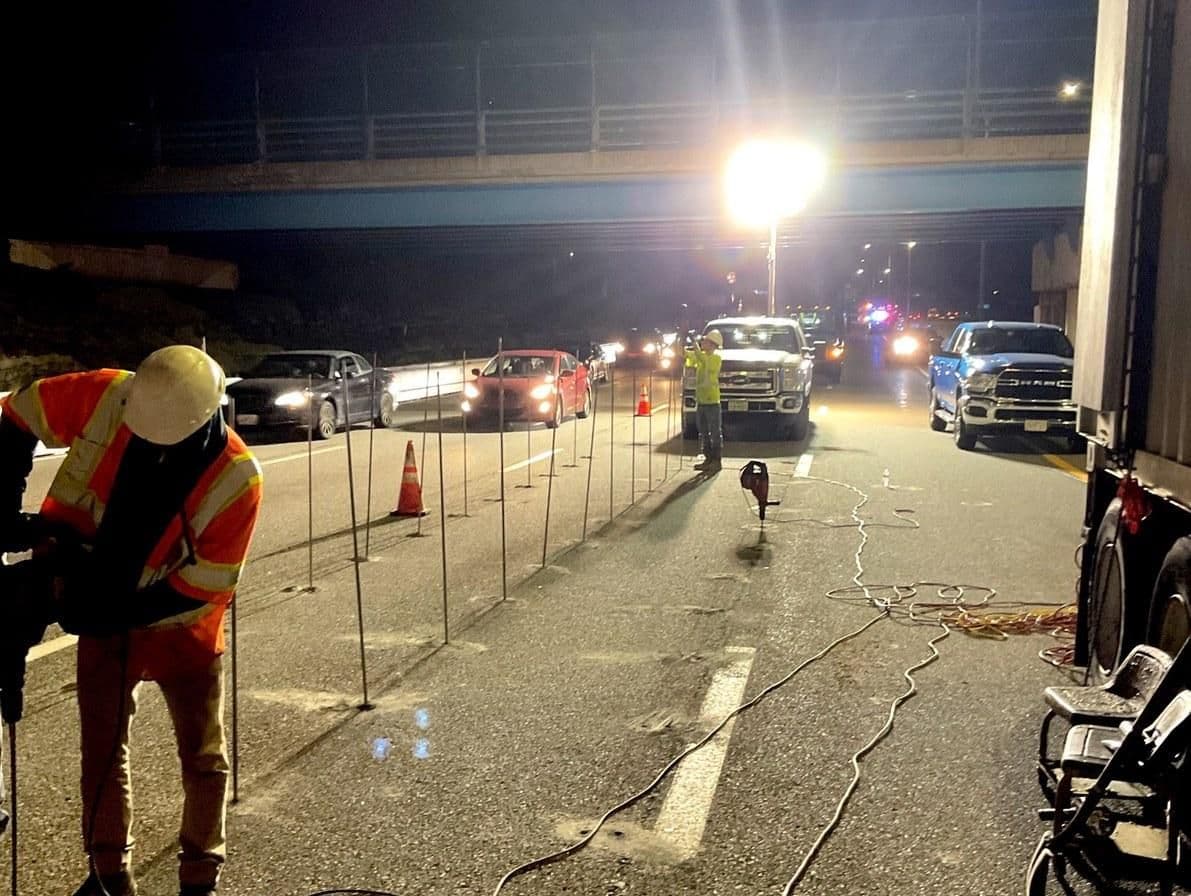
A URETEK crew works the injection grid at night on a section of Interstate 95, installing tubing through the pavement structure while the corridor stays open to traffic
A heavily traveled section of Interstate 95 in Cranston, Rhode Island was settling under all northbound lanes. Across roughly 170 linear feet, the pavement had dropped by as much as two inches. The road was originally built with about four inches of asphalt over concrete, but over the years crews had chased the movement with repeated resurfacing, adding as much as three feet of asphalt patch in the worst lanes. Repaving kept restoring the surface. It did not stop the settlement from returning.
The recurring movement pointed to a problem below the pavement structure. The settlement zone sat directly above a 108-inch reinforced concrete storm drain, installed four to five feet beneath the roadway and running the full length of the visible settlement, with two 12-inch underdrains set on either side of the main line. Third-party engineers conducted borings and analyses, but no single definitive cause could be confirmed. The suspected mechanism was fines being drawn into the clogged, non-functioning underdrains, gradually removing support from the soils beneath the pavement. Weighing both a bearing capacity problem and a possible developing sinkhole, state transportation officials called URETEK.
The repair had to work around the corridor, not shut it down. This is one of the region's busiest arteries, so the solution had to keep traffic moving, avoid extensive excavation over critical buried utilities, limit lane closures to overnight windows, and hold to an aggressive schedule. Any approach that meant opening the roadway over the storm main was a problem in its own right.
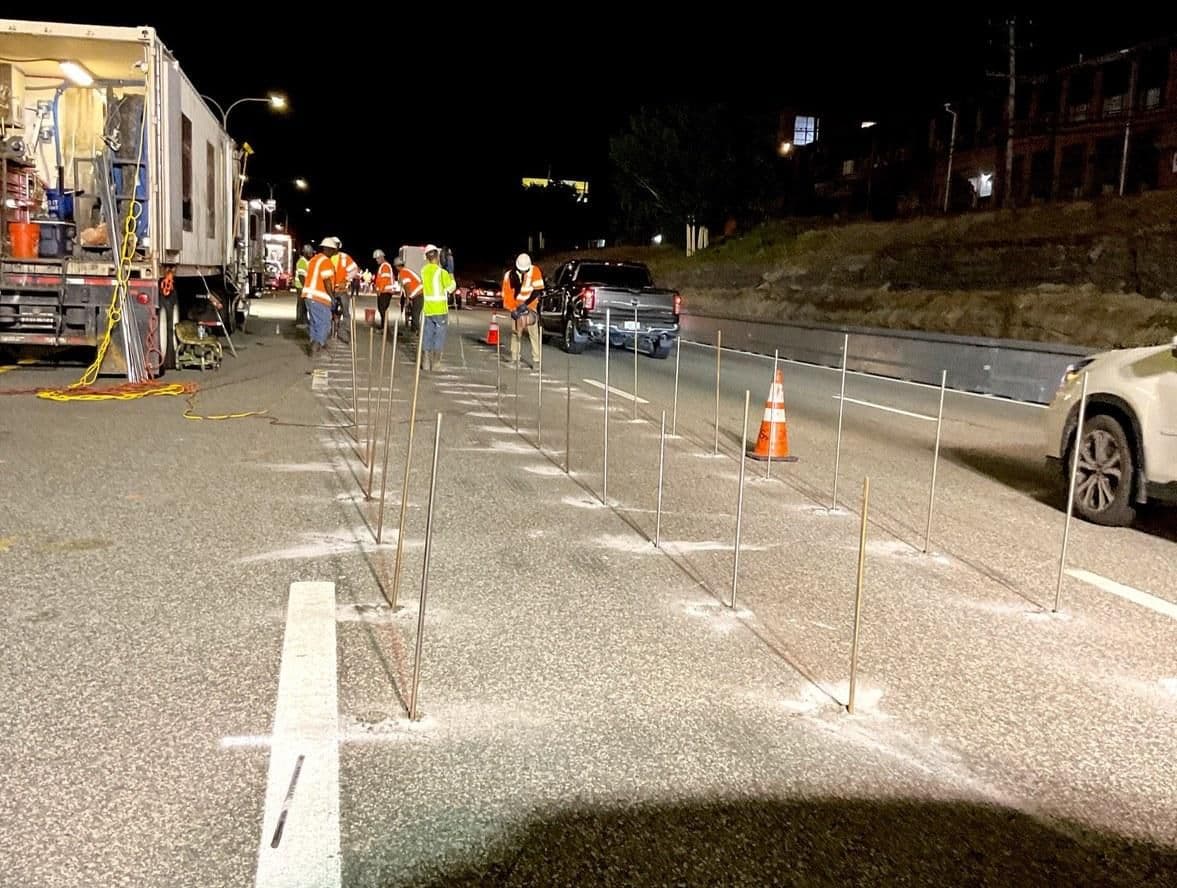
The engineered injection grid staged across the settlement zone: closely spaced tubing marks the 4 by 3 foot pattern used to deliver structural polymer at depth along the buried drainage corridor
The maintenance history made the limits of a surface fix clear. Milling and repaving treated the wearing surface while the soils that were actually losing support sat several feet down, around the drainage corridor. Each new overlay added dead load and bought time, but the settlement returned because the underlying condition was never addressed.
Full-depth reconstruction was the conventional alternative, and on this site it carried real risk. Excavating to rebuild the subgrade over a 108-inch storm main and its underdrains meant working directly on top of critical, active infrastructure, with the disruption, cost, and extended full-lane closures that come with open-cut work on a high-volume interstate. The buried utilities that complicated the settlement also made digging the least attractive way to fix it.
What the project needed was a method that could reach the weak soils at depth, strengthen them in place, and confirm the result through direct field measurement, all without excavation and all within short overnight work windows. That is what URETEK Deep Injection was designed to deliver.
URETEK developed an injection plan to stabilize and strengthen the foundation soils to 15 feet below grade and presented it, with engineering drawings, to the state transportation officials. URETEK Deep Injection (UDI) places structural polymer into targeted weak zones through small holes drilled directly through the pavement. The polymer fills voids, compacts and confines the surrounding soils, and forms stabilized support zones that restore bearing performance and reduce future settlement, without removing the existing roadway.
Crews drilled 5/8-inch holes through the pavement with handheld rotary hammers on a 4 by 3 foot grid across the work area. Injection tubing was set at varying depths from 3 to 15 feet, following the plan drawings, so structural polymer could be delivered at five distinct elevations below the surface. The layout was designed to bridge the identified weak soils across the settlement zone and tie into the competent soils beyond it, building a continuous zone of improved support around the buried drainage line.
Injection depths were set from Dynamic Cone Penetrometer (DCP) testing performed in each surface lane, so treatment followed the measured soil conditions rather than a uniform assumption. At each location, injection continued until surface monitoring reached the target movement or the predetermined material quantity from the drawings was placed, whichever came first. When the work was complete, the injection tubing was driven at least two inches below grade and the holes were patched with non-shrink cementitious grout.
Grade and surface response were monitored continuously throughout the work. The crew recorded a pavement profile every 10 feet along the edges and center of the work area, before and after injection, and documented the readings for review. During each injection, movement was tracked with a laser level and dial indicator, and injection at a given point stopped as soon as one millimeter of surface movement was detected, confirming that the soils below had been adequately stabilized. Because the polymer reaches roughly 90 percent of its compressive strength within about 15 minutes, lanes could be reopened to traffic about 15 minutes after the final injection of each shift.
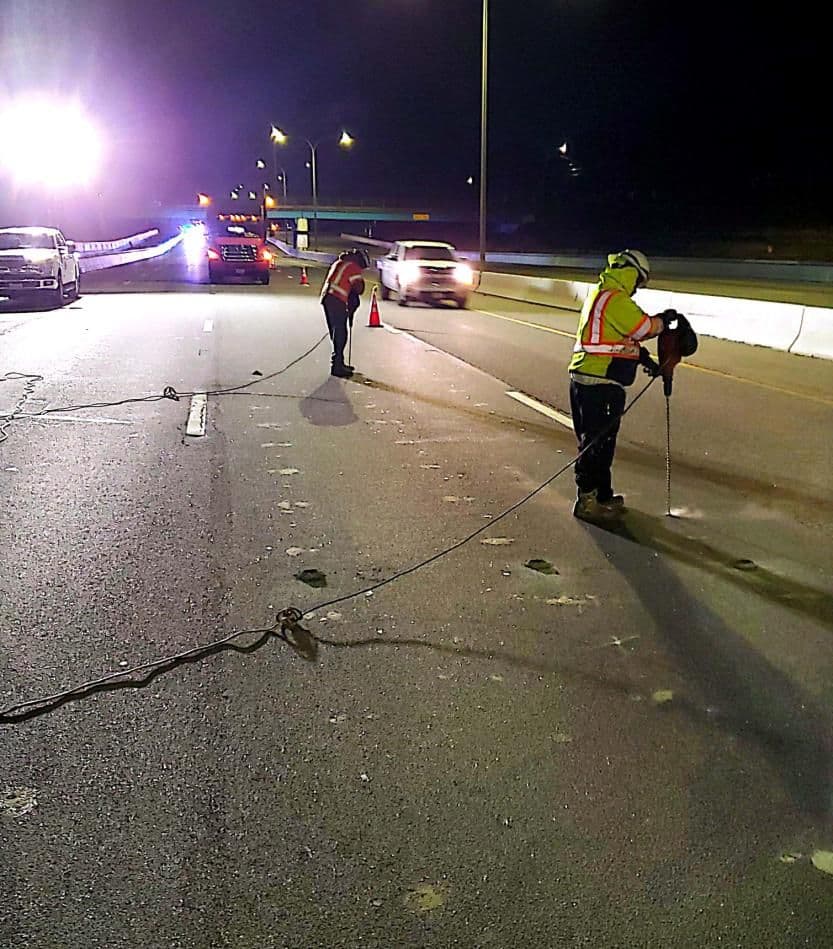
Drilling 5/8-inch injection holes through the pavement at night: the program ran entirely in overnight lane closures, keeping the interstate open to traffic during the day and requiring no excavation over the buried storm main
The figures that defined this repair came from the project drawings, the DCP program, and continuous field monitoring, not from injection volume alone. Together they describe the problem, the treatment, and the level of control the crew held on a live interstate.
The problem measured up as deep-seated, recurring settlement: as much as two inches of drop across all northbound lanes over roughly 170 linear feet, on a roadway originally built with about four inches of asphalt over concrete and since carrying up to three feet of accumulated asphalt patch in the worst lanes. Directly below sat a 108-inch reinforced concrete storm drain, four to five feet deep, flanked by two 12-inch underdrains.
The treatment was sized to that geometry. Crews worked a 4 by 3 foot grid of 5/8-inch injection holes, set tubing at depths ranging from 3 to 15 feet, and injected structural polymer at five distinct elevations. The improved support zone extended the full length of the settlement, roughly 170 linear feet, and reached about 24 feet across the northbound lanes.
Control came from measurement, not volume. Injection at each point was held to a one-millimeter surface-movement threshold, verified in real time by laser level and dial indicator, with pavement profiles recorded every 10 feet before and after. Because the polymer reached about 90 percent compressive strength within roughly 15 minutes, the corridor returned to traffic about 15 minutes after each shift's last injection.
The stabilization program met the project's objectives on the road, on the schedule, and on the budget.

Full settlement zone stabilized. Roughly 170 linear feet by 24 feet of pavement across all northbound lanes was strengthened down to the compromised underdrains, with soils treated across five injection elevations to 15 feet below grade.
Completed five days ahead of schedule. The work finished in 10 days against a 15-day estimate, shortening the time crews and lane closures affected one of the region’s busiest corridors.
About $125,000 under budget. Final project cost came in roughly $125,000 below the estimate, without the expense of full-depth reconstruction over the storm main.
No excavation and no daytime closures. Small 5/8-inch access holes replaced open-cut repair over the buried drainage line, and all work ran in overnight windows with traffic restored about 15 minutes after each shift.
Bearing capacity increased, settlement risk reduced. The stabilized support zone raised the soil bearing capacity and was designed to limit further loss of fines into the underdrains, the suspected driver of the settlement.
Diagnose below the pavement, not just on it. Years of resurfacing did not hold because the cause sat in the subgrade near the drainage corridor, not in the wearing surface. DCP testing in each lane located the weak zones and set the injection depths.
Match injection depth to the failure, not the surface. Treating soils across five elevations to 15 feet addressed the full depth contributing to settlement, rather than lifting the pavement and leaving the weak soils in place to move again.
Real-time monitoring turns injection into a controlled process. Laser levels, dial indicators, and a one-millimeter movement threshold let the crew confirm stabilization at each point and protect the riding surface, even while working under live interstate traffic.
Trenchless ground improvement protects the utilities that complicate the repair. Injecting through small holes meant no open excavation over a 108-inch storm main and its underdrains, so the buried infrastructure stayed undisturbed and the interstate stayed in service.
If you are managing recurring roadway or pavement settlement, especially over buried utilities where excavation is risky and lane closures must stay short, URETEK can help. We stabilize and strengthen the soils that support the pavement, in place and under traffic. We will evaluate your subsurface conditions, establish injection depths through in-situ testing, and stabilize the foundation soils with continuous monitoring, giving your team a verifiable repair without tearing out the roadway.

 800-240-7868


