

Location
Washington, D.C.
Structure Type
Historic subterranean slow sand filtration structure: a below- grade vaulted masonry complex requiring shallow foundation support for new column loads
Core Challenge
Cohesive subgrade soils exhibited unacceptable settlement under design column loads; pre-injection testing confirmed existing foundations were not suitable without treatment
Verification
Pre- and post-injection plate load testing performed in general accordance with ASTM D1194 to directly measure bearing capacity and settlement response before and after treatment
URETEK Scope
Targeted chemical injection ground improvement program with in-situ load testing to confirm compliance with bearing capacity and settlement criteria
Result
Order-of-magnitude reduction in settlement at design load, from approximately 1.38 inches pre-injection to 0.07 inches post-injection, with bearing capacity and elastic response confirmed by testing
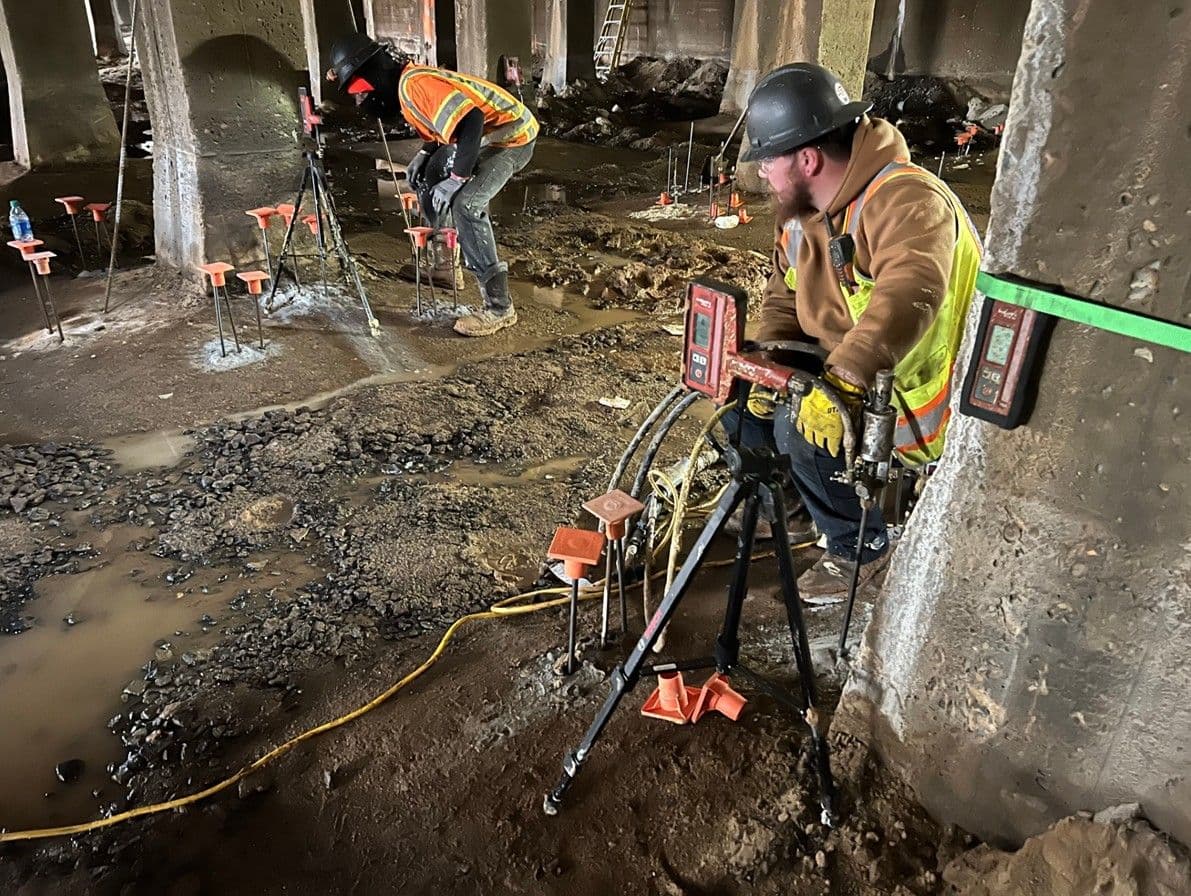
URETEK crew inside the historic subterranean filtration cells: injection probes installed in a dense grid pattern throughout the flooded working environment, with real-time monitoring equipment staged at each injection station
A major redevelopment project in Washington, D.C. required the adaptive reuse of a historic below-grade slow sand filtration complex. Built more than a century ago, the subterranean structure, a series of vaulted masonry cells supported by a grid of columns, was being transformed to support a modern mixed-use program. That transformation introduced new column service loads of approximately 98 kips, and with those loads came a critical question: could the existing shallow foundations and the cohesive subgrade soils beneath them handle what was being asked of them?
The answer, based on pre-injection plate load testing, was unambiguous: not without treatment. Testing confirmed that under design loading, the untreated foundation system exhibited excessive settlement and limited elastic recovery. At 40 kips, measured settlement was approaching two inches, with minimal rebound. At the design allowable bearing pressure, total settlement was approximately 1.38 inches, well outside the strict tolerance thresholds established to protect the existing structure from differential movement and irreversible deformation.
For engineers managing adaptive reuse of historic infrastructure, this scenario is familiar and consequential. The structure cannot be demolished and rebuilt. The existing foundations cannot be easily replaced. And the tolerance for settlement is tightly constrained, both by the loads and by the preservation requirements. The challenge is not whether to improve the ground, but how to do it in a way that is verifiable, precise, and minimally disruptive to a structure that has already survived a century of service.
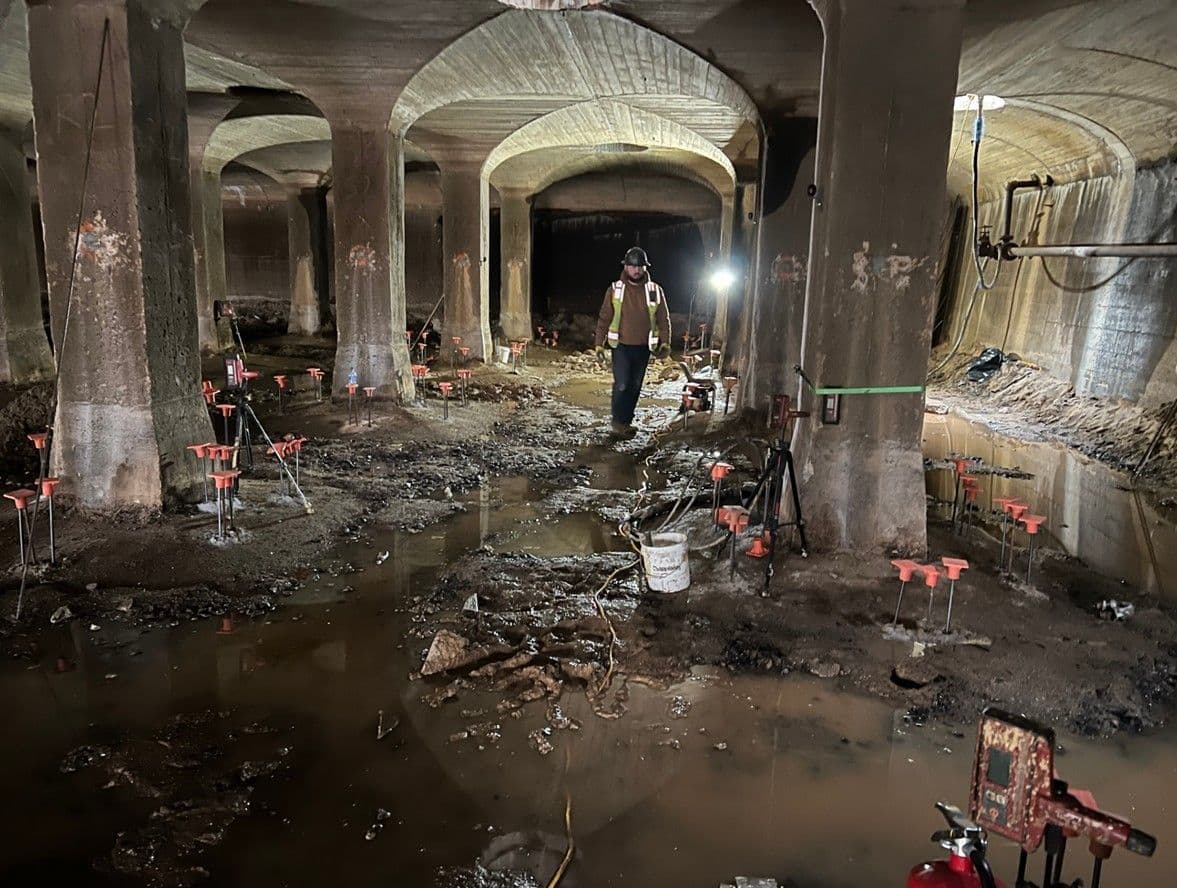
The vaulted below-grade working environment: hundreds of injection probes installed across the treatment grid; active water and deteriorated conditions visible throughout the space reflect the demanding site conditions under which the ground improvement program was executed
When shallow foundations underperform in cohesive soils, the traditional remediation path often points toward deep foundations: micropiles, helical piers, or similar systems that bypass the problematic soil layer entirely. On a greenfield site, that is a straightforward decision. Inside a historic subterranean masonry structure, it is not.
Installing deep foundation elements within the existing cell structure would have required significant disturbance to the masonry fabric, complex drill access in tight ceiling-height conditions, and the kind of vibration and structural disruption that preservation requirements actively prohibit. The structure itself was the constraint, not just a physical one, but a programmatic one tied to the historic character of the asset.
What the project needed was a method that could reach the soils contributing to settlement, improve their stiffness and load-carrying capacity from within, and confirm that improvement through direct field measurement, all without compromising the structure, all within the confines of the existing below-grade environment. That is exactly what chemical injection ground improvement with in-situ plate load verification was designed to deliver.
URETEK designed and executed a targeted chemical injection ground improvement program to increase the stiffness and reduce the compressibility of the cohesive soils beneath the test footings. The approach was built around a fundamental principle that distinguishes it from volume-based grouting programs: verify performance directly, in the ground, under simulated load, before committing to full-scale implementation.
Injection points were installed around and beneath the test footing at depths of 0, 3, 6, 9, and 12 feet below grade, creating a treatment zone that encompassed the full depth range contributing to foundation response. Injection quantities were calibrated to subsurface response at each depth increment rather than applied uniformly. Near- surface soils between zero and three feet showed limited material acceptance, indicating relatively stiff conditions that required less treatment. Deeper soils between six and twelve feet exhibited significantly greater injection take, confirming that these zones governed overall settlement behavior and warranted the highest treatment intensity.
Average injection quantities were approximately 4.8 pounds per node per depth, corresponding to roughly 7 to 8 pounds per square foot beneath the improved foundation area. This depth-differentiated approach ensured that the most mechanically significant zones received the most treatment, concentrating the improvement where the soil testing and injection response indicated it was needed most, and avoiding over-treatment of zones that did not require it.
Pre- and post-injection plate load tests were performed in general accordance with ASTM D1194 to directly evaluate foundation behavior at each stage. The testing protocol simulated a shallow foundation subjected to incremental loading up to 100 kips, exceeding the design allowable bearing pressure of approximately 10,900 psf, and measured settlement response and elastic rebound at each load increment. This is the critical distinction of a verified ground improvement program: the test simulates the actual performance scenario in the actual soil, under actual load, before full-scale work proceeds.
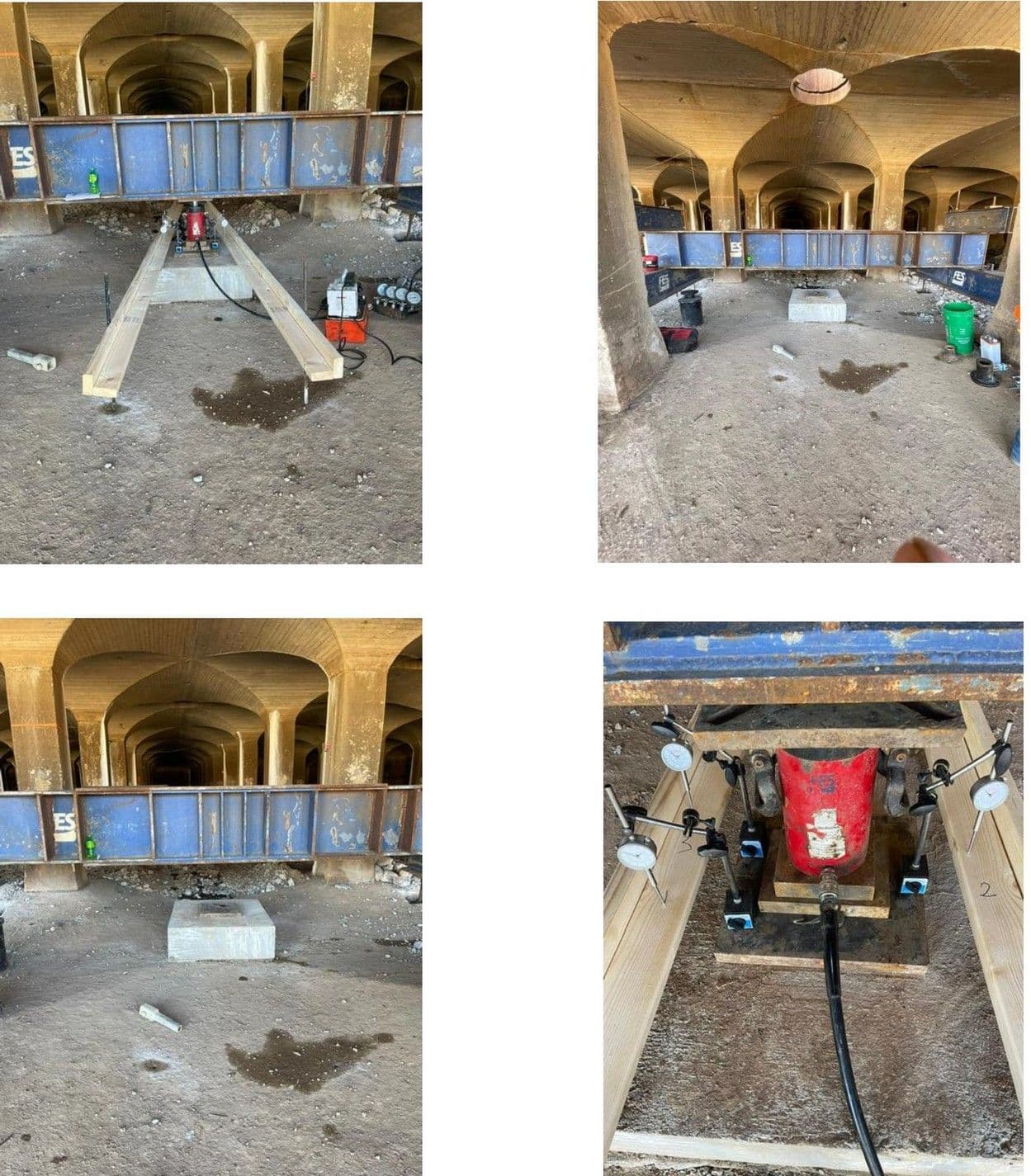
Pre- and post-injection plate load testing at the Cell 28 footing location: the custom test frame, load jack, and precision dial gauges measured settlement response and elastic rebound under incremental loading up to 100 kips, directly confirming the effectiveness of the ground improvement program before full-scale implementation
The pre- and post-injection test results told a clear and quantitative story about the effectiveness of the treatment, one that engineers and owners can evaluate directly rather than inferring from injection volumes alone.
Before injection, the foundation system exhibited the behavior that had raised the concern: measured settlements ranged from approximately 0.16 inches at minimal load to nearly 2 inches at 40 kips, with very limited elastic rebound upon unloading. This predominantly plastic response indicated that the untreated soils were deforming in ways that would not recover under service loading, exactly the condition that drives long-term differential settlement and structural distress in sensitive existing structures.
After injection, the foundation response changed fundamentally. Settlements across the full loading range dropped to a fraction of their pre-treatment values, from approximately 0.003 inches at minimal load to 0.07 inches at 100 kips. Equally important, the post-injection foundation exhibited substantial elastic rebound upon unloading. The soil was no longer deforming plastically under load; it was responding elastically, compressing under load and recovering when load was removed. That behavioral shift, from plastic to elastic, is the engineering signature of a successfully stiffened and improved soil mass.
At the design allowable bearing pressure, total gross settlement was reduced from approximately 1.38 inches pre-injection to approximately 0.07 inches post-injection. That is a twenty-fold reduction, an order-of-magnitude improvement that confirmed the treatment had achieved its intended effect with margin to spare.
Plate load testing confirmed that chemical injection ground improvement was both necessary and effective for the Cell 28 foundations. The measured outcomes met every project performance criterion.

Bearing capacity achieved. Post-injection testing confirmed that the improved foundation system meets the required bearing capacity of approximately 10,900 psf, the threshold the project engineer established for safe support of design column loads.
Settlement reduced to acceptable limits. Total and differential settlement were reduced to less than 0.1 inches at service loads, within the strict tolerance thresholds established to protect the historic structure.
Elastic foundation response confirmed. The transition from predominantly plastic to predominantly elastic foundation response confirms that the improved soil mass will not continue to deform under sustained service loading, protecting the structure from long-term differential movement.
Order-of-magnitude performance improvement. Settlement at design load reduced from approximately 1.38 inches pre-injection to 0.07 inches post- injection, a direct, quantifiable outcome produced by in-situ testing rather than assumed from injection volumes.
Full-scale implementation supported. Post-injection test results provided the direct, quantitative validation required to authorize full-scale ground improvement for remaining columns at Cell 28, giving the project team confidence before committing to the broader program.
Verify performance in the ground, not just in the injection log. Plate load testing under simulated service conditions produced direct, quantitative evidence of bearing capacity and settlement behavior, before full-scale implementation. On a project where an occupied historic structure sets the settlement tolerance, that verification is what separates a defensible decision from an assumption.
Depth-differentiated injection matches treatment to soil behavior. Injection response at this project showed clearly that near-surface soils were already relatively stiff, while deeper zones between six and twelve feet governed settlement performance. Concentrating treatment where the soil data indicated it was needed, not applying it uniformly, is what produces efficient, measurable improvement rather than wasted material.
Chemical injection can upgrade foundations without disturbing what’s above them. In a historic below-grade masonry structure where deep foundation alternatives would have required significant structural disturbance, chemical injection delivered the required performance improvement through minimal-diameter injection points, preserving the structure’s integrity while improving the ground beneath it.
The shift from plastic to elastic response is the engineering goal. Volume- based targets measure what went in. Load testing measures how the foundation actually behaves. The transition from plastic deformation to elastic recovery confirms that the treated soil will not continue settling under sustained service load, the outcome that matters for long-term structural performance.
If you are managing a project that requires shallow foundation improvement in cohesive or variable soils, especially where settlement limits are strict, existing structures must be preserved, and deep foundation alternatives are not practical, URETEK’s Specialty Grouting Division can help. We will evaluate your subsurface conditions, design a targeted injection program, and confirm performance through in-situ testing before full-scale implementation, giving your engineering team the quantitative evidence it needs to proceed with confidence.

 800-240-7868


