

Location
Northern Virginia
Structure Type
Asphalt roadway on a business route through a historic downtown, built over an earlier excavated sinkhole repair.
Core Challenge
The patch over the old sinkhole repair had settled again, as much as 3 inches in 2 areas. The first fix (excavation, a large stone at 12 feet, soil and cobble backfill, an asphalt patch) left the ground beneath it still moving.
Verification
Project photos show settlement checked with a stringline and tape, and tripod-mounted laser levels at the work zone during injection. No post-treatment test data or long-term monitoring is on file.
URETEK Scope
URETEK Deep Injection (UDI) in a three-dimensional grid 30 feet wide by 24 feet long, reaching 12 feet deep to the stone from the earlier repair. Holes pre-drilled, tube bundles set, polymer injected at multiple depths.
Result
Supporting soils stabilized and the asphalt lifted in 4 days, with no excavation and no heavy construction equipment, working 9:30 a.m. to 3 p.m. around school bus traffic for 3 nearby schools.
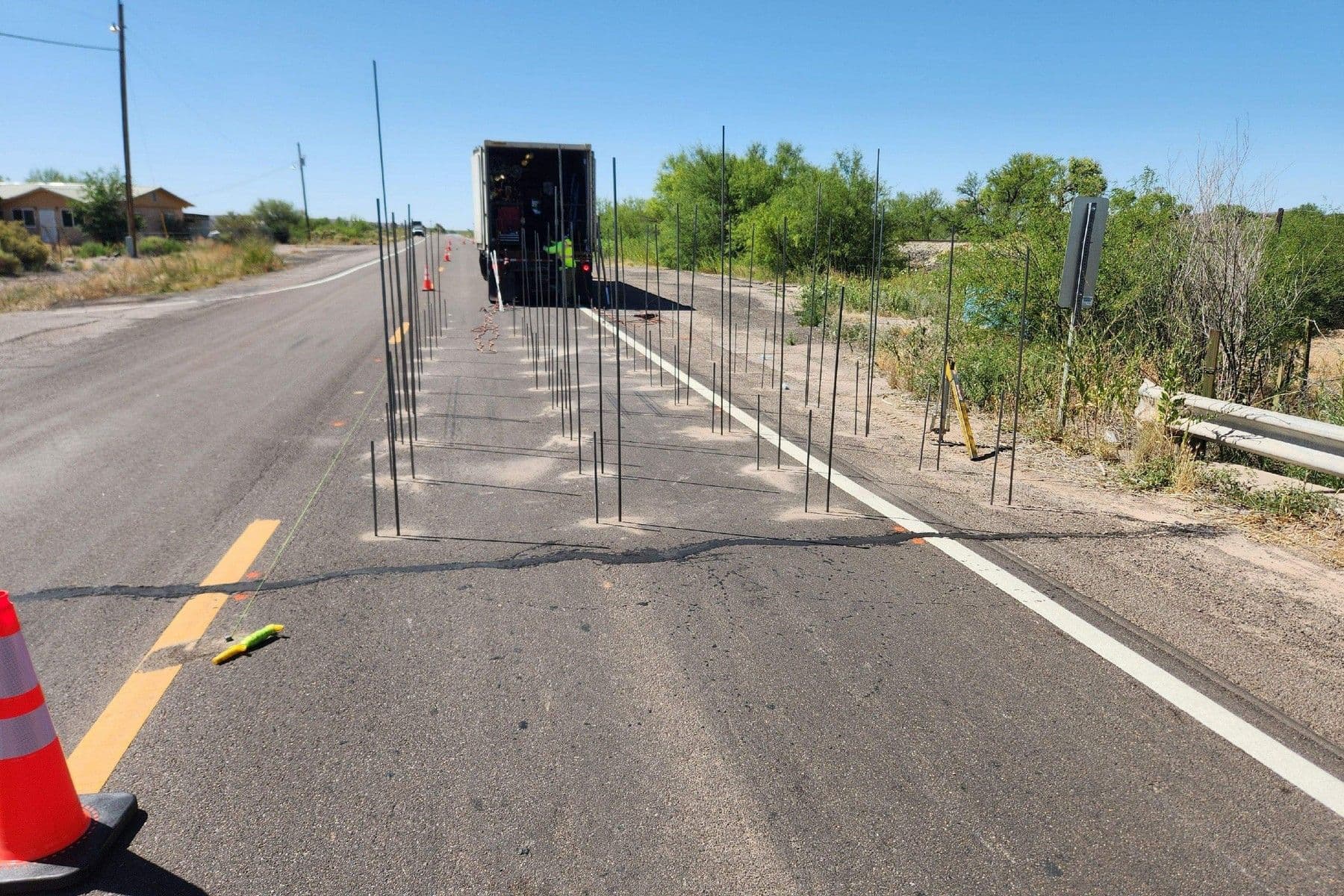
Representative photo from another URETEK roadway project: injection tubes set in a grid across a settled asphalt lane.
A business route of a U.S. highway runs through the center of a historic downtown in Northern Virginia. A sinkhole had opened in that roadway once already, and it had been repaired.
The first repair was conventional. Crews dug out the area around the sinkhole, set a large stone 12 feet below the pavement, backfilled over it with soil and cobbles, and patched the asphalt.
Over time the patch settled again, as much as 3 inches in 2 separate areas. A depression coming back over an old sinkhole repair means the ground under it is still moving, so the owner brought in URETEK to stabilize it.
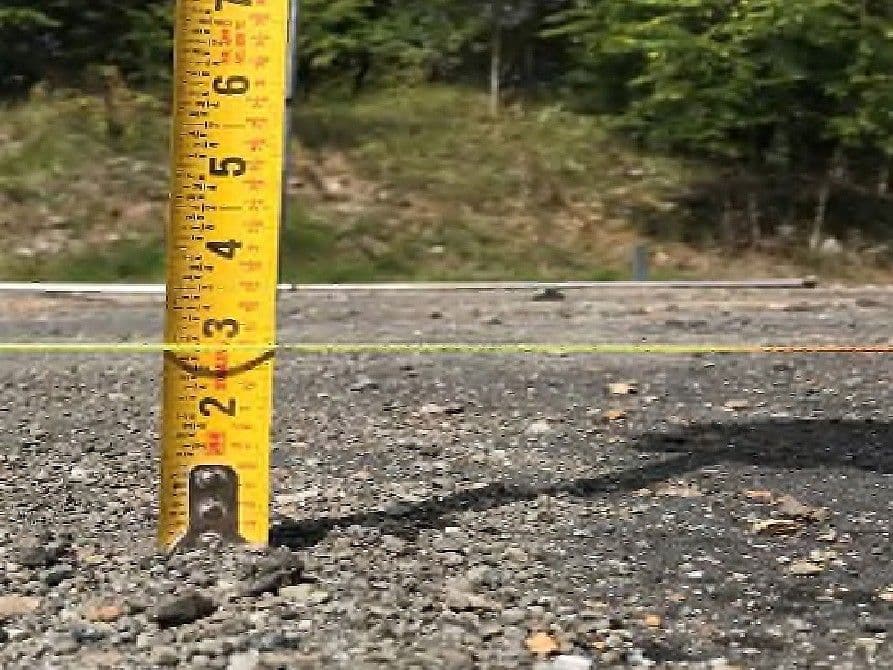
A tape held against a stringline at the settled patch, measuring how far the asphalt had dropped.
Excavation had already been tried at this exact spot. The patch settling again showed that the dig, the stone and the backfill hadn't fixed the support under the road.
A second dig would have meant reopening a downtown street to 12 feet, with the trench protection, heavy equipment and lane closures that come with it, on a route that school buses for 3 nearby schools depend on. Then the backfill and pavement would have to be rebuilt over the same ground.
URETEK proposed treating the ground in place: reach the depth of the old repair through small drilled holes, stabilize the soil from the stone up to the pavement, and lift the asphalt back toward grade, with no excavation.
URETEK laid out a three-dimensional URETEK Deep Injection (UDI) grid covering an area 30 feet wide by 24 feet long and reaching 12 feet deep, the depth of the stone from the earlier repair. Crews pre-drilled the holes, set tube bundles, and injected structural polymer at multiple depths. The expanding polymer fills voids, compacts and confines the surrounding soil, and forms stabilized support zones; controlled expansion at shallow depth lifts the pavement above.
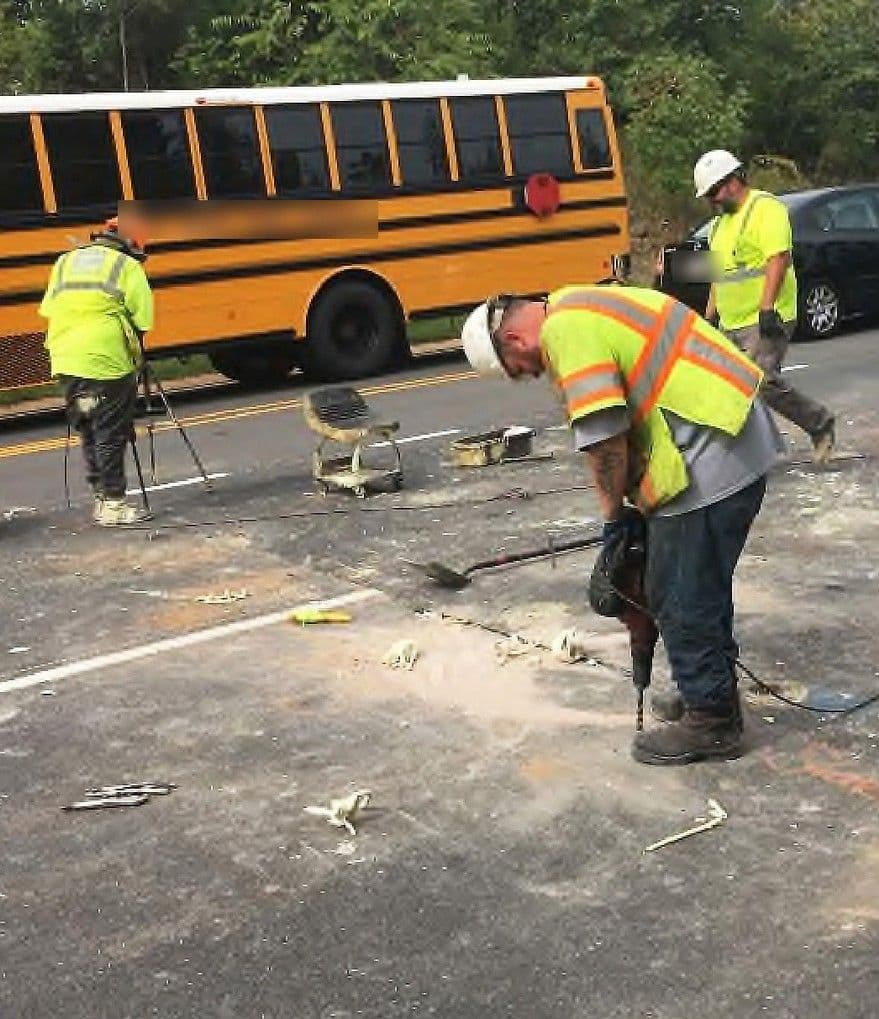
Drilling an injection hole in the settled lane as a school bus passes. Work ran from 9:30 a.m. to 3 p.m. to stay out of the bus schedule.
The site sat near 3 schools, and the road carried their buses. So URETEK limited working hours to 9:30 a.m. to 3 p.m., keeping the work clear of the busy school bus schedule.
Inside that window, the job needed no excavation and no heavy construction equipment: drills, tube bundles and the injection truck. The full program took 4 days.
The project photos show how movement was tracked. A tape and stringline across the patch measured the settlement, and tripod-mounted laser levels stood at the work zone during injection, the setup URETEK crews use to watch the pavement surface as each point is injected.
The limits of the record belong here. The original project account reports that the soils were strengthened and stabilized and the roadway lifted, but it gives no final lift figure, no post-treatment soil testing and no follow-up monitoring. The cause of the original sinkhole isn't documented either.
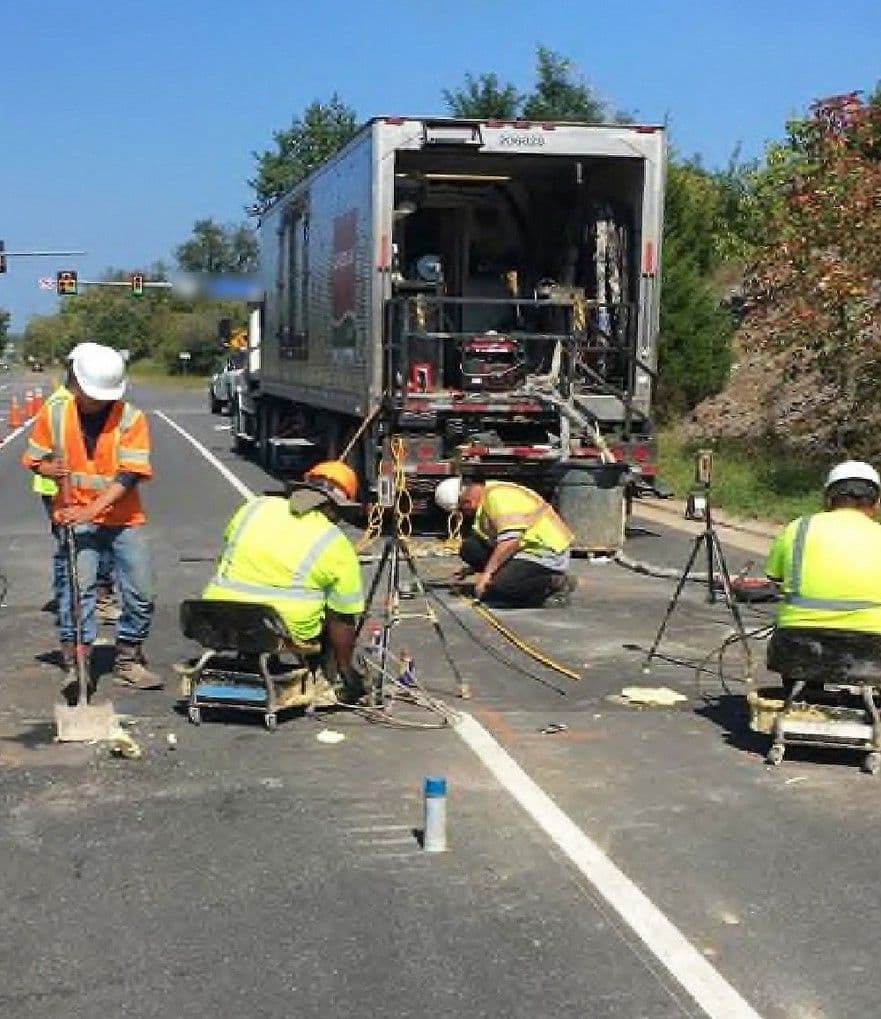
The crew working the injection grid, with tripod-mounted laser levels set up to watch the pavement surface during the lift.
This is a production record. The settlement, the treatment geometry and the schedule are documented. Post-treatment measurements are not, so the numbers below describe the problem and the work.
The settlement: up to 3 inches, in 2 separate areas of the old patch.
The treatment zone: 30 feet wide by 24 feet long by 12 feet deep, matched to the depth of the stone placed in the first repair, with injections at multiple depths through pre-drilled holes.
The schedule: 4 days on site, working 9:30 a.m. to 3 p.m. each day, with no excavation and no heavy construction equipment.
A resettling sinkhole repair beneath a downtown roadway was stabilized and lifted from the surface in 4 days, without reopening the excavation.
 Ground stabilized to the depth of the old repair. Multi-depth injection treated the soil from the pavement down to the stone at 12 feet.Asphalt roadway lifted. The project account reports the settled pavement lifted along with the soil stabilization.Done in 4 days. URETEK completed the stabilization and lift in 4 working days inside a shortened daily window.No excavation, no heavy equipment. All the work went in through small drilled holes, so the old repair stayed buried and the street stayed intact.School traffic kept moving. Working 9:30 a.m. to 3 p.m. kept crews clear of the bus schedule for 3 nearby schools.Backed by URETEK's two-year warranty against settlement. URETEK's two-year warranty against settlement covers the treated area.
Read the old repair as a clue. When a patch over a past sinkhole settles again, the depth and makeup of the first repair tell you where treatment has to reach. Here, that was the stone at 12 feet.
Treat in three dimensions. A grid across the footprint and down through the depth treats the whole block of ground under the dip, from the stone up to the pavement.
Plan around the neighbors. A fixed 9:30-to-3 window kept the work out of school bus traffic, and the job still finished in 4 days.
Record the movement. Stringline checks and laser levels show the settlement and the lift as they happen. Record a post-treatment profile too, so the owner has a baseline to hold the warranty against.
If a road over a past sinkhole repair is dipping again, the ground underneath is still moving. URETEK Deep Injection reaches the depth of the old repair through small drilled holes, stabilizes the soil, and lifts the pavement, with little or no excavation where conditions permit. We'll size the injection grid to the old repair and fit the work around your traffic.

 800-240-7868


