

Location
Lake Jackson, Texas
Structure Type
A 60-year-old commercial building with a settling concrete slab across roughly 4,000 square feet of interior suites and adjoining construction areas
Core Challenge
Non-uniform slab settlement (floor elevations scattered from about -1.6 to +2.6 inches) had opened dips and differential movement between interior walls and the slab, in a commercial building being renovated
Verification
Ground-penetrating radar to map subsurface voids and locate plumbing before drilling, with continuous surface-movement monitoring during injection and a stop-if-damage limit protecting the slab, walls, and finishes
URETEK Scope
URETEK Deep Injection (UDI) through 5/8-inch holes: staged injection of expanding structural polymer to fill voids, densify weak soils, and stabilize the subgrade, lifting the slab back toward grade where conditions allowed
Result
The affected slab areas were stabilized and voids filled across roughly 4,000 square feet in about three days, through small holes and without removing the existing concrete, with lift performed where the slab could respond safely
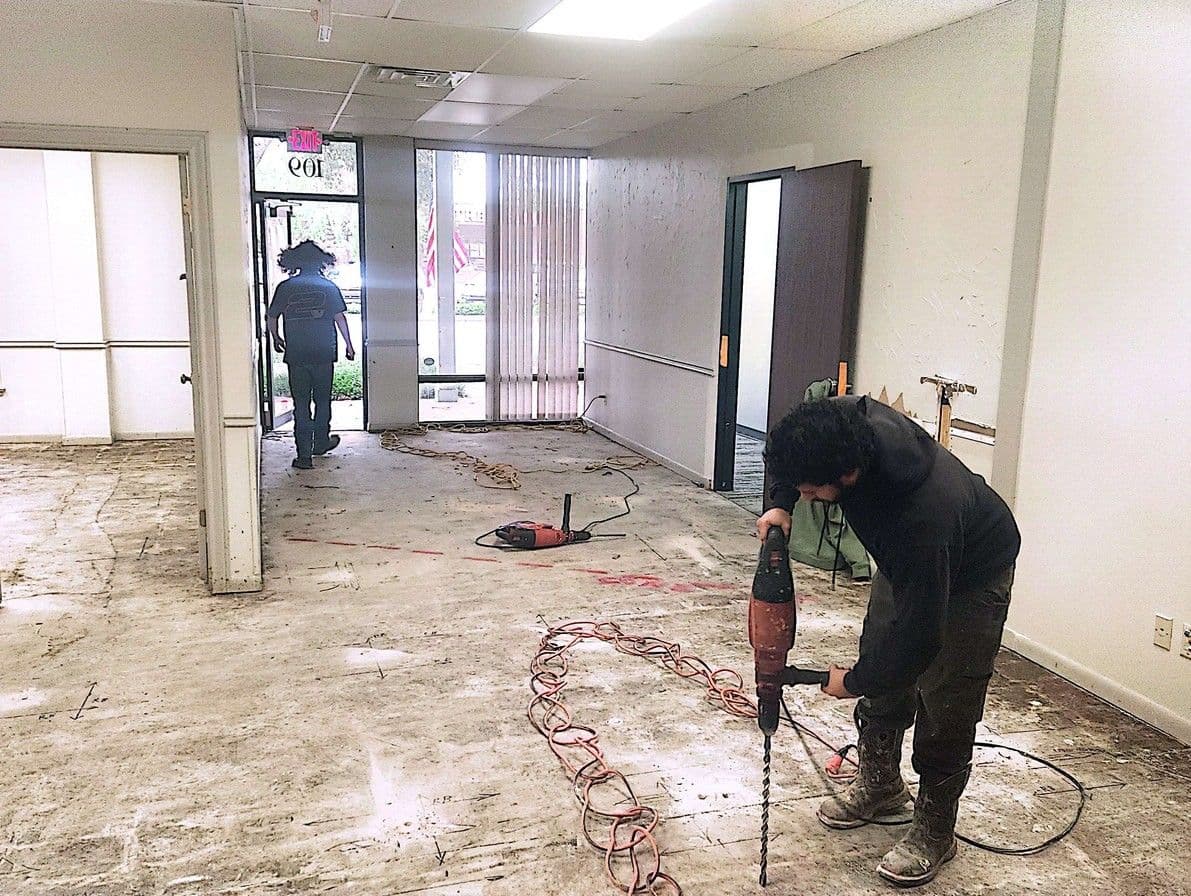
URETEK Deep Injection underway inside the building: crews drilled 5/8-inch holes and injected expanding structural polymer to fill voids and stabilize the subgrade, working room by room without removing the slab
A 60-year-old commercial building in Lake Jackson, Texas, had a settling concrete slab across roughly 4,000 square feet of interior suites and adjoining construction areas. Floor dips and visible differential movement had opened up where interior walls met the slab, and a relative floor survey found elevations scattered from about -1.6 inches in the low areas to +2.6 inches in the high ones, a differential of more than four inches across the affected rooms.
The pattern mattered as much as the range. The high and low readings were scattered from room to room rather than sloping in one consistent direction, which pointed to non-uniform support beneath the slab, not a single settling corner. The owner needed the slab stabilized and the settlement arrested while the building was being renovated, without tearing out and repouring the floor.
The exact cause was not established. The likely contributors, based on the site review, were inadequate subbase compaction, moisture variation in the supporting soils, and the roots of large oak trees near the building, but without a full geotechnical investigation the specific mechanism is best treated as a working hypothesis. What was clear was the need: fill the voids, firm up the weak soils, and stop the movement, through the existing slab.
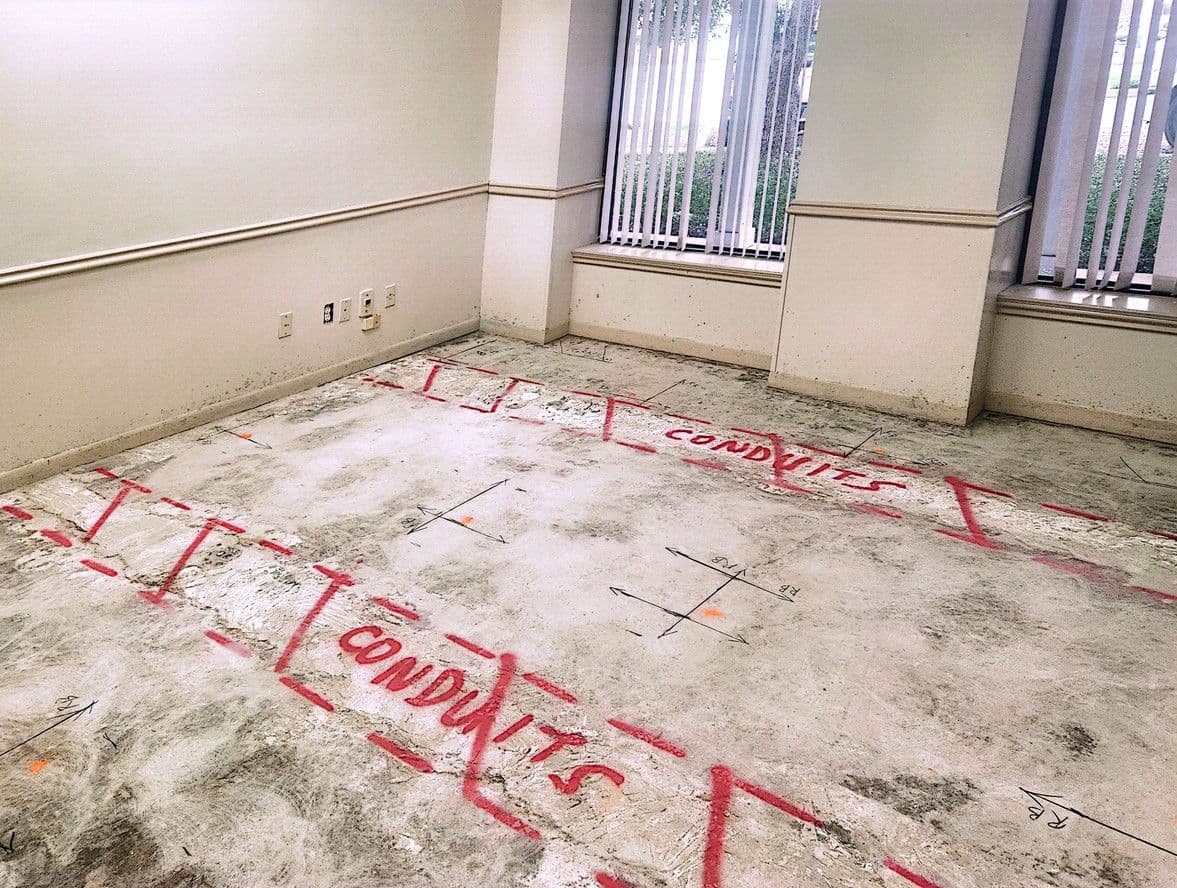
Ground-penetrating radar mapped subsurface voids and located conduits and plumbing before any drilling: the red layout marks each injection point and the utilities to avoid
The conventional way to fix a failing slab is to remove and replace it: demolish the concrete, rework the subgrade, and repour. In an occupied commercial building under renovation, that means demolition dust, displaced operations, and weeks of downtime, and it does not, by itself, resolve the weak and voided soils that let the slab settle in the first place.
The movement here was in the ground, not just the concrete. Scattered high and low readings across the rooms showed that support under the slab was inconsistent, with voids in some areas and soft soils in others. A repair that only addressed the surface would not reach that, so the work needed to get beneath the slab and rebuild its support in place.
That is what URETEK Deep Injection was designed to do: reach the weak soils and voids through small holes in the existing slab, firm them up, and raise the concrete where it can respond, all without removing the floor. It let the building keep moving through renovation instead of stopping for a slab replacement.
URETEK Deep Injection (UDI) places an expanding structural polymer into the soils beneath the slab through small holes drilled in the concrete. As it reacts, the polymer fills voids and loss-of-support gaps, densifies and confines weak or poorly consolidated soils, drives out excess moisture, and applies controlled upward pressure that can lift the slab back toward grade where the structure allows.
Before any drilling, crews used ground-penetrating radar to map the subsurface: identifying the voids to be filled and locating conduits and plumbing lines so injection holes could avoid them. Ground-penetrating radar is a risk-reduction step, not a guarantee that every buried feature is found, so it was paired with careful hole placement. Crews then drilled 5/8-inch holes through the slab and set injection tubes to the depths the conditions called for.
Injection was staged and watched closely. Crews worked from selected points within the affected suites and construction areas, placing polymer in stages and evaluating the slab's response at the surface before moving on. Stabilization and void filling were the priority; lifting was pursued only where the slab could respond safely, and operations were set to stop if continued movement risked damaging the slab, walls, or interior finishes.
The whole approach was built to stay out of the way. Because the work went through small holes in the existing slab, it concentrated on the specific rooms and areas where the differential movement had been documented, rather than demolishing and replacing the floor. That kept the repair localized, limited the disruption inside a building that was still in use and under renovation, and left the existing slab in place.
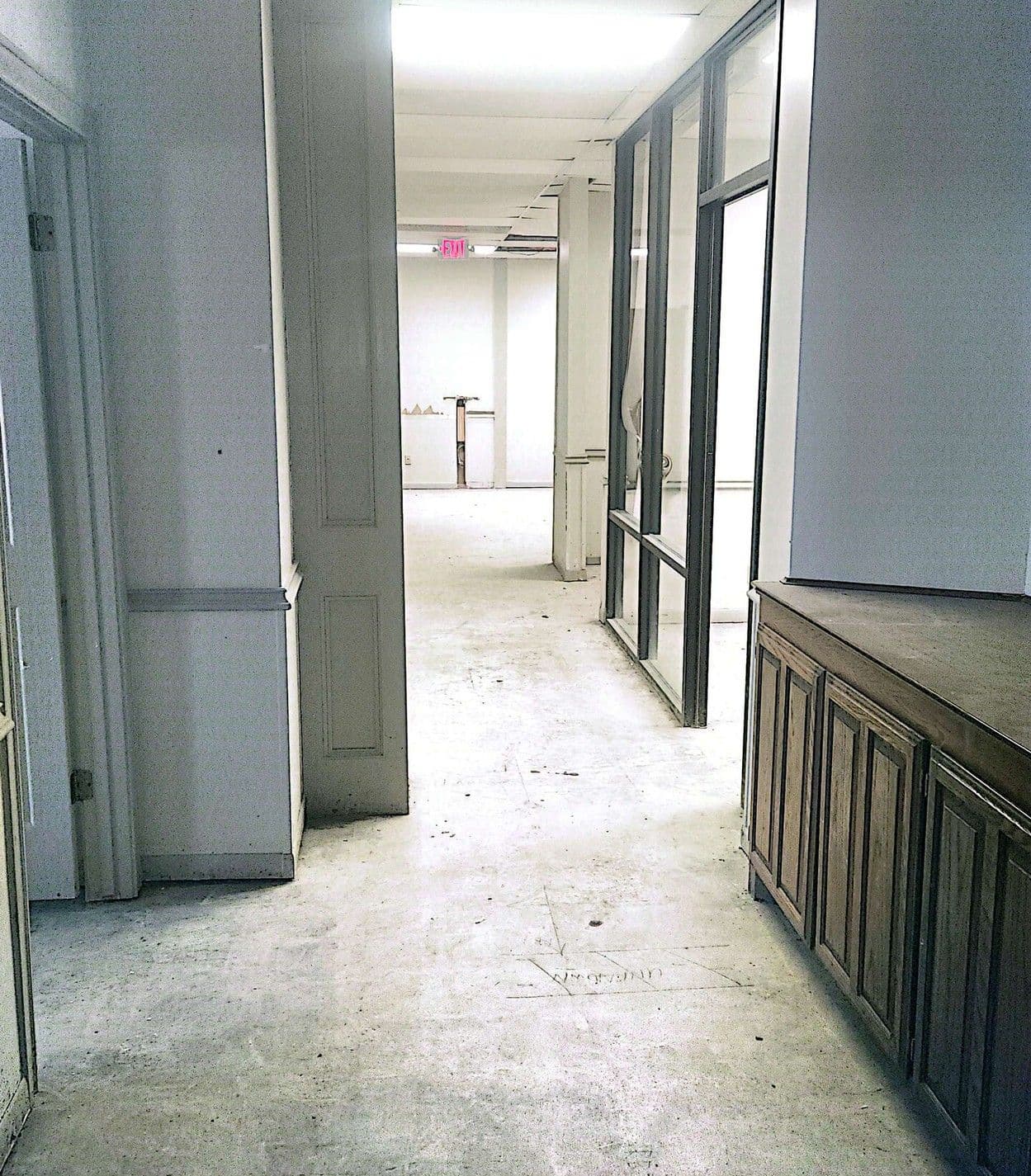
Inside the commercial building: the settlement had opened dips and differential movement across interior suites and corridors, which URETEK stabilized from beneath through the existing slab
The measures for this repair come from the floor survey, the building sketch, and the project scope: the record of how far the slab had moved and what was done about it.
The relative floor survey found elevations scattered from about -1.6 to +2.6 inches across the affected rooms, a differential of more than four inches, in a non-uniform pattern that indicated inconsistent support rather than a single slope. The treated area covered roughly 4,000 square feet of interior suites and adjoining construction space in the 60-year-old building.
The work itself was deliberately small in footprint: 5/8-inch injection holes through the existing slab, ground-penetrating radar to map voids and avoid plumbing, and staged polymer injection to fill voids, densify soils, and lift where the slab could respond. Surface movement was monitored throughout, with a stop-if-damage limit.
The stabilization and void-filling program was completed in about three days, through drilled access points, with no removal of the existing concrete slab.
URETEK stabilized the slab and filled the voids beneath it, in place and in about three days, without the demolition and downtime of a slab replacement.

Voids filled and soils stabilized. Expanding structural polymer filled the subsurface voids and densified the weak, inconsistent soils across roughly 4,000 square feet, rebuilding support beneath the slab rather than only addressing the surface.
Slab retained, not replaced. All work was done through 5/8-inch holes in the existing concrete, avoiding the demolition, dust, and downtime of tearing out and repouring the floor of an occupied building.
Lift where the slab could respond. With the settlement pattern non-uniform (about -1.6 to +2.6 inches), the crew stabilized throughout and raised the slab back toward grade where it could move safely, stopping short of forcing areas that risked damage.
Utilities protected by scanning. Ground-penetrating radar mapped voids and located conduits and plumbing before drilling, and surface movement was monitored throughout, keeping the work controlled around a live, occupied building.
Completed in about three days. The localized, non-intrusive approach let the stabilization and void filling finish in roughly three days, keeping the renovation moving instead of pausing for slab replacement.
Read the pattern, not just the range. Elevations scattered from about -1.6 to +2.6 inches across the rooms pointed to non-uniform support, voids in some areas and soft soils in others, which is a stabilization-and-void-fill problem more than a simple re- leveling one.
Fix the support through the slab. Injecting through small holes reached the weak soils and voids in place, rebuilding support without the demolition and downtime of removing an occupied building’s floor.
Scan before you drill. Ground-penetrating radar mapped the voids to fill and located conduits and plumbing to avoid, a risk-reduction step that made drilling through a finished commercial slab far safer.
Stabilize first, lift where it responds. On a non-uniform slab, the durable win is filling voids and firming the soils; lifting is pursued only where the concrete can move safely, with monitoring and a stop-if-damage limit protecting the structure.
If floor dips and differential movement are showing up in an occupied building you cannot afford to tear out, URETEK can help. We scan for voids and utilities, then stabilize the soils and fill the voids beneath your slab through small holes, lifting where the structure allows. We will assess your slab and subsurface, design a targeted injection program, and stabilize it under continuous monitoring, giving your building a repair that keeps it in service instead of demolishing and repouring the floor.

 800-240-7868


