

Location
Los Angeles, California
Structure Type
Concrete airfield pavement (taxiways, an apron and gate area, and a runway) at a major international airport, cracked and settling over weak or voided support
Core Challenge
Cracked, settling concrete slabs across an active airfield had to be stabilized, and lifted where directed, without full-panel removal, working in short escorted shifts around aircraft operations and over buried utilities that barred deep drilling
Verification
Airport engineering identified each work area and set the allowable procedures, and crews injected to the slab response at the surface. Buried utilities limited drilling to just beneath the slab and, in places, prevented DCP testing
URETEK Scope
Shallow, direct-under-slab structural polymer injection (URETEK's UDI process in a utility-constrained, tube-free configuration) to fill voids, restore support, and lift settled slabs back to grade where directed
Result
Cracked and settled concrete slabs were stabilized, and lifted back to grade where requested (including an area sunk about 1.5 to 1.75 inches), across a phased multi-shift program, with each area cleaned and returned to the airport by the end of its window and no full-panel removal
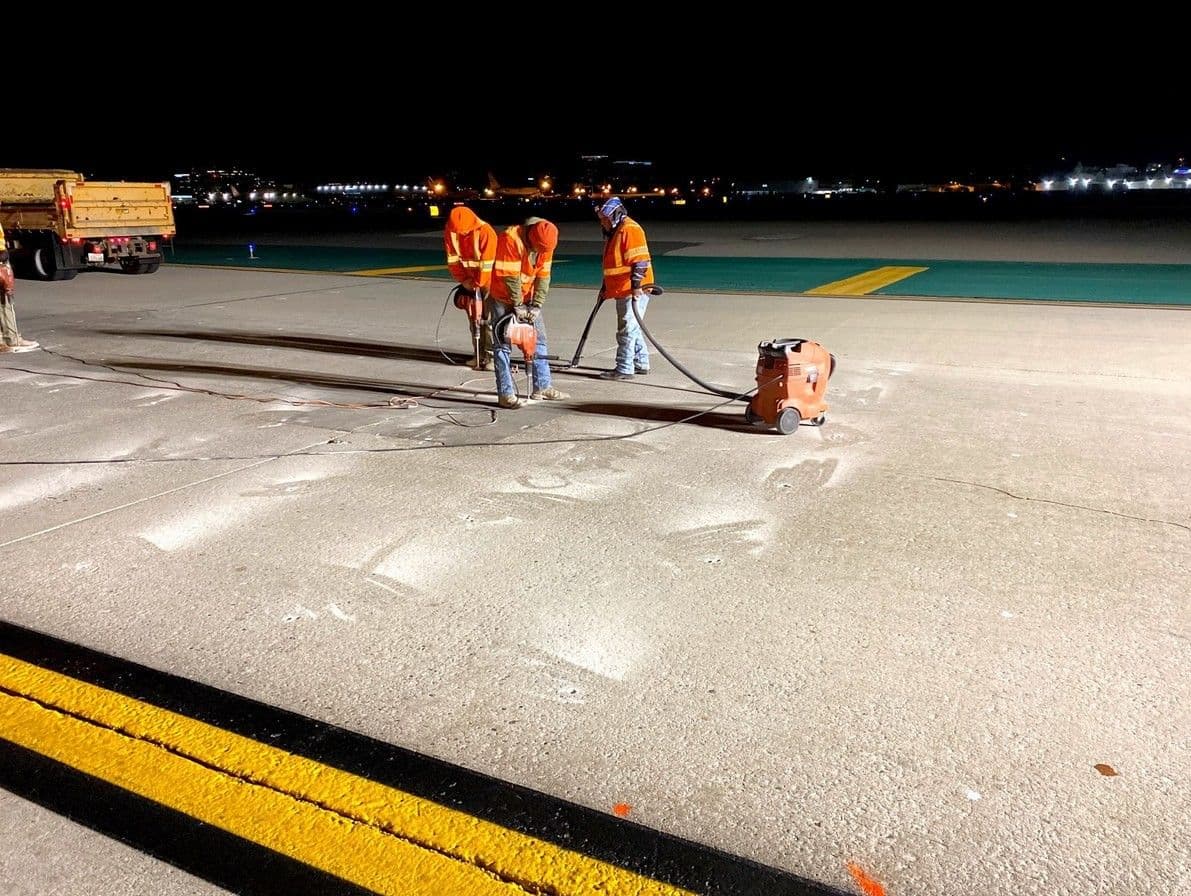
Working the airfield at night: URETEK crews stabilized cracked concrete slabs during short, escorted closures, keeping the pavement in service for daytime aircraft operations
At a major international airport in Los Angeles, California, concrete pavement across the airfield, taxiways, a gate apron, and a runway, had developed cracking and localized settlement. The affected slabs were no longer fully supported from below, and on an airfield that distress cannot be left to grow: a settled or cracking slab is both a ride-quality and a foreign-object-debris concern for aircraft.
The catch was that almost nothing about the site was flexible. The pavement stayed in near-constant use, so work could happen only in short windows, at night or between operations, reached through security checkpoints and under escort. The airport's engineering and maintenance staff identified each work area and set the rules shift by shift, around aircraft movements and scheduled closures.
The subsurface added its own constraint. Buried utilities ran beneath the pavement in the work areas, so the airport restricted how deep crews could drill: no deep tube injection, and in at least one area that same restriction meant a Dynamic Cone Penetrometer test could not be run. Whatever method was used had to work in the shallow zone directly beneath the slab, without a full geotechnical workup and without disturbing what was buried below.
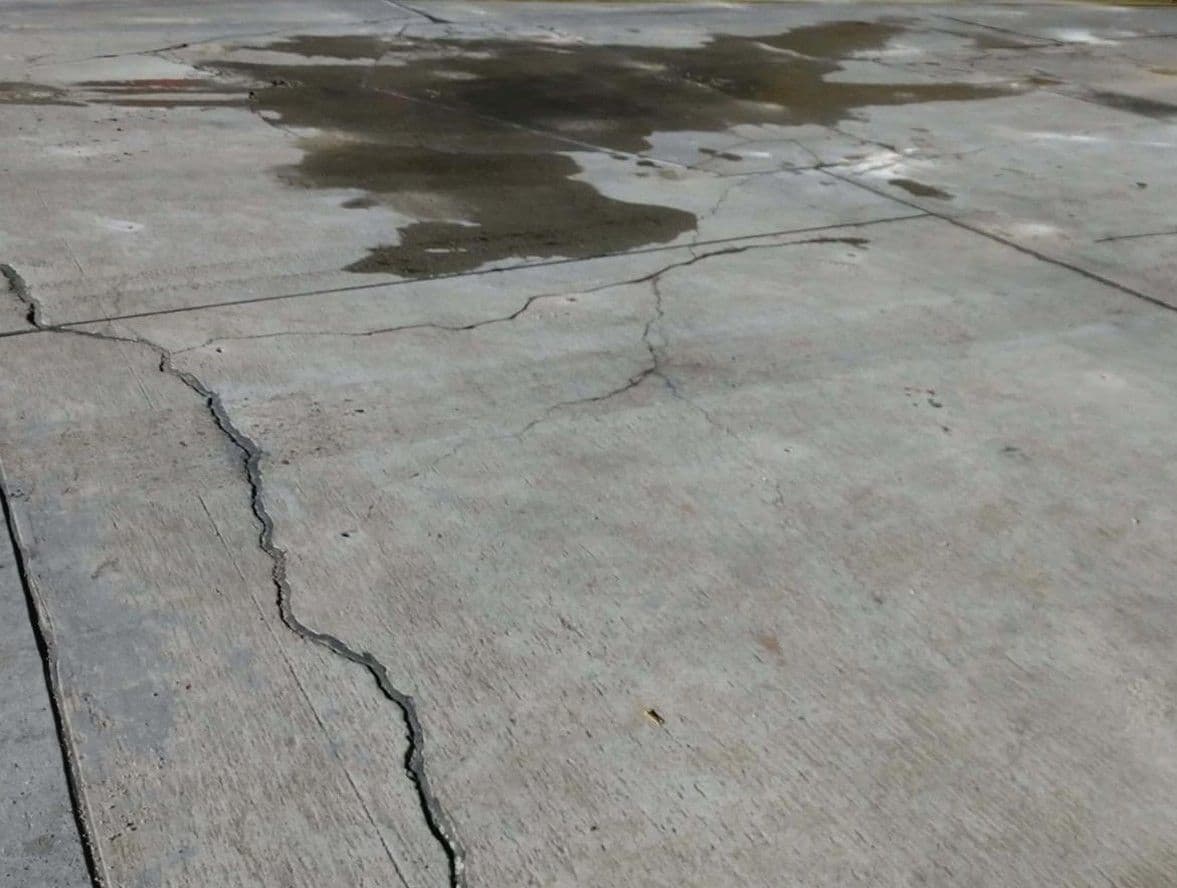
Cracked and settled airfield slabs: the concrete had lost uniform support from below, the condition the injection program was there to stabilize
The conventional fix for a cracked, unsupported airfield slab is to break it out and repour it. On a live airfield that is the most disruptive option there is: a demolished panel is out of service for demolition, forming, pouring, and days of curing, none of which fits inside an overnight window on pavement that has to carry aircraft the next morning.
Deeper ground-improvement methods were constrained too. The buried utilities meant crews could not drill deep or drive injection tubes in these areas, so any approach that depended on reaching well below the slab was off the table. The problem to solve was the loss of support and the voids directly under the concrete, and that is where the work needed to stay.
What the airport needed was a method that could restore support and lift settled slabs from just beneath the concrete, through small holes, fast enough to clear the pavement by morning. That is what URETEK's structural polymer injection was designed to deliver, adapted here to a deliberately shallow, tube-free configuration.
After clearing security and being escorted to each designated area, crews laid out injection points and drilled small holes through the concrete. They injected a high-density expanding structural polymer directly beneath the slab, where it filled the accessible voids, restored contact between the concrete and the material below, and, where lift was called for, applied controlled pressure to raise the pavement back to grade. Because utilities barred deeper drilling, this was a shallow, direct-under-slab configuration of URETEK Deep Injection, no injection tubes, kept in the zone immediately below the concrete.
The airport set the objective area by area. Where a slab only needed support, crews injected until it was stabilized and stopped. Where settlement had to be corrected, they continued in a controlled manner, watching the surface, until the pavement came back to grade, as in one 50-by-50-foot area that had sunk roughly 1.5 to 1.75 inches and was stabilized and lifted back to level. Most work areas were full concrete panels, commonly around 25 by 25 feet, treated a few at a time as access allowed.
Every shift was built around the airfield schedule. Crews entered through security and under escort, worked the assigned panels within a tight window, then patched every drilled hole with grout, cleaned the work area, and cleared the zone so the pavement could return to service, often before the morning push. One runway location alone had roughly fourteen slabs the airport wanted stabilized, worked across several coordinated shifts.
The work spanned many coordinated shifts across multiple locations, taxiways, a gate apron, a cargo apron taxi area, and a runway, rather than a single visit. Some shifts ran overnight and others by day, each limited to the areas the airport could take out of service at the time. Coordinating with airport engineering, the concrete crew, and electrical staff kept the work moving safely around live operations and let each treated area reopen on schedule.
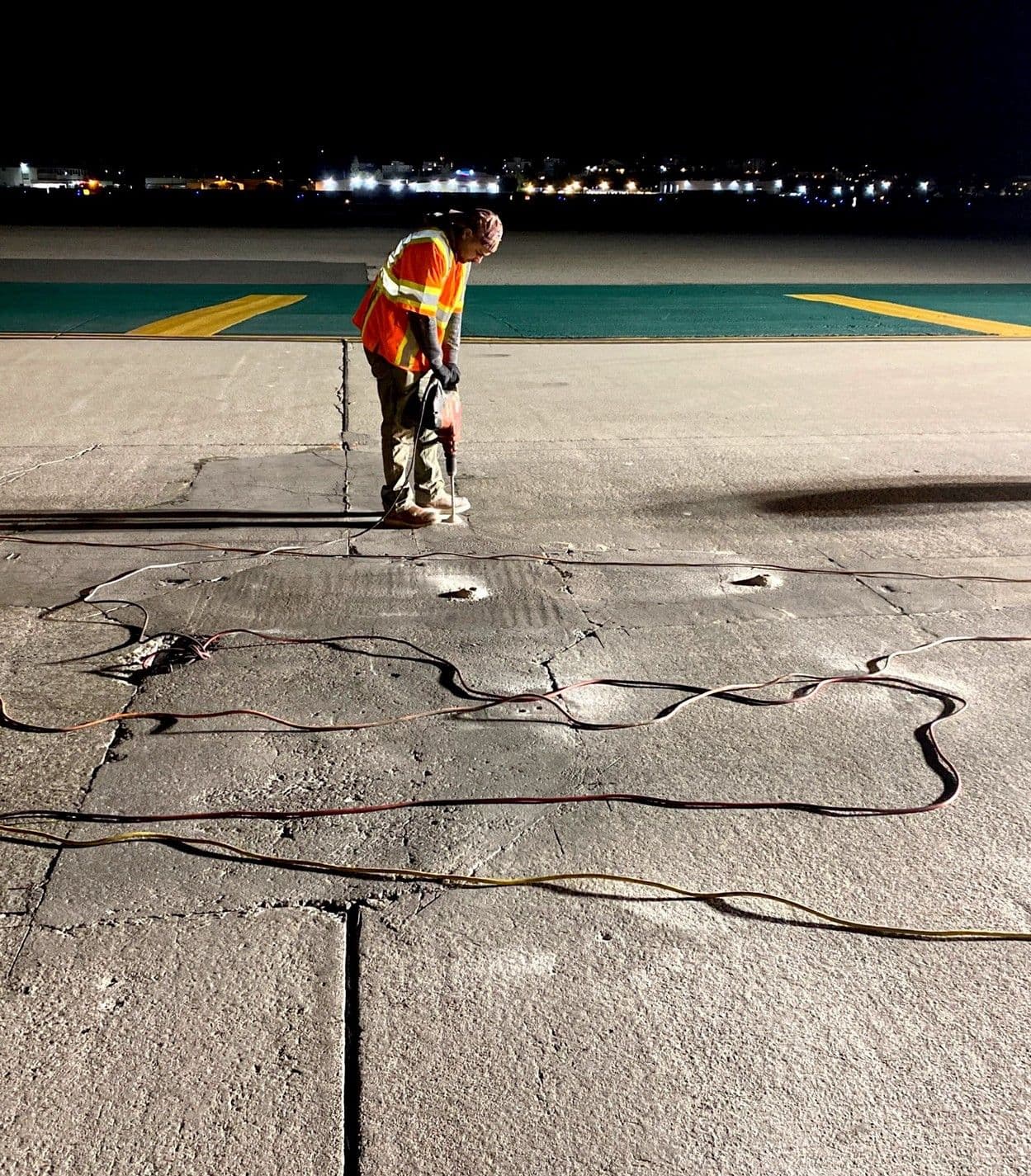
Direct-under-slab injection at night: a crew member injects structural polymer into the shallow zone beneath a cracked slab, the tube-free configuration the buried utilities required
The figures for this work come from the daily field reports and the airport's own direction, the record of what was treated and under what constraints, rather than a single headline number.
The distress was in the slabs: full concrete panels, commonly about 25 by 25 feet (some smaller, around 15 by 15), cracked and in places settled, including a 50-by-50-foot area that had sunk roughly 1.5 to 1.75 inches. One runway location alone carried about fourteen slabs the airport wanted stabilized.
The method was defined by its limits. Injection stayed shallow, directly beneath the slab, with no tubes and no deep drilling, because buried utilities restricted depth; in at least one area those same utilities prevented a DCP test. Airport engineering set each work area and procedure, and crews injected to the slab's response at the surface: stabilize where that was the goal, lift back to grade where correction was directed.
The work was phased around operations across many escorted shifts, entering through security and clearing each zone, holes grouted and area cleaned, by the end of its window so the pavement could return to aircraft service.
URETEK stabilized the cracked airfield slabs, and lifted the settled ones where directed, entirely around live operations and without removing a single panel.
 Slabs stabilized in place. Cracked, under-supported concrete panels, commonly about 25 by 25 feet, were stabilized by filling the voids and restoring contact beneath the slab, without breaking out and repouring the pavement.Settled areas lifted where directed. Where correction was requested, the pavement was raised back to grade, including a 50-by-50-foot area that had settled roughly 1.5 to 1.75 inches, using controlled injection watched at the surface.Worked around live airfield operations. Every shift ran within short, escorted closures through airport security, and each area was grouted, cleaned, and cleared by the end of its window so the pavement returned to aircraft service.Delivered within tight utility and access limits. With buried utilities barring deep drilling and tubes (and, in places, DCP testing), the shallow direct-under-slab approach restored support without disturbing what was buried or removing the concrete.Backed by URETEK's two-year warranty against settlement. URETEK stands behind the completed work with its two-year warranty against settlement.
Match the method to the access, not just the soil. Short escorted windows and buried utilities ruled out deep injection and panel replacement, so the work stayed in the shallow zone beneath the slab, restoring support fast enough to reopen the pavement by morning.
Stabilize first, lift where directed. On an airfield the priority is uniform support and a safe surface; lifting was done only where the airport asked for grade correction, watched at the surface to protect the panels.
Let the buried utilities set the depth. Because deep drilling and tubes were prohibited, injection was confined to directly beneath the slab, which respected the utilities and kept the work inside the allowed window.
Phase the work around operations. Treating panels a few at a time across many coordinated, escorted shifts, and clearing each area on schedule, let a busy airfield keep running while the pavement was repaired.
If cracked or settling concrete is a problem on pavement you cannot take out of service, and where utilities or access limit how you can work, URETEK can help. We restore support and lift settled slabs through small holes, in short windows, around live operations. We will assess your pavement and its constraints, design an injection program that fits your access and subsurface, and stabilize the slabs under continuous monitoring, keeping the surface in service instead of tearing it out.

 800-240-7868


