

Written By Admin
|
Published on 8/12/2026
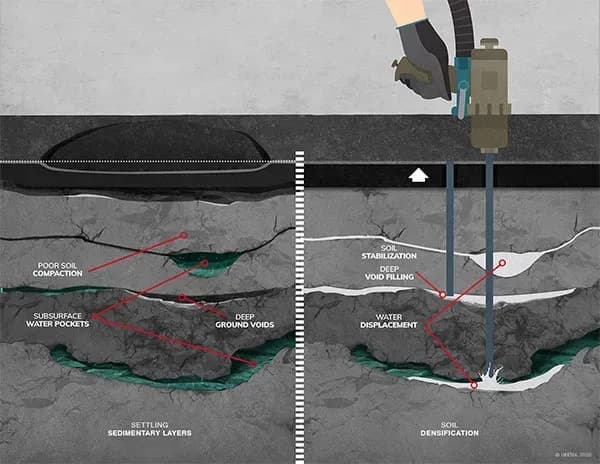
Geotechnical engineers understand that settlement is a naturally occurring process that can negatively impact the work we complete on the earth's surface. The vertical movement of the ground over time is a result of stresses within the earth, and in cases of settlement and subsidence can result in major damage to pavement systems and construction projects. Soil settlement can happen in an instant, or it can slowly take place over years. Left unchecked, settlement or subsidence can lead to structural damage and can negatively impact buried utility lines and expensive infrastructure assets.
That's why so much engineering goes into the evaluation of soil and rock mechanics before major construction projects, and why environmental issues such as the location of flood plains and water tables factor into major construction design plans.
However, even when the initial engineering has been completed to the highest standards, the earth moves, water flows, and geology ultimately wins. For this reason, reliable soil stabilization is critically important in the modern world.
In the past, stabilizing weak soil strata involved the use of products such as bitumen and Portland cement. Over time, materials such as fly ash, tar, cement kiln dust, tree resins, and ionic stabilizers have also been used in the ongoing effort to find a cost- and environment-friendly solution that provides adequate stabilization to weak or compromised soils. These efforts have often resulted in the use of on-site materials such as sub-soils, sand, mining waste material, and construction waste material.
Over the past 30 years, an increasing awareness of the environmental impact of these methods, and their increased cost, has led to the development of new materials and techniques to accomplish the same ends.
Beginning in 1989, with the introduction of URETEK Deep Injection® (UDI), a superior method of soil stabilization has emerged for geotechnical engineers intent on finding a better approach to mitigating the consequences of weak soils below the surface.
UDI involves the injection of structural polymer into base and subgrade soils to increase their load bearing capacity. This is achieved by injecting the polymer through small holes drilled directly through the pavement structure to depths determined by site-specific analysis. URETEK's proprietary high-density structural polymer flows easily into voids and weak zones within the soil mass below. Then, through a controlled chemical reaction, the expanding polymer compacts surrounding soils, increasing their load bearing capacity. The composite material quickly cures into a strong, dimensionally stable, water-resistant geo-material designed for long-term performance when properly selected and installed.
For over 30 years, professionals have turned to URETEK for rapid, lasting solutions that align with tight budgets and keep our nation's roadways smooth and stable.
URETEK's long history of successful UDI application has established the company as a trusted UDI contractor that can instantly mobilize to job sites across the country. When we arrive, our crews get right to work on a site-specific repair or maintenance solution that quickly mitigates weak soil issues and extends the reliable working life of roads, bridges, airport runways, and other paved surfaces. With little or no excavation where conditions permit, many projects are completed in days rather than weeks or months.
Contact URETEK today to learn more about our speedy soil stabilization solutions that keep budgets in line while assuring many more years of reliable service from highways, bridges, and runways.
Historically, stabilization relied on materials like bitumen, Portland cement, fly ash, tar, cement kiln dust, tree resins, and ionic stabilizers, often combined with on-site materials like sub-soils and sand.
A structural polymer is injected through small holes into the base and subgrade soils. The polymer expands through a controlled chemical reaction, compacting surrounding soils and curing into a strong, water-resistant geo-material.
URETEK introduced UDI in 1989 and has been refining and applying the technology for over 30 years since.
See how UDI keeps roads, bridges, and runways stable for years to come.
Contact URETEK

 800-240-7868


