

Written By Admin
|
Published on 8/12/2026
Polymer injection has long been hailed as a solution for rehabilitating roads, but one persistent issue has plagued the process: the leftover steel tubes embedded in the pavement. These tubes not only hinder the milling process necessary for asphalt recycling, but also pose challenges to the structural integrity of the newly repaired roads.
Traditionally, the thin-walled steel tubes used in polymer injection are either removed or left just below the surface after the injection process. This approach presents several drawbacks.
1. Interference with Milling Leaving the tubes at or slightly below grade results in milling machines cutting into them, contaminating the asphalt and preventing effective recycling.
2. Potential Damage During Vibrating or Driving Attempts to sink the tubes deeper post-injection risk damaging the newly formed bonds within the soil's geopolymer matrix, compromising the structural integrity of the repair.
3. Structural Implications Removing the tubes post-injection creates voids in the soil, leading to issues like moisture infiltration, sloughing, and weak soil layer reformation.
URETEK has developed a new approach to road rehabilitation with its proprietary UDI® system. Unlike traditional methods, UDI® countersinks all tubing before polymer injection, preserving crucial bonds within the soil's structure.
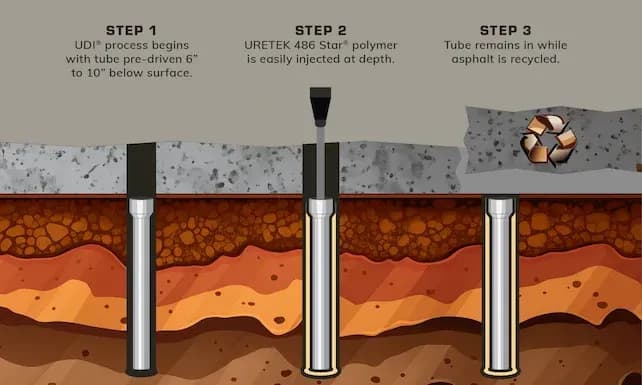
 Pre-Driven Tubes: the UDI® process begins with tubes pre-driven 6" to 10" below the surface.Polymer Injection: URETEK's specialized polymer, URETEK 486 Star®, is then injected at the desired depth.Tube Retention: tubes remain in place during asphalt recycling, eliminating the need for post-injection cutting or vibrating.Structural integrity: with no cutting or vibrating required post-injection, the structural integrity of the tubes is preserved, ensuring a robust repair.Cleaner reclaimed asphalt: with no steel tubes left in the pavement, milled asphalt is free of tube debris, which supports asphalt recycling.Safety assurance: by eliminating the need for tube removal after injection, UDI® reduces safety risks associated with exposed tubing.Unrestricted project advancement: with no protrusions or limitations between shifts, project advancement is seamless and efficient.Optimized injection patterns: URETEK engineers injection patterns precisely to maintain volumetric control, preventing overuse and maintaining a minimum factor of safety.No puncture risk: controlled traffic removal between shifts eliminates the risk of punctured tires or lost tubes.
Widely referenced within the industry, UDI® involves the injection of structural polymer into the base and sub-grade soils to increase their load-bearing capacity. The polymer is injected through small holes drilled directly through the pavement structure, to a depth determined by site-specific analysis. URETEK 486 Star® material compacts surrounding soils and applies controlled pressure on targeted areas of the affected pavement above.
URETEK 486 Star® is developed to be the ideal solution for under-sealing, void filling, lifting of settled pavement, and stabilization. It is hydro-insensitive, keeping its compressive strength even when injected into flowing water, and its current SDS and TDS are available on request.
Want to dig deeper? Reach out to URETEK USA today to learn more about how we help maintain the integrity of commercial, industrial, and infrastructure foundations.
Tubes left at or near the surface interfere with milling machines and contaminate the asphalt, preventing effective recycling. If the tubes are removed instead, that creates voids in the soil that can lead to moisture infiltration and weak soil layer reformation.
The UDI® countersinking process begins with tubes pre-driven 6" to 10" below the surface, before polymer injection takes place.
No, it reduces them. By eliminating the need to remove tubes after injection, countersinking removes the safety risks associated with exposed tubing.
See how URETEK's countersinking system protects the integrity of every road repair.
Request an Assessment

 800-240-7868


