

Written By Admin
|
Published on 8/12/2026
According to the Federal Aviation Administration (FAA), our nation's airports are busier than ever. With over 19,600 active public and private facilities servicing 2,790,000 passengers every day on over 44,000 individual flights, it makes sense that the FAA would have an opinion about runway maintenance.
In fact, the FAA advocates for each public and private airport to create and stick to a Pavement Maintenance Program (PMP). According to the FAA, a PMP should include up-to-date records regarding pavement inventory and inspection, and should reference the FAA's own guidelines and procedures for pavement system repair and maintenance.
Pavement systems at our nation's airports are all subject to what the FAA defines as the Pavement Life Cycle curve. This curve illustrates the usable life of a pavement system over time. In the first several years of a pavement system's life, deterioration in pavement condition is relatively low. However, as time moves on, pavement deterioration increases, resulting in an accelerated drop in pavement condition.
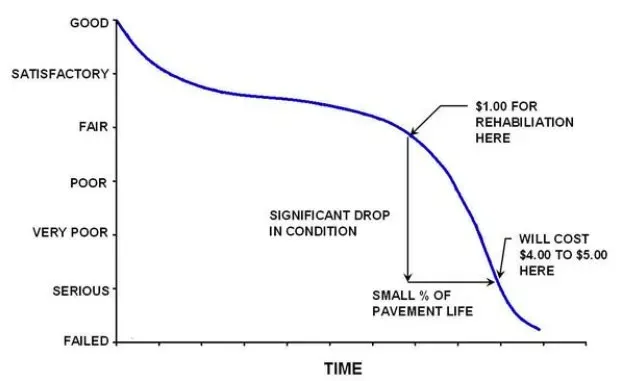
Importantly, the Pavement Life Cycle curve also points out the cost of delayed maintenance. As the curve makes clear, $1 spent on preventative maintenance early in the working life of a pavement system is equivalent to $4 to $5 spent later to address advanced pavement deterioration.
For airport administrators, the intent of a maintenance program is to keep the condition of the pavement as high as possible for the least amount of money. Because timely maintenance can renew the pavement condition, prolong the life of the pavement system, and exert clear economies on tight facility budgets, administrators across the country have come to rely on the speed, value, and long-term reliability of URETEK Deep Injection® (UDI).
Beginning in 1989, with the introduction of URETEK Deep Injection® (UDI), this trusted pavement preservation method has been relied upon by administrators at our nation's largest public airports, Air Force bases, and local general aviation facilities. Large or small, they all depend on UDI to stabilize soils, fill voids, and maintain smooth and level runways, taxiways, and aprons.
UDI involves the injection of structural polymer into base and subgrade soils to increase their load-bearing capacity. This is achieved by injecting the polymer through small holes drilled directly through the pavement structure to depths determined by site-specific analysis. URETEK's proprietary high-density structural polymer flows easily into voids and weak zones within the soil mass below. Through a controlled chemical reaction, the expanding polymer compacts surrounding soils, increasing their load-bearing capacity. The composite material quickly cures into a strong, dimensionally stable, water-resistant geo-material designed for long-term performance when properly selected and installed.
For over 30 years, URETEK has been a trusted, reliable partner for airport administrators intent on maintaining their critical pavement systems. With its rapid response and crew scheduling that takes advantage of overnight and off-peak hours, URETEK is well prepared to complete pavement maintenance tasks without severely impacting flight schedules.
With little or no excavation where conditions permit, many projects are completed in days rather than weeks or months. Contact URETEK today to learn more about our speedy pavement maintenance and repair solutions that keep budgets in line while assuring many more years of reliable service from runways, taxiways, and critical airport pavement systems. Also, see our case studies to learn more about how our UDI application has worked for airports and other critical infrastructure across the country.
The FAA reports over 19,600 active public and private airport facilities, serving 2,790,000 passengers daily across more than 44,000 individual flights.
Per the FAA's Pavement Life Cycle curve, $1 spent on preventative maintenance early in a pavement system's life is equivalent to $4 to $5 spent later to address advanced deterioration.
URETEK Deep Injection® has been in use since 1989, relied on by major public airports, Air Force bases, and general aviation facilities for over 30 years.
Keep runways, taxiways, and aprons smooth and level without disrupting flight schedules.
Contact URETEK

 800-240-7868


